Over the last year and a half of blogging I’ve pretty much restricted myself to theological issues. However, today I’ve decided to take my life into my own hands and finally start to address a question that I’ve often heard among my female friends: “Why doesn’t that nice Catholic boy ask me out?”
This is exciting news 🙂 My friend Jenna has been accepted into the Dominican Sisters of Hawthorne, an order of nuns who care for terminal cancer patients who can’t afford care. I’ve known Jenna for over three years now and, trust me, she’s going to be a seriously epic kind of nun:
Before Jenna can join the nuns, however, she has to expunge her student debt. So, if you’d like to help get her to the convent, I’d invite you to visit the website below, read her story, look at the pictures and make a donation:
As one of her friends put it, the sooner we can get her to the convent, the sooner we can get her praying for us and the sooner we can get holy 😉
A while ago I promised a friend that I would do an in-depth treatment of the Catholic Church’s teaching on the Communion of Saints. I’m still planning on doing that more detailed examination at some point in the future, but today I’d like to do another brief post following on from yesterday’s posts about All Saints Day.
I’ve mentioned Jay before, a Protestant with whom I dialogued for several months. During our discussions he brought up the subject of the Saints. It wasn’t really pertinent to the subject at hand so I didn’t dwell on it for long, but here was what I wrote to him:
“The Saints” was another issue you raised, but again, in an effort to stay on-topic, I’ll try to be brief.
We don’t worship Saints – we honour them. Worship is for God alone. If you catch any Catholic worshiping a Saint, let me know and I’ll make sure that both their Priest and Bishop find out. I will ensure that they are kept behind after Mass for extra catechism classes while the other parishioners enjoy coffee and donuts 😉
I can pretty much guarantee that all of your disagreements stem from how you view the Church. The Catholic view is that the Body Of Christ is simply one, composed of:
1. …those here on earth (“Church Militant”)
2. …those in purgatory (“Church Expectant”)
3. …and those in heaven (“Church Triumphant”).
Although we may be physically separated by the barrier of death, we nonetheless remain united to each other.
I’m sure you’ve asked people to pray for you before – it’s a very natural thing to do and I’m guessing you would find no conflict here with 1 Timothy 2:5 (to which you allude). Moses, Abraham and Job were all mediators and intercessors. In fact, as you rightly point out, interceding for others is a living out of our universal priestly calling.
I would also suggest that the people you ask to pray for you are often those whose faith is the strongest, as you hope in the power of their intercession (James 5:17). The Catholic response to this is a hearty “Amen!” But how much more powerful will the prayer be of one who has been completely sanctified and is standing before the throne of God?
There’s loads more I could say about this, but I’ll simply say that this is why we ask Saints for their intercession and why the Vatican teaches “filial reverence” – it’s simply because these are people who are part of the Church – it’s just that this part that is in heaven.
During my blogging hiatus, one of my friends posted the following meme:
When I first saw this meme I sat there for a few minutes trying to work out what argument it was actually making. It’s trying to point out what it perceives as an inconsistency, but what solution is being implied here? Is the meme-maker saying that circumcision shouldn’t happen because of potential pain experienced by the baby? Or is the argument being made that babies should be aborted, regardless of whether or not they suffer pain during the process?
Of course, a false equivalency is being made here. The number of babies who die because of circumcision is somewhat lower than those who die from abortion and, while some advantages to being circumcised may be argued, the unborn typically don’t report too many health benefits following the abortion procedure…
So, a while back I wrote a series of posts on the subject of dating which turned out to be rather popular. People clearly love to read and talk about relationships! At the end of the series, several of my friends asked me if I would be writing more entries, but I told them that I’d already said everything I had to share on the subject.
Well…it turns out that I was wrong, because here I am, a year later, writing another post on the subject of dating. A while back, I had a friend of mine message me and say “I wanna ask someone out. Any ideas for a date and how should I ask her out?” Clearly, word had got around that I now have a beautiful girlfriend and this qualifies me to answer a question of this magnitude!
Seriously though, as I wrote in an earlier article, Catholic guys are generally pretty terrible at asking girls out, so I think it’s worth publishing the answer I gave my friend. Not everyone will agree with what I have to say, but that’s fine, please leave a message in the comment box.
Now, I have not always followed the suggestions I am about to give below, but I wish I had. My advice represents the solution to some of the different kinds of mistakes I’ve made in the past… 🙂
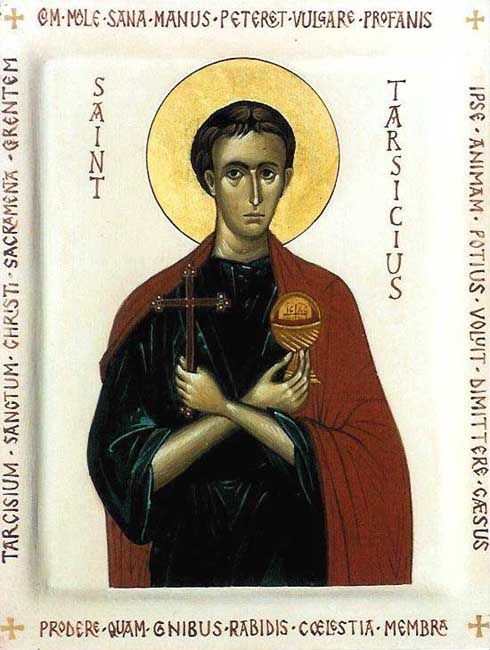
Since in JP2 we’ve been studying early Christian worship, we’ve been talking a lot about the Eucharist. A story which illustrates the importance of the Eucharist to the Early Church is that of St. Tarsicius.
St. Tarsicius was an acolyte (one of the minor orders of clergy) who was killed by a gang of pagans as he carried a portion of the Eucharist from the Eucharistic liturgy.
It is quite likely that he was taking Holy Communion to someone sick or in prison. At that time it was also the practice for some of the consecrated bread to be taken from the bishop’s Mass to the other Masses around the city as a sign of unity with the bishop.
Here is how Tarsicius’ story is recorded in the Roman Martyrology:
“…the heathen met [him] bearing the sacrament of the Body of Christ and asked him what it was he carried. He judged it a shameful thing to cast pearls before swine, and so was attacked by them for a long time with sticks and stones, until he gave up the ghost. When they turned over his body, the sacrilegious assailants could find no trace of Christ’s sacrament, either in his hands or among his clothing.”
– Roman Martyrology
I’ve got a longer article in progress on the subject of abortion, but today’s post is an extremely short entry on a point I’ve been wanting to mention for some time…
Whenever you see an abortion debate, either in a formal setting or on Facebook, it’s not long before you hear someone, typically from the pro-choice side, talk about “fertilized eggs”. I only note this because I think it’s always worth pointing out that “fertilized egg” is something of a misnomer…
I say this because once an egg is fertilized, it ceases being an egg. It is now a new, distinct human organism. Calling it a “fertilized egg” is rather like referring to a man as a “married bachelor”. It’s nonsensical since, once married, a man ceases to be a bachelor. Likewise, we would never refer to someone being a “born fetus” because once the child is born it ceases to be a fetus.



 A while ago I promised a friend that I would do an in-depth treatment of the Catholic Church’s teaching on the Communion of Saints. I’m still planning on doing that more detailed examination at some point in the future, but today I’d like to do another brief post following on from



 So, a while back I wrote
 Since in

 I’ve got a longer article in progress on the subject of abortion, but today’s post is an extremely short entry on a point I’ve been wanting to mention for some time…