The Epistle of Joy – Episode #1 (Video)

So, it’s nearly the end of January which means that we’re just a couple of weeks away from Ash Wednesday and the beginning of Lent.

So, what are you going to be doing this Lent? Give up chocolate…again?! Don’t misunderstand me, fasting from treats is a good thing to do, but why not do something a little different this year?

With that in mind, why don’t you join me for Scripture study? Throughout Lent I will be posting videos on YouTube three times a week. Each video will be nice and short, enough time for you finish a nice cup of tea (or coffee, if that is your poison).

For an audio-only version of this video, please click here.

We’ll be working through St. Paul’s letter to the Philippians using the RSV-CE translation. More details to follow in the run-up to Ash Wednesday!

Previous Episode | Next Episode

My 12 for 2012

I wrote earlier about my New Year’s Resolutions. One of the items was “Complete Reading List”. Here are the books I’ve selected:

My Reading List

I’m sure this little bundle will inspire a blog entry or two…

The Church and the New Media – Brandon Vogt
The Path of Life – Cyprian Smith OSB
I’m Not Being Fed! – Jeff Cavins
Jesus of Nazareth – Pope Benedict XVI
Rediscover Catholicism – Matthew Kelly
Godless Delusion – Patric Madrid & Kenneth Hensley
The Passion of Jesus Christ – John Piper
How To Listen When God Is Speaking – Mitch Pacwa, SJ
Father Brown of the Church of Rome – G.K Chesterton
Jesus Among Other Gods – Ravi Zacharias
The Story of Christianity – Justo Gonzalez
Philosophy For Dummies – Thomas Morris

I will be beginning with the one at the top of the pile The Church and the New Media which I recently won in a competition over at the author’s blog, The Thin Veil. Thanks Brandon! 🙂

Temple of Friendship

Today I’d like to ramble a little bit about the subject of “friendship” as it has been on my mind recently. In fact, one of my New Year Resolutions this year was as follows:

Resolution #6. Invest more time in friendships
I have some really good friends. I should spend more time with them.

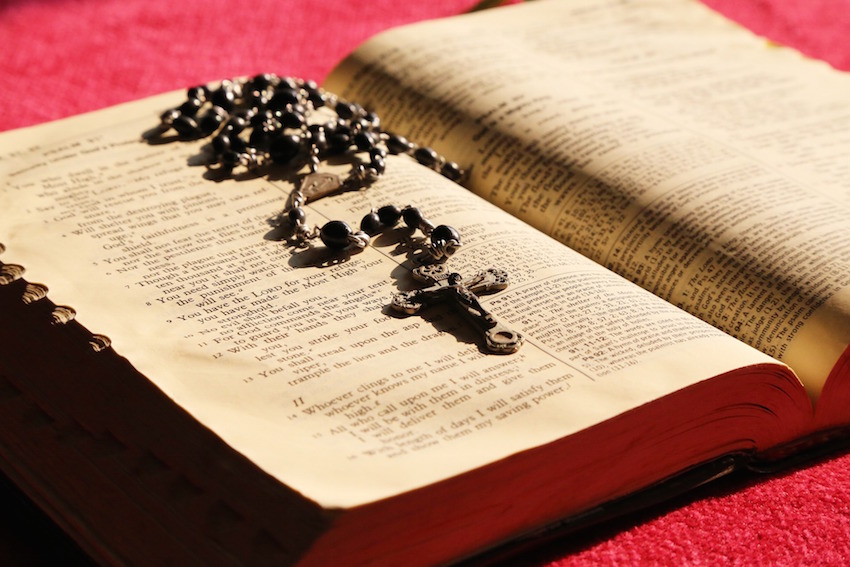
This was inspired by one of my favourite Bible pages from the Deuterocanon:

Let your acquaintances be many, but one in a thousand your confidant.
When you gain a friend, first test him, and be not too ready to trust him.
For one sort is a friend when it suits him, but he will not be with you in time of distress.

A faithful friend is a sturdy shelter; he who finds one finds a treasure.
A faithful friend is beyond price, no sum can balance his worth.
A faithful friend is a life-saving remedy, such as he who fears God finds;
For he who fears God behaves accordingly, and his friend will be like himself.

– Sirach 6:6-17

Read more

Bad Islamic Apologetics

I was in an apologetics discussion group and someone posted the following:

I told the members of the group that I didn’t like this line of argumentation. Several people responded by saying that since the Qur’an claims that there are no contradictions within its pages, the passages cited above were clear evidence that the book is not of divine origin.

In reply, I explained that they were interpreting the Qur’an in a way which forced a contradiction and then declared it to contain contradictions. I pointed out that they would never accept a Muslim exegeting the Bible in this way.

Even without digging into the context of these passages from the Qur’an, it seemed immediately obvious to me that the statements could very easily be harmonised by simply recognising that “first of” can mean “foremost among”. This would mean that, according to the Qur’an, Moses declared himself to be foremost among the believers of his time and Muhammad made the same claim for himself in his own generation. Interpreting the passages in this way eliminates the contradiction.

There are many apparent contradictions in the Bible, but careful exegesis can show this not to be the case.  If you wouldn’t accept bad methodology when interpreting the Bible, you shouldn’t force it on the Qur’an….

Quick Apology: Soul Sleep?

The other day I received an email from a reader who had spoken to a non-Catholic with a rather rare point-of-view, and who asked for helpful suggestions when speaking to him…

Objection

During a discussion about the Saints, the Protestant in question made the following statement:

“…no one is in Heaven except Jesus, Enoch, and Elijah.”

This sort of theological position is rarely held by those in mainstream Protestantism, but how might we respond to this?

Read more

Quick Apology: Is Mary “Mother of God”?

Objection

In today’s post I’d like to offer a quick apology to the following objection:

“Mary is the mother of Jesus, she’s not the ‘Mother of God'”

The idea being expressed here was championed by Nestorius in the 5th Century and condemned at the Council of Ephesus (AD 431). Unfortunately, this is a sentiment often expressed by many Protestants when they hear Catholics and Eastern Orthodox Christians refer to Mary as “Mother of God”.

Response

In responding to this objection, I simply put forward a few logical statements:

1. Jesus is God

2. Mary gave birth to Jesus

3. Therefore, Mary is the mother of God

I then ask the person with whom I am speaking to identify the perceived error. Does he deny that Jesus is God? Does he deny that Mary gave birth to Jesus? If Jesus is God and Mary gave birth to Him, doesn’t “Mother of God” seems to be an appropriately descriptive title?

To put it in terms of Scripture, in Luke’s Gospel, St. Elizabeth says to Mary “And why is this granted me, that the mother of my Lord should come to me?” (Luke 1:43). Is Elizabeth’s “Lord” God? Yes or No? If her “Lord” is God then Mary is “the mother of [her] Lord[/God]”.

One might also consider the Deuteronomic command to “Honour your father and mother” (Deuteronomy 5:16). As we all know, Jesus fulfilled the Law perfectly. So, in fulfilling this command, whom did He honour?

Contrary to what is often proposed, Mary being “Mother of God” does not make her greater than Jesus. It simply establishes her relationship with her Son and Saviour and, like the pronouncements of the Council of Ephesus, safeguards the Church’s teaching concerning the divinity of Christ.

Mother of God

Sunday Lectionary: September 11, 2011

There’s not too much technical stuff to focus on in this week’s Mass Readings. My suggestion is to use the readings as a springboard to invite people in the study group to talk about their struggles, successes and failures in relation to that tough subject of forgiveness.

Twenty-Fourth Sunday of Ordinary Time

Last week’s Mass Readings concerned themselves with the restoration of brothers and sisters who have fallen into sin. This week’s Readings build on those of last week, focussing upon forgiveness, its centrality to the Gospel and its necessity in God’s covenant community.

“There is no offense, however serious, that the Church cannot forgive. There is no one, however wicked and guilty, who may not confidently hope for forgiveness, provided his repentance is honest. Christ who died for all men desires that in his Church the gates of forgiveness should always be open to anyone who turns away from sin” – Catechism of the Catholic Church, Paragraph 982


Reading I: Sirach 27:30-28:7

Our First Reading comes from the book of Sirach. This book is one of the books which was removed from the Bible by non-Catholics at the time of the Reformation in the 16th Century. Non-Catholics refer to this collection of books as the Apocrypha, whereas Catholics refer to them as the Deuterocanonical books. Other books in this collection include Tobit, Wisdom and 1 & 2 Maccabees.

The link between this First Reading and the Gospel passage is clear: if you would like the Lord’s forgiveness and mercy, you should treat others with forgiveness and mercy.

“Wrath and anger are hateful things, yet the sinner hugs them tight. The vengeful will suffer the LORD’s vengeance, for he remembers their sins in detail. Forgive your neighbor’s injustice; then when you pray, your own sins will be forgiven.

Could anyone nourish anger against another and expect healing from the LORD? Could anyone refuse mercy to another like himself, can he seek pardon for his own sins? If one who is but flesh cherishes wrath, who will forgive his sins?

Remember your last days, set enmity aside; remember death and decay, and cease from sin! Think of the commandments, hate not your neighbor; remember the Most High’s covenant, and overlook faults”

Possible Questions:

  • How does the author describe the sinner’s relationship to wrath and anger? What can we learn from this?
  • Practically speaking, what does this forgiveness look like?
  • There are several rhetorical questions in this passage. What point do they make?
  • What are the reasons the author gives for putting aside “wrath and anger” and “enmity”?

Read more

1 93 94 95 96 97 172