Today’s “Wise Words on Wednesday” is a correction of a quotation I’ll periodically see people quote on the Internet:
The Church is a whore, but she’s also my mother
St. Augustine?
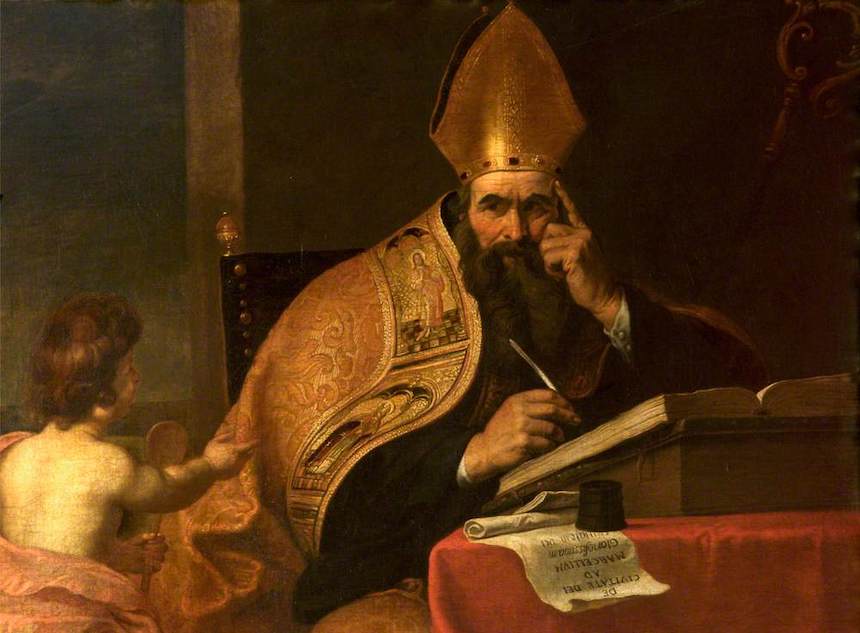
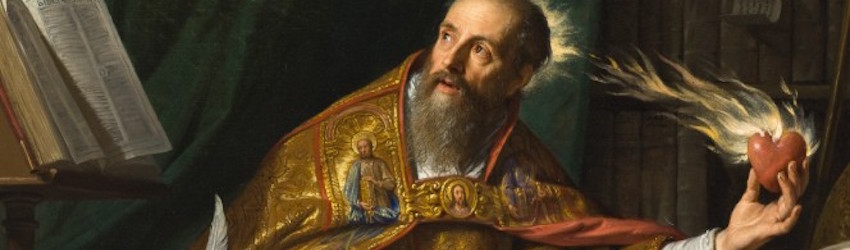
This is a poor paraphrase of something which St. Augustine wrote in Sermon 213:
“Let us honor the Catholic Church, our true Mother, the true Bride of her Husband, because she is the wife of so great a Lord. And what shall I say? How great is that Husband and of singular rank, that he discovered a prostitute and made her a virgin. Because she should not deny that she was a prostitute, lest she forget the mercy of her liberator. How can it be said that she was not a prostitute when she fornicated with demons and idols?”
Sermon 213 on the Creed
The ordering is really important here. The Bride of Christ was once unfaithful, but she was liberated by Him – the emphasis is on Christ’s ability to heal, save, and sanctify the lost.
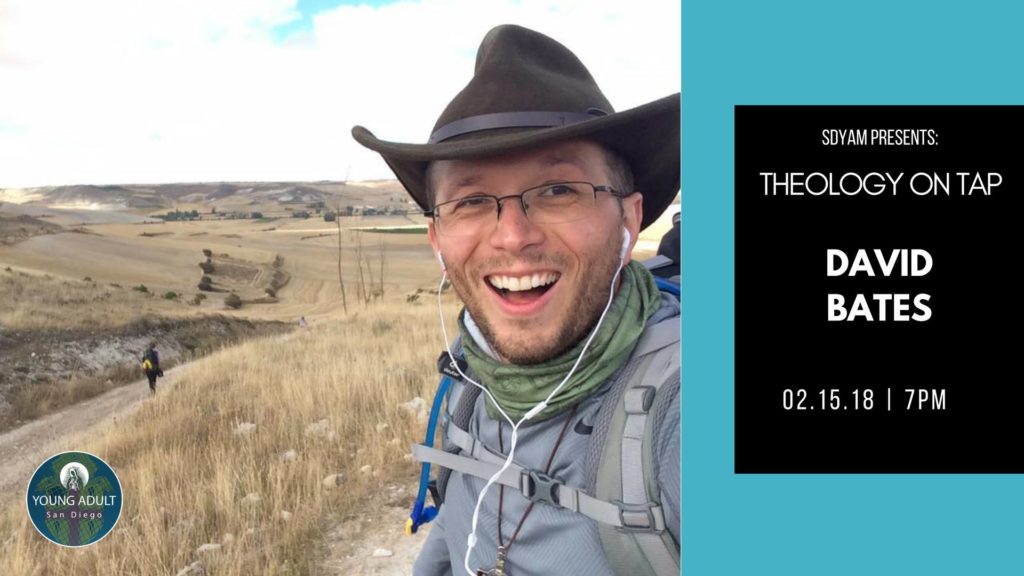
Our three-part “Theology On Tap” series came to a conclusion tonight. The Associate Young Adult Director, Pamela Poe, had tasked me to give a talk which answered the question “What does it mean to be a restless pilgrim?”. In this presentation, I recount the story of my own faith journey, I describe the story of Salvation History as a pilgrimage, and I explain why we’re all restless pilgrims…
“What does it mean to be a restless pilgrim?” (Download)
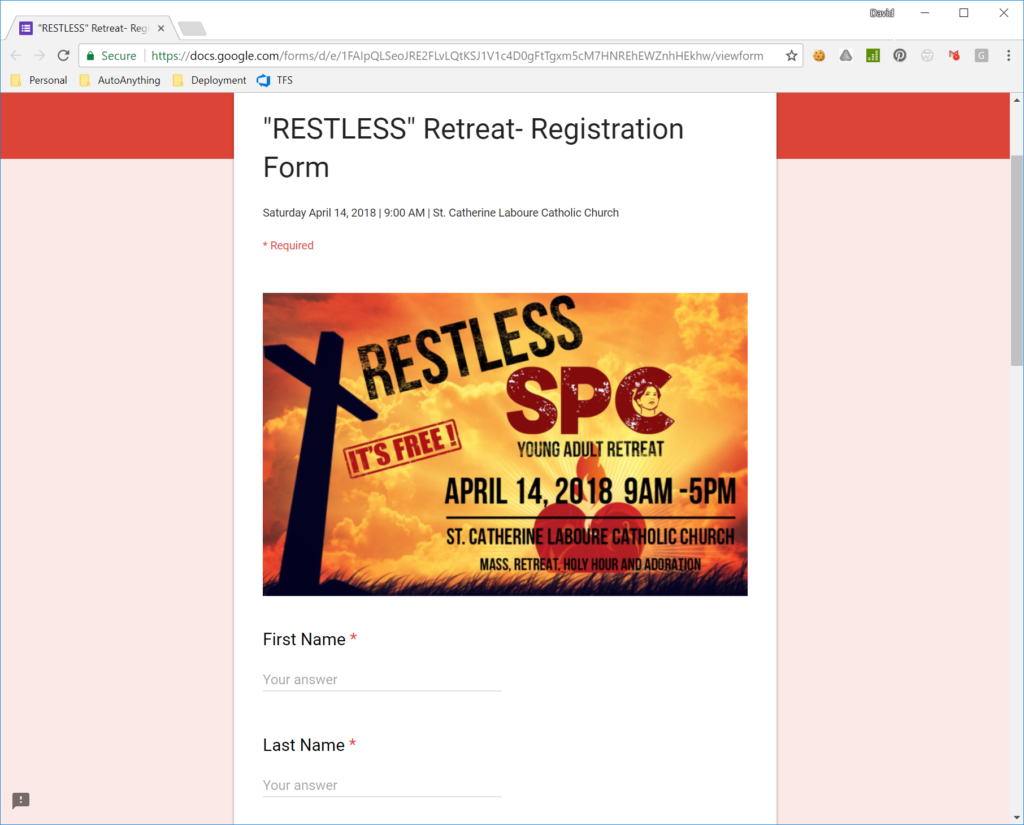
Registration is now open for the “Restless” Retreat. This is a free, one day retreat at St. Catherine Laboure on Saturday, April 14th:
The theme of the retreat is being taken from St. Augustine’s famous line, “You made us for Yourself, O Lord, and our hearts will wander restless until we rest in you”. I swear I did not pick the retreat theme… 🙂
Episode 9: Friends in high places, Part II (Download)
— Show Notes —
* My other podcast is “The Eagle and Child”, where my friend Matt and I talk about the works of C.S. Lewis. At the moment we’re working through “Mere Christianity”.
* The Camino De Santiago is a pilgrimage route from the south of France to the far western coast of Spain. I walked this route in September of 1996.
* Our first Saint was St. Basil of Caesarea. I spoke about the Emperor Valens, Arianism and the Council of Nicaea. I’ve written a little bit about St. Basil here.
* When speaking about Mother Teresa, I quoted Peter Kreeft, a well-known Philosophy Professor at Boston College: “I think nobody alive today is a more powerful agent of conversion than someone like Mother Teresa. You can refute arguments but not her life. When she came to the National Prayer Breakfast and lectured President Clinton about abortion, he had nothing to say to her. He can’t argue with a saint. It’s too bad there isn’t an easier way, because becoming a saint is not the easiest thing in the world. It’s much easier to become an apologist or a philosopher or a theologian”
* I also quote from St. Augustine’s “Confessions” (XIII, Chapter 7, 17) “But I, miserable young man…entreated chastity of You, and said, Grant me chastity and continency, but not yet. For I was afraid lest You should hear me soon, and soon deliver me from the disease of concupiscence, which I desired to have satisfied rather than extinguished”
* Nessa also quoted from Pastor Rick Warren: “Most people today do not know the difference between a hero and a celebrity. Celebrities are famous for being famous and typically use the spotlight to promote themselves. The difference between heroes and celebrities lies in the reason for their sacrifice. Celebrities often make sacrifices, but they are made for personal benefit: to win a game, an award or an election. For instance, professional athletes, actors and entertainers may be celebrities, but they are not really heroes. They sacrifice for what they do because they enjoy it, or for money, or for fame or for personal satisfactions. Heroes, in contract, sacrifice for the benefit of others. They are self-giving. Mother Teresa is ‘Exhibit A’ of a true hero, a Saint”
There are many topics I’ve wanted to write about but either through lack of time or, more recently, writer’s block, I’ve never quite managed to tackle them. However, today I will begin to scratch a writing itch which I’ve had for some time. Over the next month or so, I will be publishing articles which relate to the classical proofs for the existence of God.
A few days ago, I was talking with a friend on Facebook who is a former Catholic. During our discussion, I mentioned a philosphical proof for God, known as the “Argument From Desire”. He asked me to explain it, so I wrote a brief summary of the proof and we spent a little bit of time going back and forth. So, drawing upon this conversation, I thought that this would be good topic with which to begin this series of posts on the philosophical arguments for God…
The other day I was at the pub discussing theology with one of my friends. During our discussion, I referred to “the New Exodus”, a phrase which he hadn’t heard before. I can’t say for sure, but I think I first heard it used by either Brant Pitre or Scott Hahn…someone like that…
Actually, if you listen to other theologians at the St. Paul Center for Biblical Theology, you’ll hear them use the word “new” an awful lot. They speak about the New Moses, New Manna, New Solomon, New Temple… In light of this, today I would like to give a brief overview of this way of viewing Scripture, with particular reference to the New Exodus. Understanding this perspective on Scripture can be really helpful, particularly in seeing the overarching unity of Scripture in the Old and New Testaments.