The Dawah Dilemma

The Qur’an speaks about Allah helping the followers of Jesus and keeping them “uppermost”, but this presents a dilemma since, historically, this has to refer to Trinitarian Christians… which is a very strange thing for Allah to support. If it wasn’t Trinitarian Christians, who exactly has remained “uppermost” since the time of Christ?

O believers! Stand up for Allah, as Jesus, son of Mary, asked the disciples, “Who will stand up with me for Allah?” The disciples replied, “We will stand up for Allah.” Then a group from the Children of Israel believed while another disbelieved. We then supported the believers against their enemies, so they prevailed. – 61:14

˹Remember˺ when Allah said, “O Jesus! I will take you and raise you up to Myself. I will deliver you from those who disbelieve, and elevate your followers above the disbelievers until the Day of Judgment. Then to Me you will ˹all˺ return, and I will settle all your disputes. – 3:55

Bigger than Bob

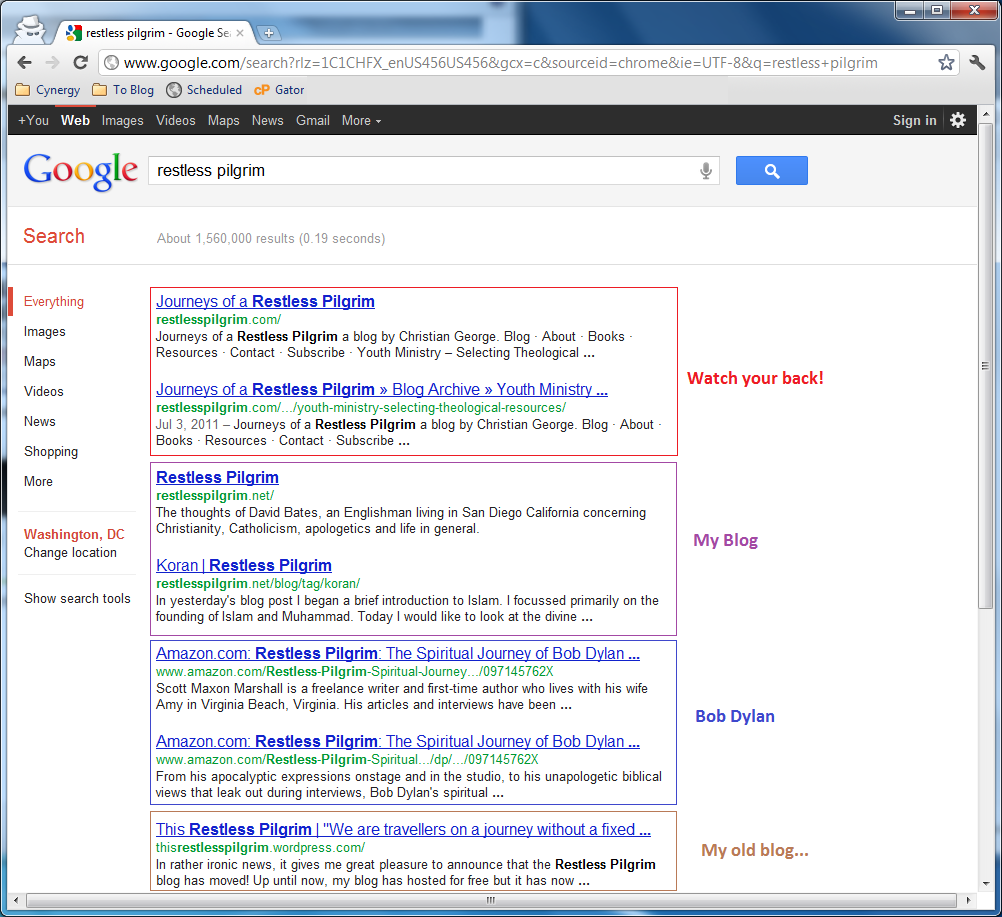
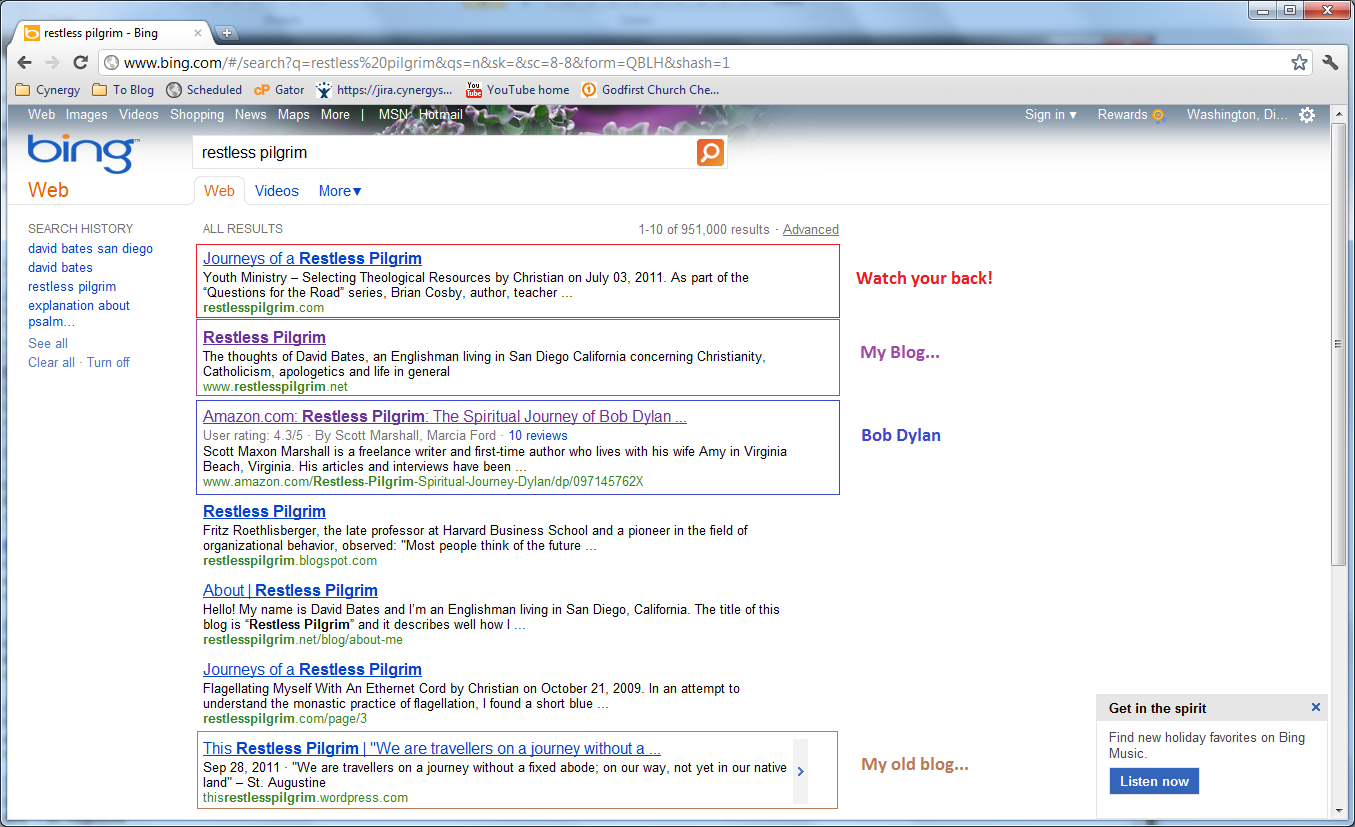
I recently started to take a little bit more interest in Search Engine Optimization (SEO). This concerns itself with ensuring that when someone uses a search engine to look for something, if your site is at all relevant to the search, it will appear as close to the top of the search results as possible.

It was only after I decided to call my blog “Restless Pilgrim” that I found out that it’s also the name of a Bob Dylan biography. Well, today I’m pleased to announce that I’m bigger than Bob Dylan!

Okay, now to get that #1 spot…

This post is not for you

I wanted to write a short follow-up to my post to an article earlier this week: Analysis Paralysis and making the first move. In that post I shared a quotation from the TV show “Person of Interest” about playing the game of chess:

“No one could possibly predict [all the possibilites]… Which means that that first move can be terrifying…there’s a virtually infinite sea of possibilities… But it also means that if you make a mistake, there’s a nearly infinite amount of ways to fix it. So you should simply relax and play.” – Harold Finch

This post was one of my most popular, so thank you to all of you who shared it on Facebook. It’s always great to know that something I’ve written has been of interest and encouragement 🙂

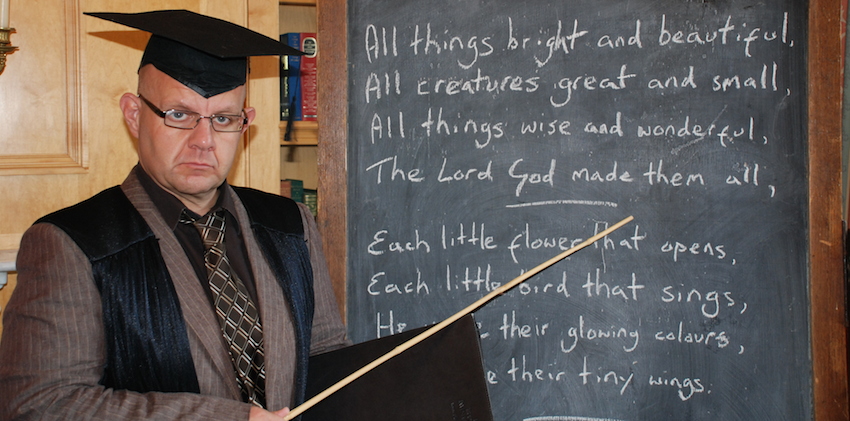
What has prompted this current post is a discussion I saw about the post Reddit. On one of the threads there were concerns that this quotation could simply be an excuse to avoid making careful decisions. I would like to respond to this concern by telling a story from my time at school…

Headmaster

Read more

Plucking out your eye

Today’s post is another entry in response to a recent Facebook conversation. This post won’t be as long as yesterday’s post, but I would like to say a few words about Jesus’ unsettling teaching in Chapter 18 of Matthew’s Gospel:

“…if your hand or your foot causes you to sin cut it off and throw it from you; it is better for you to enter life maimed or lame than with two hands or two feet to be thrown into the eternal fire.

And if your eye causes you to sin, pluck it out and throw it from you; it is better for you to enter life with one eye than with two eyes to be thrown into the hell of fire. – Matthew 18:7-9

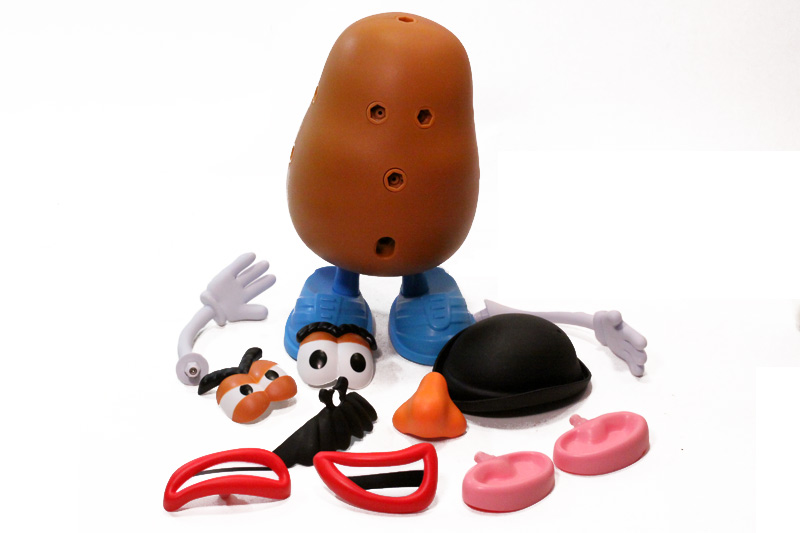
This passage from Matthew’s Gospel is rather interesting in that, in my experience, it’s a verse which fundamentalists never take literally (along with John 6 and Acts 2:38). Now, you’ll find pockets of Christians who handle snakes (Mark 16:18), but I have yet to meet someone to apply the same literalistic hermeneutic to that passage. The funny thing about this passage is that the literal sense here is clear – it is better to lose everything in this life rather than to lose Heaven – even hands and eyes.
MrPotatoHead

The central message Jesus teaches here is that we can’t take sin lightly. You can’t treat sin as though it were something with which you can negotiate. You don’t negotiate with cancer! You don’t sit down with a tumour and ask it not to grow too large. No, you cut that stuff out! You eradicate it as quickly as possible because, if left unchecked, it’ll be your ruin. The same is true with sin.

What might be an application of this passage? Well, I would say that we can understand this passage in the context of what is known in Catholic circles as “the near occasions of sin”, which the times and places where we know we can easily fall from grace. In particular, I’d like to apply this passage to the issue of porn.

If you know you are tempted to watch porn when staying a hotel, the best thing to do is cut it off at the source, literally, by phoning ahead and asking the hotel to put a block the channels on the TV. I remember Matt Fradd referencing this passage when speaking about the temptation to watch porn on a smart phone:

“If your iPhone causes you to sin, disconnect it and throw it from you; it is better for you to enter life with a dumb phone and poor connectivity, rather than to be thrown into the eternal fire with a touchscreen and wifi access”

Symbolism: The Cross

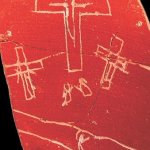
A little while ago I wrote a post about the earliest known depiction of the crucixion, the Alexamenos Graffito. During the ensuing Facebook discussion, the subject of the use of the cross in Christian art and worship was raised. This reminded me that I had myself that I would do a blog series on early Christian symbolism.

I’ve written before about abbreviations such as IHS and INRI, but I would like to expand upon this by examining early Christian symbols. So with that in mind, I’ve decided to do that today, beginning with probably the best known Christian symbol, the cross.

inscription

Irenua-Veleia, Basque (3rd Century)

It may come as a surprise to many people to find out that, in the first few centuries, the use of the cross in Christian art and worship is somewhat unclear. Some historians and archeologists see this symbol throughout the historical record, while others claim that the cross is almost completely absent.

At first glance this might seem strange. Why is there such disagreement? Over the remainder of this post we will see why…

Read more

Quick Apology: The Deuterocanon

A couple of days ago I posted some of the important dates concerning the setting of the Biblical canon. Closely related to the subject of the canon is the issue of the deuterocanon, the books referred to by Protestants as “the apocrypha”, which were removed from the canon at the time of the Reformation.

I haven’t done a “Quick Apology” post this week, so here goes. However, rather than dealing with just one objection in this post, today I’m going to provide a series of brief rebuttals of the top ten most common objections raised….

Tobit

Protestants typically say that the deuterocanonical books shouldn’t be included in the Bible because…

Read more

1 … 95 96 97 98 99 … 137