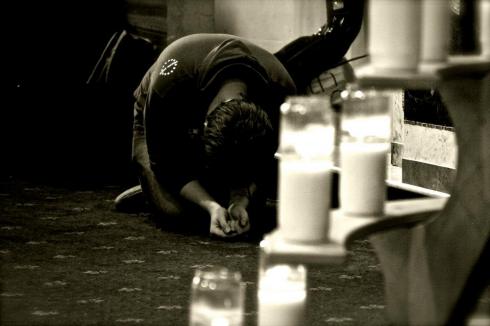
In the Diocese of San Diego we’ve had various “Mega”-themed events. It all began with “Mega Mass”, then “Mega Adoration” and then “Mega Rosary”. We even had something akin to a “Mega Bible Study” at the end of my Theology On Tap talk.
Why have “Mega” events? Well, we Christians often need to be reminded that we are part of something much larger than ourselves. We need to be reminded that the Church is far bigger than just our local parish or our local Bible study.
But you are a chosen race, a royal priesthood, a holy nation, God’s own people, that you may declare the wonderful deeds of him who called you out of darkness into his marvelous light. – 1 Peter 2:9
This idea has been brought home to me at several points in my life, but the one which sticks out to me is when I traveled to Australia in 2002 and visited Hillsong church in Sydney. If you’ve never been, it’s absolutely massive. It was quite something to be surrounded by a couple of thousand Christians singing praise to God.
After this I looked, and behold, a great multitude which no man could number, from every nation, from all tribes and peoples and tongues, standing before the throne and before the Lamb, …crying out with a loud voice, “Salvation belongs to our God who sits upon the throne, and to the Lamb!”
– Revelation 7:6-10
This week in the JP2 Group we will be continuing our study of the letters of St. Ignatius of Antioch, martyr of the early 2nd Century.
Last week we read his words to the Trallians where Ignatius presents unity with the bishop as a defence against heresy. This week we move on to the letter he wrote to the Ephesians, the community in which Paul lived for three years and to whom he wrote a letter which we find in Sacred Scripture.
In this letter Ignatius pulls together all the different topics we have seen him address in his letters thus far: unity, the episcopacy, heresy, the Eucharist etc. However, as well as being a nice revision of all we have seen thus far, he also gives us some advice on how to deal with those outside the Church.
After looking at several different translations, I have, again, created my own abridged version so that we will be able to complete our study of this letter in a single evening. The letter to the Ephesians is quite long so unfortunately I had to cut quite a bit. Anyway, here it is:
Thus far we have been reading the letters this inspirational martyr wrote from the city of Smyrna, but we must now follow him to Troas where he will write his last three letters before completing his journey to Rome and to the mouths of the wild beasts!
Ignatius now addresses the schism and the Judaising attempts at the church in the city of brotherly love, Philadelphia. Here is my abridged version of the letter:
In 2008, Dr. Michael Ward released “Planet Narnia”, a book which caused a real stir in C.S. Lewis studies in which he offered a new lens through which to view “The Chronicles of Narnia”. On today’s show, in addition to his book, Dr. Ward discusses his friendship with the late Walter Hooper, as well as his involvement in honouring Lewis’ life and legacy. Oh yes, and he also explains how he came to give James Bond a pair of x-ray glasses…
Recently, a listener to our C.S. Lewis podcast reached out to us. She had just begun RCIA with her family and they were quite taken aback when the priest described Purgatory in the following way:
“Purgatory is a place of fire and burning. However, there will be hope there because you will know you’re getting out someday.”
RCIA Class
It seemed to her that this would make the work of Christ incomplete. After the class, her daughter exclaimed:
“How do they expect anyone to convert if you’re still going to Hell? Because that’s exactly what Purgatory sounds like!”
When they got home, they did some googling and found several other sources that said Purgatory would be the same fire of hell, but with the hope of one day escaping.
Since my co-host and I had spoken about Purgatory on the podcast, she sent us a message expressing her consternation. I too once balked at the fire imagery I saw in some artistic depictions of Purgatory (such as in the altarpiece above), so I thought it would be a good idea to turn my answer into a blog post…
Hello everyone! We’ll have a fresh episode of The Eagle and Child for you next week, but in the meantime, here is this week’s episode of The Lamp-Post Listener. I was invited onto the show by Daniel and Phil to discuss Chapter 16 of C.S. Lewis’ The Lion, The Witch and the Wardrobe…
Bonus Episode: Guest Appearance on The Lamp-Post Listener (Download)
I enjoy a lot of Frank Turek’s apologetics and listen to his weekly podcast, but he really does have a few blind spots. I recently came across this video which shows that the canon of Scripture is one such blind spot…
What he says here concerning the discernment of the canon isn’t entirely false, but he offers a very insufficient description of what took place. It was the Catholic Church who determined the canon in the early centuries of the Church. In fact, it’s a bit embarrassing that it’s the questioner who is the first person to bring up these councils!
His statement about the Protestant Bible lining up with the Jewish Old Testament is too simplistic, so much so that it’s misleading. The Protestant Old Testament matches the canon of the Jews today… but not of all the Jews in the First Century! After all, there were a number of different Jewish sects in the First Century, such as the Sadducees, Pharisees and Essenes. Each of these groups had a different canon of Scripture…
Now, the Protestant canon matches the canon settled by the rabbis in the Second Century, following the establishment of the Church and the destruction of Jerusalem by the Romans. However, this begs the question: why should Christians accept the opinion of this particular Jewish group? After all, these are the successors to those who rejected that Jesus was the Messiah! If they didn’t recognize the Word incarnate, why would they necessarily correctly recognise the written Word of God? Not only that, wouldn’t they have motivation to exclude books from the canon which very clearly prophesy the suffering of Jesus?
The really egregious error in this video is Frank’s assertion that Roman Catholics added books to the Bible at the Council of Trent. That claim is patently false and honestly I’d expect more from an apologist of Frank’s calibre. Catholics did not add books to the Bible at the Reformation, the Protestants removed them. This is just one of the worst arguments used against the Deuterocanon. Incidentally, Luther even tried to remove books from the New Testament, such as the Epistle of James because he couldn’t reconcile it with his novel theology of Sola Fide…
The Catholic Bible aligns itself to the Septuagint, the Greek translation of the Old Testament which is the translation most often quoted by the New Testament authors themselves. The Catholic Canon was declared by the early councils of the Church, as well as later ones such as The Council of Florence (AD 1431). You don’t have to wait for the Council of Trent (AD 1545). For further proof of this, just ask a Coptic or Eastern Orthodox Christian if they have the Deuterocanonical books in their Bible. These Churches separated from the Catholic Church long before the Reformation, yet still have these Deuterocanonical books…conclusive proof that what Frank said here is incorrect.