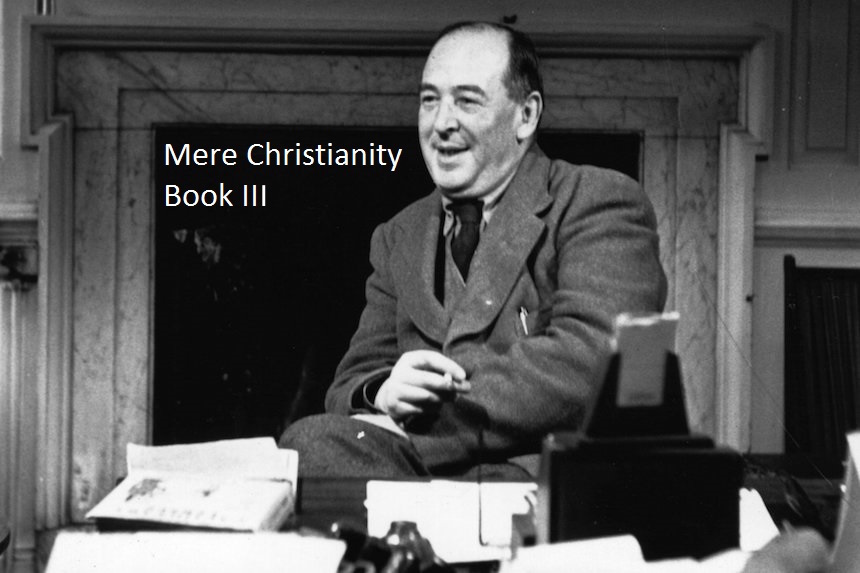
Picking back up my notes for C.S. Lewis’ “Mere Christianity”…
Notes & Quotes
1. Building a Christian society requires a multi-pronged approach
It means that we must begin both jobs at once – (1) the job of seeing how “Do as you would be done by” can be applied in detail to modern society, and (2) the job of becoming the sort of people who really would apply it if we saw how.
2. Christian morality claims to fix the human machine, but so does psychoanalysis
(a) We must distinguish between psychoanalysis and the philosophical views added to them by men such as Freud
“…when Freud is talking about how to cure neurotics he is speaking as a specialist on his own subject, but when he goes on to talk general philosophy he is speaking as an amateur”
(b) Psychoanalysis is not contrary to Christianity and, in fact, has some overlap, albeit different ends
“…psychoanalysis itself…is not in the least contradictory to Christianity. Its technique overlaps with Christian morality at some points…but it does not run the same course all the way, for the two techniques are doing rather different things”
3. A moral choice involves two different things:
(a) The raw materials involved in choosing
“…the various feelings, impulses and so on which his psychological outfit presents him with”
These raw materials may be:
(i) Normal
“…the sort of feelings that are common to all men”
(ii) Unnatural
“…unnatural feelings due to things that have gone wrong in his subconscious”
The job of psychoanalysis is to make these raw materials better:
“…psychoanalysis undertakes to do is to remove the abnormal feelings…to give the man better raw material for his acts of choice…bad psychological material is not a sin but a disease. It does not need to be repented of, but to be cured…morality is concerned with the acts of choice themselves“
(b) The act of choosing itself
“However much you improve the man’s raw material, you have still got something else: the real, free choice of the man, on the material presented to him, either to put his own advantage first or to put it last. And this free choice is the only thing that morality is concerned with”
4. Human judgements and Divine judgement are very different
(a) We judge by actions, God judges by moral choices
“Human beings judge one another by their external actions. God judges them by their moral choices. When a neurotic who has a pathological horror of cats forces himself to pick up a cat for some good reason, it is quite possible that in God’s eyes he has shown more courage than a healthy man may have shown in winning the V.C.* When a man who has been perverted from his youth and taught that cruelty is the right thing, does some tiny little kindness, or refrains from some cruelty he might have committed, and thereby, perhaps, risks being sneered at by his companions, he may, in God’s eyes, be doing more than you and I would do if we gave up life itself for a friend…
* Victor Cross, a medal awarded in the military
(b) At death, all will become clear
Some of us who seem quite nice people may, in fact, have made so little use of a good heredity and a good upbringing that we are really worse than those whom we regard as fiends…
Most of the man’s psychological make-up is probably due to his body: when his body dies all that will fall off him, and the real central man. The thing that chose, that made the best or the worst out of this material, will stand naked. All sorts of nice things which we thought our own, but which were really due to a good digestion, will fall off some of us: all sorts of nasty things which were due to complexes or bad health will fall off others. We shall then, for the first time, see every one as he really was. There will be surprises.”
5. Our choices matter
(a) They prepare us for Heaven or Hell
“…every time you make a choice you are turning the central part of you, the part of you that chooses, into something a little different from what it was before. And taking your life as a whole, with all your innumerable choices, all your life long you are slowly turning this central thing either into a heavenly creature or into a hellish creature… Each of us at each moment is progressing to the one state or the other”
(b) This is why Christian writers seem so strict one moment and easy at another
“They talk about mere sins of thought as if they were immensely important: and then they talk about the most frightful murders and treacheries as if you had only got to repent and all would be forgiven… What they are always thinking of is the mark which the action leaves on that tiny central self which no one sees in this life but which each of us will have to endure-or enjoy-for ever. One man may be so placed that his anger sheds the blood of thousands, and another so placed that however angry he gets he will only be laughed at. But the little mark on the soul may be much the same in both. Each has done something to himself which, unless he repents, will make it harder for him to keep out of the rage next time he is tempted, and will make the rage worse when he does fall into it. Each of them, if he seriously turns to God, can have that twist in the central man straightened out again: each is, in the long run, doomed if he will not. The bigness or smallness of the thing, seen from the outside, is not what really matters”
(c) These choices change our sensitivity to good and evil
“When a man is getting better he understands more and more clearly the evil that is still left in him. When a man is getting worse, he understands his own badness less and less. A moderately bad man knows he is not very good: a thoroughly bad man thinks he is all right… Good people know about both good and evil: bad people do not know about either”
Discussion Questions
1. What is Jack’s opinion regarding psychoanalysis?
2. What are the two different different components of a moral choice? Which one benefits from psychoanalysis
3. What is the difference between man’s judgements and God’s judgements? How will death make the truth clearer?
4. In what way do our choices prepare us for Heaven and Hell? How do they affect our sensitivity to good and evil?
C.S. Lewis Doodle
No doodle!