Listening to the Liturgy

oransA couple of days ago I wrote a post entitled Lex Orandi, Lex Credendi but I realized today that I never explained what that phrase actually means. Bad Pilgrim!

Long before there was the Nicene Creed or the official Biblical canon, there was the worship of the Church. Ever since Pentecost, Christians have gathered together to pray and to celebrate the Sacraments. Therefore, when issues arose in the Church, such as when the canon was being solidified or the creeds were being written, the Bishops would look to the worship of the Church to provide their theological framework in which to address these issues.

It is to this principle that “Lex Orandi, Lex Credendi” refers. It is a Latin phrase which means:

“The law (‘lex’) of prayer (‘orandi’) is the law of belief (‘credendi’)”

This phrase is first found in the works of a Fifth Century Christian writer called Prosper, who was a disciple of St. Augustine:

“Let us consider the sacraments of priestly prayers which, having been handed down by the apostles, are celebrated uniformly throughout the whole world and in every catholic Church so that the law of praying might establish the law of believing – Prosper of Aquitaine

It’s a bit like the phrase “You are what you eat”, maybe something like “You believe what you pray”.  This is why liturgy was so important to the ancient Church and it’s why it’s important today.

I’ll admit, it took me a long to really wrap my head around why Catholics put such an emphasis on what happens on Sunday mornings. It was only when I started studying the worship of the Early Church that I began to realize its importance and begin to understand the teaching and creedal role of the liturgy.  Our liturgy demonstrates what is important to us. It expresses (among other things) what we believe about God, how we understand ourselves and the Church.

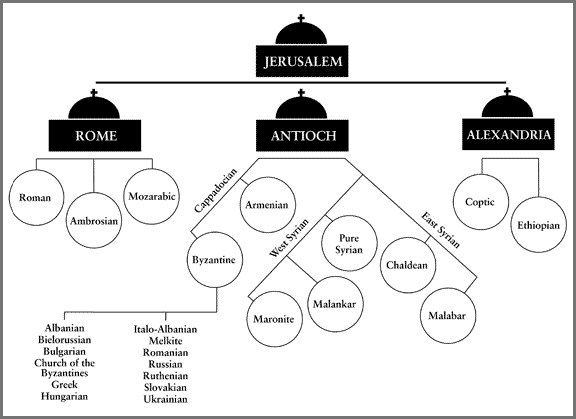
So why am I bringing this up? Well, yesterday afternoon I went to Vespers at my Byzantine parish and noticed a couple of things in  the liturgy that got me excited which I wanted to share…

Read more

New “Theology On Tap” Podcast!

I’m very pleased to announce that the San Diego Diocese has just launched a podcast feed! From now on, the audio from the Theology On Tap sessions will be available on your desktop and mobile devices.

It is available on iTunes:

iTunes

…and also on Google Play:

GooglePlay

If you have difficulty subscribing with either of these, you can either search for the podcast in the respective stores, or manually add the feed to your podcast app:

http://feeds.feedburner.com/sdyam

Podcast

If you have any problems with the podcast, please let me know in the comments below and I’ll do my best to sort them out!

Real Men Still Do This

I was at lunch with a new friend the other day and, as a matter of course, as we were leaving the café, I opened the store’s door for her. Her reaction was one of utter surprise! She asked me if opening doors was an “English thing”! I replied no, it’s a “real man” thing.

It’s a complete joke!

You may have heard the joke that if you see a man opening a car door for a lady then it’s either a new lady or a new car. Unfortunately, this joke appears to be, in fact, reality. This is tragic! It’s so sad when a man does not think enough of the lady in his company so as to perform this simple act of kindness. It’s even more heartbreaking when a husband does not do this for the woman to whom he has pledged his life.

Husbands, love your wives, just as Christ loved the church and gave himself up for her…husbands ought to love their wives as their own bodies – Ephesians 5:25, 28

Read more

Quick Apology: Chained Bibles

In today’s Quick Apology post I wanted to turn to the subject of history…

Objection

When speaking about the Catholic approach to Scripture, some Protestants will make the following accusation:

“The Catholic Church used to chain up Bibles!”

Response

The statement is absolutely true; it was not uncommon prior to the Reformation for Bibles to be chained up. When I am told this in a discussion I concede the point, but I then ask the person speaking if they know why this was done…

It is not uncommon to receive as a response, “They chained them up to stop people reading the Bible!”. While the initial statement was true, this explanation as to why Bibles were chained is completely incorrect. In fact, Bibles were chained for completely the opposite reason. Bibles were chained up so that more people had access to the Scriptures!*

You see, prior to the Fifteen Century and the invention of the movable type printing press, Bibles were hand-written. This was an colossal undertaking and therefore extremely costly. This meant that Bibles were expensive items liable to be stolen by thieves. Therefore, in an attempt to provide people with access to the Scriptures, it was common for a Bible to be made available in or around a church building, but to prevent theft, it was chained to a heavy object. If you had a Bible worth tens of thousands of dollars, would you want to leave it unsecured and unattended in a public building?!

If you visit a post office or a bank, you will often see pens chained to immovable services. Do these institutions chain these pens because they don’t want you to use them? Of course not! They want you to use the pens, but they want to make sure nobody steals them! Why? Because if they are stolen then other people won’t have the opportunity to use the pens. It is the same logic at work concerning the chaining of Bibles.

Chained Bible

* It is probably worth pointing out that literacy rates were also extremely low even until the 19th Century. It is for this reason that the most common way of learning the Bible throughout Christian history has been the hearing the Scriptures proclaimed at the Eucharistic liturgy.

Things that make me happy

The other day I was thinking about things which make me happy. It’s actually quite a difficult exercise – if you don’t believe me, give it a go. What are the things which make you really, truly happy? Where are the places you can always find joy?

After sitting down and writing the list I’ve concluded that I’m actually quite easy to please. Although in many ways I’m extremely demanding of myself and others, it doesn’t actually take a whole lot to make me happy:

Read more

The Pascal Homily

I went to Vigil Mass last night and we were up late afterwards celebrating with the new members of the Church.

Wade

As a result, I didn’t get to Byzantine Liturgy this morning, which meant that I missed out on hearing St. John Chrysostom’s Pascal Homily. For those of you that don’t know, in the Byzantine Church, this Fourth Century homily is read by the priest at the Liturgy every Easter Day.

Since I didn’t get to hear it today, I decided to read it myself and put it up here for you all to enjoy. Christos anesti! Alithos anesti!

Pascal Homily (Download)

St John Full

The Great Divorce: Chapter 10

Summary

Lewis recounts another overheard “conversation” between a Ghost and a female Spirit named Hilda. The ghost begins by saying that she would not dream of staying in Heaven if she were expected to meet Robert, her husband and Hilda’s brother. She says that she forgives him “as a Christian…but there are some things one can never forget.” She even seems puzzled as to how he came to be in Heaven at all.

She then begins to retell the story of her life with Robert. Her chief complaint was “The ingratitude! It was I who made a man of him! Sacrificed my whole life to him! And what was my reward? Absolute, utter selfishness”. She explains that he was relatively poor man, completely lacking ambition, and that she was the one “who had to drive him every step of the way”. She nagged him to take on extra work, which is regarded as nothing in comparison to her own workload, since she “I had to keep him going all evening…draw him out of himself and brighten him up and make conversation”. He didn’t appreciate her flower arrangements, particularly when she spilled a vase on the manuscript of a book he was writing (something which she “cured him of…in the end”)

She complained about Robert’s attempts to “just slink off by himself every now and then to see what he called his old friends… and leave me to amuse myself!” Instead, she insisted that the friends come to the house instead. She both subtlety manipulated her husband and made his friends feel uncomfortable, managing to drive them away by the end of their first year of marriage.

Upon receiving a promotion, Robert hoped for peace, but his wife now wanted to get a bigger house and was irritated that he doesn’t seem thoroughly enthusiastic about the house-hunting process. She convinced him to buy a house they couldn’t really afford, but she was excited that she could now “entertain properly”. In contrast, she said that Robert “…just set himself to get old and silent and grumpy”, even though he “hadn’t always been like that”. Robert would just sit there, hating her and she grew to hate him too. There appears to have been some issue with the “younger men who came to the house” who liked her better than her “old bear of a husband” and “used to laugh at him”.

Towards the end of Robert’s life, she bought a great Dane and forced him to walk it for his health. She kept hosting parties, “took him for the most wonderful holidays…[and] saw that he didn’t drink too much”. She even allowed him to take up writing again (“It couldn’t do any harm by then”). But in the end, Robert had a nervous breakdown, but the ghost said her conscience is clear – she had done her duty.

Reconsidering, the ghost says that she will, in fact, meet Robert. If Heaven will give her “a free hand”, she’ll “take charge of him again…make something of him…. There’s lots, lots, lots of things I still want to do with him”. When Hilda tells her this is not possible, she becomes desperate: “Please, please! I’m so miserable. I must have someone to – to do things to…. No one minds about me at all [in Hell]. I can’t alter them”. The ghost snaps, saying “I hate you. How can I pay him out if you won’t let me have him?”. Lewis says that “The Ghost which had towered up like a dying candle flame snapped suddenly… and then there was no Ghost to be seen”.

Questions

Q1. How would you describe the ghost? How would you describe the husband?

Q2. Why is the ghost reticent about meeting her husband? What does she think about forgiveness?

Q3. How did she regard the relationship with her husband? What kind of relationship does Christianity imagine?

Q4. What do you think was the ghost’s motivation regarding her husband?

Q5. What did she think of his desire to write a book?

Q6. Why do you think Robert’s ability to be a good host declined?

Q7. Why does the ghost change her mind about seeing Robert? Under what condition? How does she respond?

Previous Chapter | Index | Next Chapter

1 74 75 76 77 78 137