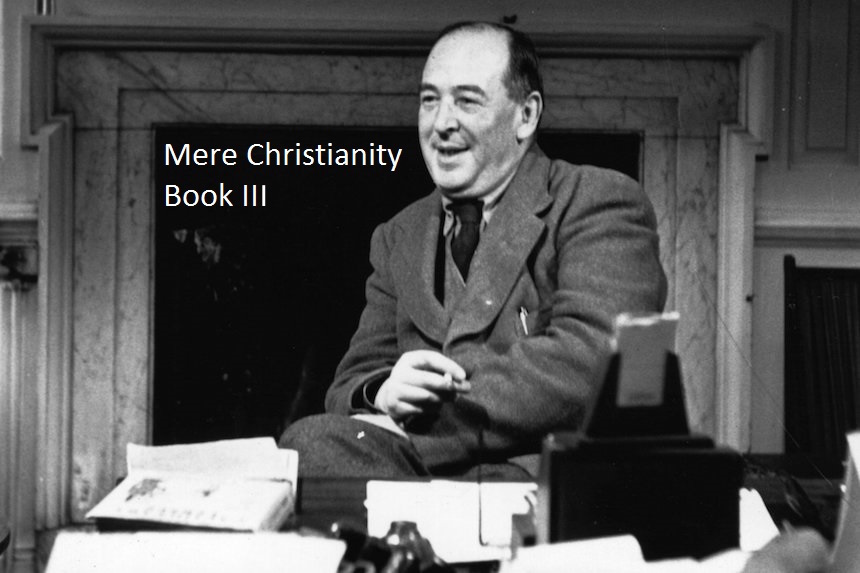
Picking back up my notes for C.S. Lewis’ “Mere Christianity”…
Notes & Quotes
1. We no consider the vice of Pride
“…[the] vice of which no man in the world is free; which every one in the world loathes when he sees it in someone else; and of which hardly any people, except Christians, ever imagine that they are guilty themselves”
2. This is the centre of Christian morality
“According to Christian teachers, the essential vice, the utmost evil, is Pride… it was through Pride that the devil became the devil: Pride leads to every other vice: it is the complete anti-God state of mind”
3. Pride is inherently competitive
“…each person’s pride is in competition with every one else’s pride. It is because I wanted to be the big noise at the party that I am so annoyed at someone else being the big noise… Pride gets no pleasure out of having something, only out of having more of it than the next man. We say that people are proud of being rich, or clever, or good-looking, but they are not. They are proud of being richer, or cleverer, or better-looking than others. If every one else became equally rich, or clever, or good-looking there would be nothing to be proud about. It is the comparison that makes you proud: the pleasure of being above the rest. Once the element of competition has gone, pride has gone”
4. The vice of Pride is often mistaken for another vice
(a) Greed
“Greed will certainly make a man want money, for the sake of a better house, better holidays, better things to eat and drink. But only up to a point. What is it that makes a man with $10,000 a year anxious to get $20,000 a year? It is not the greed for more pleasure. $10,000 will give all the luxuries that any man can really enjoy. It is Pride-the wish to be richer than some other rich man, and (still more) the wish for power”
(b) Lust
“What makes a pretty girl spread misery wherever she goes by collecting admirers? Certainly not her sexual instinct: that kind of girl is quite often sexually frigid. It is Pride. What is it that makes a political leader or a whole nation go on and on, demanding more and more? Pride again”
5. Other vices can bring people together. Pride cannot.
“Other vices may sometimes bring people together: you may find good fellowship and jokes and friendliness among drunken people or unchaste people. But Pride always means enmity-it is enmity”
6. Pride automatically places us in competition with God.
“In God you come up against something which is in every respect immeasurably superior to yourself. Unless you know God as that – and, therefore, know yourself as nothing in comparison- you do not know God at all. As long as you are proud you cannot know God. A proud man is always looking down on things and people: and, of course, as long as you are looking down, you cannot see something that is above you”
7. How then, is that the prideful can describe themselves as “very religious”?
(a) They are worshipping an imaginary God
“They theoretically admit themselves to be nothing in the presence of this phantom God, but are really all the time imagining how He approves of them and thinks them far better than ordinary people…”
(b) There is a test we can apply to ourselves
“The real test of being in the presence of God is that you either forget about yourself altogether or see yourself as a small, dirty object. It is better to forget about yourself altogether”
(c) It is worse than vices from our animal nature
“It comes direct from Hell. It is purely spiritual: consequently it is far more subtle and deadly”
(d) It can even be used to beat down the simpler vices
“Teachers, in fact, often appeal to a boy’s Pride, or, as they call it, his self-respect, to make him behave decently: many a man has overcome cowardice, or lust, or ill-temper by learning to think that they are beneath his dignity-that is, by Pride. The devil laughs. He is perfectly content to see you becoming chaste and brave and self-con trolled provided, all the time, he is setting up in you the Dictatorship of Pride – just as he would be quite content to see your chilblains cured if he was allowed, in return, to give you cancer. For Pride is spiritual cancer: it eats up the very possibility of love, or contentment, or even common sense”
8. There are several possible misunderstandings related to Pride
(a) Pleasure in being praised is not Pride
“The child who is patted on the back for doing a lesson well, the woman whose beauty is praised by her lover, the saved soul to whom Christ says “Well done,” are pleased and ought to be”
(i) This is because of where the pleasure lies
“For here the pleasure lies not in what you are but in the fact that you have pleased someone you wanted (and rightly wanted) to please”
(ii) It is only problematic when you delight more in yourself
“The trouble begins when you pass from thinking, ‘I have pleased him; all is well,’ to thinking, “What a fine person I must be to have done it.” The more you delight in yourself and the less you delight in the praise, the worse you are becoming”
(A) This is why vanity is the least bad
“It is a fault, but a childlike and even (in an odd way) a humble fault. It shows that you are not yet completely contented with your own admiration”
(B) The real problem is when you don’t care at all
“The real black, diabolical Pride comes when you look down on others so much that you do not care what they think of you… He says ‘Why should I care for the applause of that rabble as if their opinion were worth anything?’ In this way real thoroughgoing Pride may act as a check on vanity; for, as I said a moment ago, the devil loves “curing” a small fault by giving you a great one. We must try not to be vain, but we must never call in our Pride to cure our vanity; better the frying-pan than the fire”
(b) It is not necessarily bad to be “proud of” a son, father, school etc.
(i) It very often simply means admiration
“Very often, in such sentences, the phrase ‘is proud of’ means ‘has a warm-hearted admiration for.’ Such an admiration is, of course, very far from being a sin”
(ii) However, it may mean that a person gives himself airs
“But it might, perhaps, mean that the person in question gives himself airs on the ground of his distinguished father, or because he belongs to a famous regiment. This would, clearly, be a fault; but even then, it would be better than being proud simply of himself. To love and admire anything outside yourself is to take one step away from utter spiritual ruin; though we shall not be well so long as we love and admire anything more than we love and admire God”
(c) Pride isn’t forbidden for the principal reason that God is worried about His own dignity, but because Pride prevents us from knowing God
“He wants you to know Him; wants to give you Himself… He is trying to make you humble in order to make this moment possible: trying to take off a lot of silly, ugly, fancy-dress in which we have all got ourselves up and are strutting about like the little idiots we are”
(d) Don’t imagine that a humble man will be what most people call “humble” nowadays
“…he will not be a sort of greasy, smarmy person, who is always telling you that, of course, he is nobody. Probably all you will think about him is that he seemed a cheerful, intelligent chap who took a real interest in what you said to him. If you do dislike him it will be because you feel a little envious of anyone who seems to enjoy life so easily. He will not be thinking about humility: he will not be thinking about himself at all”
9. In order to begin to become humble, we must realize that we are pride.
“The first step is to realise that one is proud. And a biggish step, too. At least, nothing whatever can be done before it. If you think you are not conceited, it means you are very conceited indeed”
Discussion Questions
1. Why does Jack regard Pride as the centre of Christian morality?
2. In what way is Pride inherently competitive?
3. What kind of vices actually have their roots in Pride?
4. Why is it that the prideful can think of themselves as very religious? What makes pride so dangerous?
5. Is it prideful to take pleasure in praise?
6. Is it sinful to be proud of things such as your family or school?
7. Why does pride prevent us from coming close to God?
8. What might a humble man look like?
9. What does Jack think is the first step in becoming humble?
C.S. Lewis Doodle
No doodle!
 Since this Year of Faith marks the 50th anniversary of the Second Vatican Council, I’d like to publish more posts concerning the Council this year.


 This morning’s post marks the 1,500th entry on this blog. I don’t know about you, but I can tell you that
 Yesterday morning I came across the following video: