Catholic Dating: True love waits…and waits…

In this series I’m trying to examine some of the issues and problems within the Catholic dating world. However, before I get underway with today’s post I would like very briefly to reply to an important question which was raised in response to an earlier post. The question was asked, is there actually even a problem here to address?!

I would suggest that we do indeed have a problem. In addition to anecdotal evidence, there is statistical data to demonstrate that there are fewer and fewer marriages taking place today, even among practising Catholics:

Marriage-trends

This decline has far reaching consequences, both for Catholic schools and parishes, as well as for Catholic culture and the Church’s witness to the world. If you would like to read about this further then I would recommend this article by Msgr. Pope.

Choice and Commitment

So with that issue addressed, let’s return to the main question of this series: why aren’t more Catholic guys asking girls out on dates? One possible answer might be because many guys are in no hurry to settle down.

Society today praises choice. With regards to commitment, we are urged to be cautious: “Don’t commit yourself!”, “Someone better might be just around the corner!”, “Leave yourself an escape!”. I would suggest that, because of this, some guys refrain from dating in a misguided attempt to keep their options open (there is a related dynamic here on the part of the ladies, but I plan to deal with that in a later post).

To make matters worse, do we sometimes hear a message from the Church that can sound somewhat similar? In the Catholic Church, marriage is a Sacrament, something serious, important, binding and lifelong. We are therefore often urged to move with great caution. Additionally, with broken marriages all around us, isn’t it sensible to be extremely careful in selecting a future spouse?

I think there is good sense in caution, but have we gone too far? Are we encouraged to wait too long?

Read more

Abortion and Quality of life

For today’s entry in this series, I would like to address another comment which appeared on Facebook last year in response to my presence at the March For Life in Washington DC. One of my former work colleagues wrote the following:

“Pro life has to do with wanting people to live lives, including unborn children. But is the quality of life for both child and mother taken into consideration, or is it only about “saving” the life of the child?”

The question concerning quality of life is often raised in the abortion debate. The motivation behind it is good – we don’t want people to suffer, we want them to live the happiest lives possible.

Pregnant

Read more

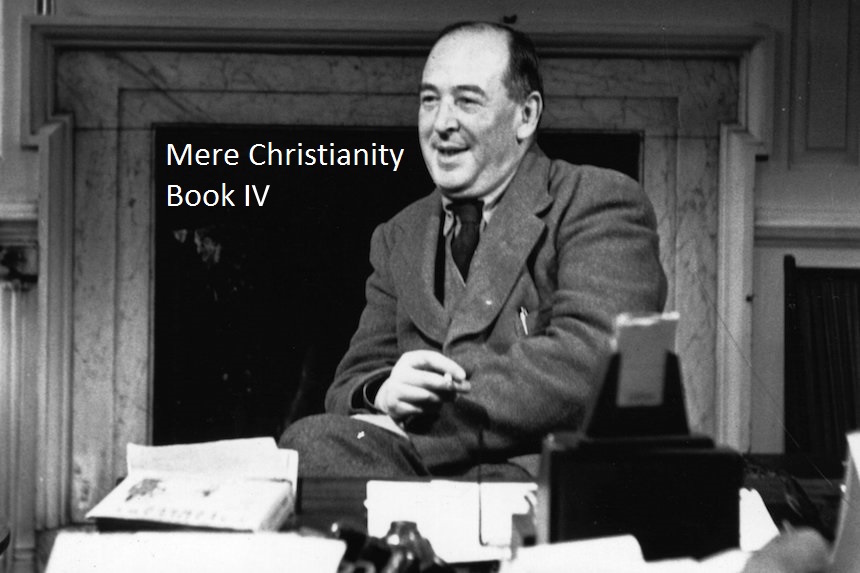
Mere Christianity – Book III (Summary)

Book-3

You can look at my more detailed notes, but this is an overview of the content of Book III of “Mere Christianity”…

Chapter 1 – “The Three Parts of Morality”

Morality isn’t about interference but our own good

“…moral rules are directions for running the human machine. Every moral rule is there to prevent a breakdown, or a strain, or a friction, in the running of that machine”
Morality isn’t about “ideals”

“It might lead you…to think you were rather a special person…you might just as well expect to be congratulated because, whenever you do a sum, you try to get it quite right… By talking about rules and obedience instead of “ideals” and ‘idealism’ we help to remind ourselves of these facts”

Fleet of Ships

“The voyage will be a success only… if the ships do not collide and get in one another’s way; and, secondly, if each ship is seaworthy and has her engines in good order… you cannot have either of these two things without the other. If the ships keep on having collisions they will not remain seaworthy very long. On the other hand, if their steering gears are out of order they will not be able to avoid collisions… [finally], its voyage would be a failure if it were meant to reach New York and actually arrived at Calcutta”

Musical Band

“…think of humanity as a band playing a tune. To get a good result…each player’s individual instrument must be in tune and also each must come in at the right moment so as to combine with all the others… the performance would not be a success if they had been engaged to provide dance music and actually played nothing but…Marches”

Exterior, Interior and Teleological Dimensions to Morality

“When people say in the newspapers that we are striving for Christian moral standards, they usually mean that we are striving for kindness and fair play between nations, and classes, and individuals; that is, they are thinking only of the first thing”

Why the second dimension is important

“…the results of bad morality in [the first] sphere are so obvious…war and poverty and graft and lies and shoddy work. And also, as long as you stick to the first thing, there is very little disagreement about morality… [However], unless we go on to the second thing – the tidying up inside each human being – we are only deceiving ourselves.

What is the good of telling the ships how to steer so as to avoid collisions if, in fact, they are such crazy old tubs that they cannot be steered at all? What is the good of drawing up, on paper, rules for social behaviour, if we know that, in fact, our greed, cowardice, ill temper, and self-conceit are going to prevent us from keeping them?”

…nothing but the courage and unselfishness of individuals is ever going to make any system work properly… It is easy enough to remove the particular kinds of…bullying that go on under the present system: but as long as men are twisters or bullies they will find some new way of carrying on the old game under the new system. You cannot make men good by law: and without good men you cannot have a good society. That is why we must go on to think of the second thing: of morality inside the individual”

Why the third dimension is important

“…religion involves a series of statements about facts, which must be either true or false. If they are true, one set of conclusions will follow about the right sailing of the human fleet: if they are false, quite a different set

…If somebody else made me, for his own purposes, then I shall have a lot of duties which I should not have if I simply belonged to myself…there are a good many things which would not be worth bothering about if I were going to live only seventy years, but which I had better bother about very seriously if I am going to live for ever”

The Consequences of Eternity

“Perhaps my bad temper or my jealousy are gradually getting worse – so gradually that the increase in seventy years will not be very noticeable. But it might be absolute hell in a million years: in fact, if Christianity is true, Hell is the precisely correct technical term for what it would be if Christianity is true, then the individual is not only more important but incomparably more important, for he is everlasting and the life of a state or a civilisation, compared with his, is only a moment”

Questions

1. How do many people view morality? How does Jack present it?
2. What is the problem with talking about morals as “ideals”?
3. What are the two metaphors Jack uses to explain the different components of morality?
5. What are these three parts of morality? Around which parts are there consensus?
6. What can we not just stop at inter-personal morality? Why does interior morality matter? What are the consequences for society?
7. Why does it matter if we live forever?

Chapter 2 – “The ‘Cardinal Virtues’”

“It comes from a Latin word meaning “the hinge of a door”…they are… ‘pivotal'”

Prudence

“Prudence means practical common sense, taking the trouble to think out what you are doing and what is likely to come of it… [Christ] wants us to be simple, single-minded, affectionate, and teachable, as good children are; but He also wants every bit of intelligence we have to be alert at its job, and in first-class fighting trim.”

Temperance

“Temperance referred not specially to drink, but to all pleasures; and it meant not abstaining, but going the right length and no further… [However], the moment he starts saying [marriage, or meat, or beer, or the cinema] are bad in themselves, or looking down his nose at other people who do use them, he has taken the wrong turning… One great piece of mischief has been done by the modern restriction of the word Temperance to the question of drink. It helps people to forget that you can be just as intemperate about lots of other things”

Justice

“It is the old name for everything we should now call “fairness”; it includes honesty, give and take, truthfulness, keeping promises, and all that side of life”

Fortitude

“…the kind [of courage] that faces danger as well as the kind that “sticks it” under pain… you cannot practise any of the other virtues very long without bringing this one into play”

Act and Character

“Someone who is not a good tennis player may now and then make a good shot. What you mean by a good player is the man whose eye and muscles and nerves have been so trained by making innumerable good shots that they can now be relied on… Right actions done for the wrong reason do not help to build…”virtue,” and it is this quality or character that really matters… If people have not got at least the beginnings of those qualities inside them, no possible external conditions could make a “Heaven” for them…”

Questions

1. Why might some Christians not think that prudence is a virtue?
2. Why is it dangerous to restrict “temperance” to “drink” and “teetotalism”?
3. What is the difference between acts and character?

Read more

Swearing

I’ve recently been involved in a number of conversations about Christianity and swearing.

This week, a Catholic friend whom I very much respect suggested the possibility that it might be okay to “swear intentionally in the proper context”. I took some time to write a substantial reply on social media, so I thought I’d share it here as well, as I think it sums up my main thoughts on the subject…

Objections To Swearing

1. Biblical Baseline

The first objection I see to swearing is the clear motif from Scripture concerning Christian speech. To begin with, we are told that the words of our mouth are important:

Let the words of my mouth and the meditation of my heart be acceptable in your sight, O Lord, my rock and my redeemer.

Psalm 19:14
Read more

PWJ: S2E37 – Bonus – “David and Matt party in Montreat. Day 1”

Matt and I are in Montreat for the International C.S. Lewis Symposium. It’s the end of the first day and so we pull out the microphones and have a quick chat…

S2E37: “David and Matt party in Montreat. Day 1” (Download)

If you enjoy this episode, you can subscribe manually, or any place where good podcasts can be found (iTunesGoogle PlayPodbeanStitcherTuneIn and Overcast).

Read more

If you’re happy and you know it…

Something has been bugging me for some time now. The vast majority of Masses I’ve attended in the States have ended with applause. Back in England I encountered this fairly often among non-Catholic congregations, but quite rarely in Catholic parishes.

guitar

Here in San Diego I play the guitar in at a LifeTeen Mass and there is applause every week as we finish the final song. Now, there was a time when I wasn’t fussed about the clapping, but now it really rather bothers me… 

Read more

1 28 29 30 31 32 172