Hocus Pocus

This was an interesting little tidbit I heard the other day…

Have you ever wondered about the origin of “hocus pocus”, the phrase commonly uttered by magicians?

Well, the story I recently heard was that it came from a corruption of the words of the Latin Mass:

hoc (enim) est corpus meum”
“This is my body”

It sounded reasonable, but I went and did a little bit of digging…

The Oxford English Dictionary (OED) says that this explanation was the conjecture of John Tillotson, Archbishop of Canterbury. It can be found in his rather nasty sermon in 1694:

“In all probability those common juggling words of ‘hocus pocus’ are nothing else but a corruption of ‘hoc est corpus’, by way of ridiculous imitation of the priests of the Church of Rome in their trick of Transubstantiation.”

It’s possible that the Archbishop is right here, but it’s clear that he isn’t exactly the most impartial judge!

It has been suggested instead that the phrase is simply “faux Latin”, a collection of nonsense words conjured up out of thin air 😉 to aid the magician in his stagecraft.  I’ve found references to a performer of the 1620s who called himself “Hocus Pocus” and who used the following incantation in his act:

 “Hocus pocus, tontus talontus, vade celeriter jubeo.”

Unfortunately, there’s a lack of definitive evidence to confirm with any real certainty the origin of this phrase – there really are quite a wide range of possibilities. Still, speculation is fun 🙂

Mere Christianity – Book IV – Chapter 11 (“The New Men”)

Book-4

At last we come to the final chapter of “Mere Christianity” completing my notes for the book.

1. Christ came to transform

“…Christ’s work…is not mere improvement but Transformation. The nearest parallel to it in the world of nature is to be found in the remarkable transformations we can make in insects by applying certain rays to them. Some people think this is how Evolution worked”

(a) We are used to transformation through evolution

“…Everyone now knows about Evolution (though, of course, some educated people disbelieve it): everyone has been told that man has evolved from lower types of life. Consequently, people often wonder ‘What is the next step? When is the thing beyond man going to appear?'”

(b) People have constantly been incorrectly predicting the next step

“…I cannot help thinking that the Next Step will be really new; it will go off in a direction you could never have dreamed of. It would hardly be worth calling a New Step unless it did. I should expect not merely difference but a new kind of difference. I should expect not merely change but a new method of producing the change…. And finally, I should not be surprised if, when the thing happened, very few people noticed that it was happening”

(c) The Next Step is here

“Now, if you care to talk in these terms, the Christian view is precisely that the Next Step has already appeared. And it is really new. It is not a change from brainy men to brainier men: it is a change that goes off in a totally different direction – a change from being creatures of God to being sons of God. The first instance appeared in Palestine two thousand years ago”

This step has some differences in relation to the past…

“And in fact this New Step differs from all previous ones not only in coming from outside nature but in several other ways as well”

Read more

Favourite People: Fr. Robert Barron

In a previous post I spoke about one of my favourite people, Archbishop Fulton Sheen. I spoke about how I came to discover him, his sermons and writings, as well as try and describe something of the impact he had upon me.

I think it is appropriate therefore, that in this next entry, I’ve chosen to talk about someone whom I’ve often heard referred to by other people as “The Next Fulton Sheen”.

This person is Fr. Robert Barron.

If Sheen Had YouTube…

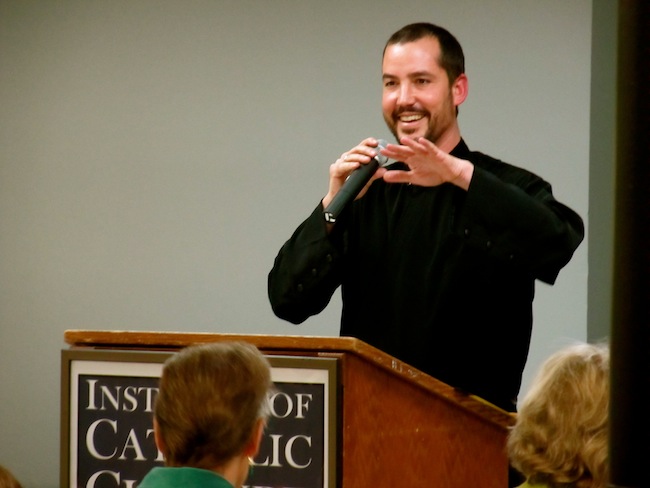
Fr. Robert is a priest who lives near Chicago in the United States. I first came across him on YouTube while I was still living in England.  He is a published author (I finished his book “The Eucharist” this week), but he has also embraced the new media and is using it to extend the reach of his ministry. It is in this sense that he is like Fulton Sheen – he’s a superb communicator and uses all means available to proclaim the faith, although in terms of style he and Archbishop Sheen are very different.

Read more

Roman Catholic All Day

Today I wanted to advertise Roman Catholic All Day, a Catholic clothing website which was recently started by two of my friends here in San Diego:

Not only do they have some great products, but 10% of the value of each order is donated to a Catholic organization. So, buying one of their t-shirts practically means you’re performing a spiritual or corporal work of mercy! 🙂

Their clothing line will be expanding soon through a Kickstarter Project. In the meantime, take a look at heir Facebook page and give them some feedback on their upcoming products.

Christmas is only a couple of months away now, so why not buy a t-shirt or two for the favourite Catholic in your life? Oh, and just in case you were wondering, my size is a “medium”… 😉

The Reformers and the Fathers

Several months ago I had a lively online exchange with a Protestant from the Reformed tradition. The conversation got really interesting and I had intended to write a series of posts based on our discussion. Alas, before I could do this, his blog was suddenly taken down, meaning that I was unable to use the record of our exchange to save me some work in constructing my posts (yes, I’m rather lazy).

To make sure the same thing doesn’t happen again, today I wanted to do a short post which is effectively a slightly expanded reproduction of my comments on an article over at Reformed Reader, in response to the blog author’s claims concerning Christian history and the Early Church Fathers.

john-calvin

Read more

Beginning Ignatius’ letter to the Smyrnaeans

The final two letters of St. Ignatius which we read are both sent to the city of Smyrna.  The first letter is sent to the Church as a whole, the second specifically to their bishop, Polycarp.

This first letter is special for many reasons, but particularly because it contains Ignatius’ clearest declaration of faith about the Eucharist, as well as being the earliest recorded use of the phrase “Catholic Church”. Invented at Nicea?  I don’t think so.

Here is my abridged version of the letter:

“St. Ignatius of Antioch’s letter to the Smyrnaeans” PDF
“St. Ignatius of Antioch’s letter to the Smyrnaeans” Audio

1 27 28 29 30 31 137