"Coming Soon"
As the Labo(u)r Day weekend and my personal mini-retreat draws to a close I’ve just finished the book I’ve been chipping away at for the last few weeks: “Coming Soon” by Dr. Michael Barber:
"We are travellers…not yet in our native land" – St. Augustine
As the Labo(u)r Day weekend and my personal mini-retreat draws to a close I’ve just finished the book I’ve been chipping away at for the last few weeks: “Coming Soon” by Dr. Michael Barber:

This week we continue to discuss the Trinity and the terms used to describe each its members. We ask what it means to say that “God is love”. Finally, we dig deeper into understanding what it means to participate in the life of God.
Please send any objections, comments or questions, either via email through my website or tweet us @pintswithjack or message us via Instagram!
Episode 32: “Good Infection” (Download)
If you enjoy this episode, you can subscribe manually, or any place where good podcasts can be found (iTunes, Google Play, Podbean, Stitcher and TuneIn).
A little while ago I was commenting on a friend’s blog where we were discussing the practice of church attendance on Sundays. Given that a lot of Protestants comment on his blog, I posed the following question to all those commenting:
What actually is the Protestant motivation for going to church on Sunday?
Now, this might seem like a silly question, but I asked it due to a certain train of thought that I had noticed during my time in the Protestant world. It’s a train of thought that I feel leads to unavoidable, awkward conclusions…


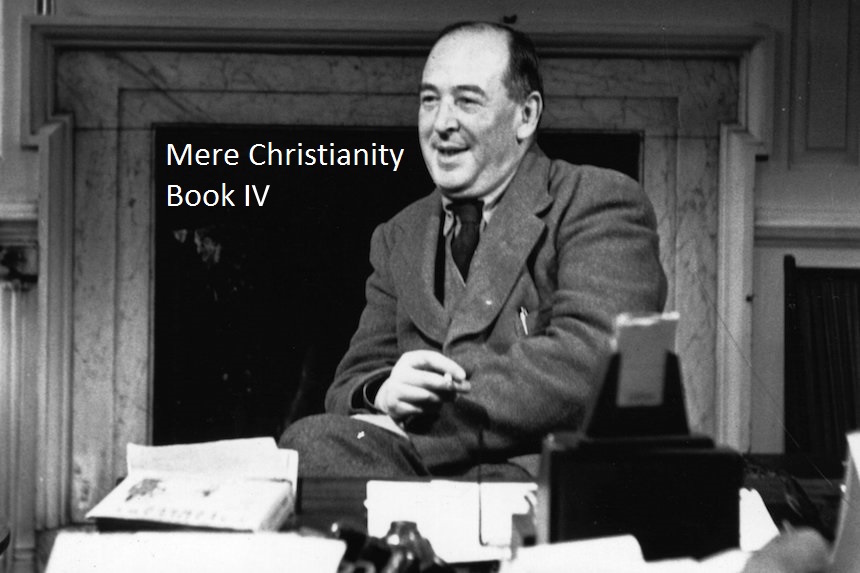
Continuing my notes for Book IV of C.S. Lewis’ “Mere Christianity”…
1. Begin with a thought experiment
(a) Imagine two books on top of one another
“I begin this chapter by asking you to get a certain picture clear in your minds. Imagine two books lying on a table one on top of the other… It is because of the underneath book that the top one is resting, say, two inches from the surface of the table instead of touching the table. Let us call the underneath book A and the top one B. The position of A is causing the position of B”
(b) and imagine that these two books have been like this forever
“…let us imagine that both books have been in that position for ever and ever. In that case B’s position would always have been resulting from A’s position. But all the same, A’s position would not have existed before B’s position. In other words the result does not come after the cause”
2. When we speak about the different persons of the Trinity, it can sound like some existed before others…
“…as soon as I begin trying to explain how these Persons are connected I have to use words which make it sound as if one of them was there before the others”
(a) It makes sense to speak of Father and Son since one “begets” the other
“The First Person is called the Father and the Second the Son. We say that the First begets or produces the second; we call it begetting, not making, because what He produces is of the same kind as Himself. In that way the word Father is the only word to use”
(b) However, this suggests that the father exists before the son
“But unfortunately it suggests that He is there first – just as a human father exists before his son. But that is not so. There is no before and after about it. And that is why I have spent some time trying to make clear how one thing can be the source, or cause, or origin, of another without being there before it. The Son exists because the Father exists: but there never was a time before the Father produced the Son”
(c) Compare the act of imagination and the mental picture which “results” from it
“I asked you just now to imagine those two books, and probably most of you did. That is, you made an act of imagination and as a result you had a mental picture. Quite obviously your act of imagining was the cause and the mental picture the result. But that does not mean that you first did the imagining and then got the picture. The moment you did it, the picture was there. Your will was keeping the picture before you all the time. Yet that act of will and the picture began at exactly the same moment and ended at the same moment. If there were a Being who had always existed and had always been imagining one thing, his act would always have been producing a mental picture; but the picture would be just as eternal as the act”
(d) It is similar with the Father and Son
“In the same way we must think of the Son always, so to speak, streaming forth from the Father, like light from a lamp, or heat from a fire, or thoughts from a mind. He is the self-expression of the Father – what the Father has to say. And there never was a time when He was not saying it.
(e) We must be careful with our images and stay close to the Scriptural language
“All these pictures of light or heat are making it sound as if the Father and Son were two things instead of two Persons. So that after all, the New Testament picture of a Father and a Son turns out to be much more accurate than anything we try to substitute for it. That is what always happens when you go away from the words of the Bible. It is quite right to go away from them for a moment in order to make some special point clear. But you must always go back. Naturally God knows how to describe Himself much better than we know how to describe Him. He knows that Father and Son is more like the relation between the First and Second Persons than anything else we can think of. Much the most important thing to know is that it is a relation of love. The Father delights in His Son; the Son looks up to His Father”

Screwtape wants to play matchmaker and choose what he regards as a suitable romantic partner for the patient.
S4E40: “Matchmaker” (Download)
If you enjoy this episode, you can subscribe manually, or any place where good podcasts can be found (iTunes, Google Play, Amazon, Podbean, Stitcher, TuneIn and Overcast), as well as on YouTube. The roadmap for Season 4 is available here.
More information about us can be found on our website, PintsWithJack.com. If you’d like to support us and get fantastic gifts, please join us on Patreon.
Read more
Okay, I know this title is an incredibly obvious pun (and far below my usual, high standards), but I thought I would make it now before anyone else did. 🙂
As most of my friends know, I’ve been wanting to study New Testament Greek for some time. However, this has been easier said than done. For a start, my geographical wanderings in recent years have made committing to a course of study difficult. Also, finding somewhere that teaches New Testament Greek is not such a simple task as one might imagine and finding one which is cost-effective only adds to the fun…
When I began my “Introduction to the New Testament” course about a month ago at the Pastoral Center I asked the instructor for suggestions as to how I could bring this desire to learn Biblical Greek to fruition. He suggested that I:
1. Contact Bethel Seminary
2. Learn using a self-study course
Up until now in the Best of British series, I have spoken exclusively about British comedy shows I associate with my childhood. I’d now like to introduce some of the shows which came along a little later.
Although I contend that British TV has fallen somewhat from the comedic heights of my childhood, there have most definitely been some real gems produced in recent years. Here are some of them…
“The Vicar of Dibley” came onto our TV screens at a particularly turbulent time for the Church of England. Two years prior to the first season, the Church of England had begun ordaining women and this was causing significant issues within the Anglican communion. In true British style, Richard Curtis sought out the comedy in this tense situation and crafted a sit-com about the life of one of these early female vicars in the sleepy village of Dibley. The lead character, Geraldine, was played by the well-known comediane, Dawn French. Although I would suggest that the final seasons were rather sub-par, on the whole, this was a lovely, gentle-natured comedy which took a light-hearted look at parish life from both sides of the pulpit.
I never felt that “My Family” really received the recognition that it deserved. As the title suggests, it’s about a family, the Harper Family. The Dad, Ben, is wonderfully grumpy and feels constantly harangued by his wife and harassed by his children, especially his idiotic son, Nick:
The show lost a lot when Nick’s character left, but I still think those earlier seasons were superb.
There is a saying in Show Business that one should never work with children or animals. The show “Outnumbered” breaks both of these rules since it stars three children who, at times, act like real animals. There is no great story line to the show, it’s simply about the lives of two parents and their three “spirited” children. The kids in this show are a-maz-ing, especially Ramona Marquez who plays little Karen.
Rather than “scripting” the children, the writers of the show give the children broad instructions and then simply turn on the cameras. The result is truly wonderful and if you pay close attention to the grown-ups in the show you can quite often see that they’re having to work very hard to suppress their laughter.
In the clip below the kids are at a wedding, under the patient care of the local vicar…