Mere Christianity – Book IV – Chapter 1 (“Making and begetting”)

Book-4

We now begin the final part of C.S. Lewis’ “Mere Christianity”, Book IV (“Beyond Personality”). My notes for the rest of the book are also available.

1. Many people think that people don’t want “theology”, just “plain practical religion”

“I do not think the ordinary reader is such a fool. Theology means ‘the science of God,’ and I think any man who wants to think about God at all would like to have the clearest and most accurate ideas about Him which are available. You are not children: why should you be treated like children?”

2. Some people are, indeed, put off by Theology

“[I have been told:] I’ve no use for all that stuff. But, mind you, I’m a religious man too. I know there’s a God. I’ve felt Him: out alone in the desert at night: the tremendous mystery. And that’s just why I don’t believe all your neat little dogmas and formulas about Him. To anyone who’s met the real thing they all seem so petty and pedantic and unreal!”

3. Consider the difference between experiencing the Atlantic from the beach and looking at a map of the Atlantic

“…if a man has once looked at the Atlantic from the beach, and then goes and looks at a map of the Atlantic, he also will be turning from something real to something less real: turning from real waves to a bit of coloured paper”

The Map is superior in the sense that…

(i) It is based on the experience of many more people

“…it is based on what hundreds and thousands of people have found out by sailing the real Atlantic… masses of experience just as real as the one you could have from the beach; only, while yours would be a single isolated glimpse, the map fits all those different experiences together”

(ii) The map is more useful if you want to travel

“…if you want to go anywhere, the map is absolutely necessary. As long as you are content with walks on the beach, your own glimpses are far more fun than looking at a map. But the map is going to be more use than walks on the beach if you want to get to America”

4. Theology is like the map

“Merely learning and thinking about the Christian doctrine, if you stop there, is less real and less exciting than [direct spiritual experiences]”

However, it is very similar to the comparison between the Atlantic and the map of the Atlantic…

(i) It is based on more than just your own experience

“Doctrines are not God: they are only a kind of map. But that map is based on the experience of hundreds of people who really were in touch with God – experiences compared with which any thrills or pious feelings you and I are likely to get on our own are very elementary and very confused”

(ii) It helps to direct your experience

“In fact, that is just why a vague religion-all about feeling God in nature, and so on-is so attractive. It is all thrills and no work; like watching the waves from the beach. But you will not get to Newfoundland by studying the Atlantic that way, and you will not get eternal life by simply feeling the presence of God in flowers or music. Neither will you get anywhere by looking at maps without going to sea. Nor will you be very safe if you go to sea without a map”

5. You cannot avoid having ideas about God. The question is just whether or not they are good ideas.

“Everyone reads, everyone hears things discussed. Consequently, if you do not listen to Theology, that will not mean that you have no ideas about God. It will mean that you have a lot of wrong ones-bad, muddled, out-of-date ideas. For a great many of the ideas about God which are trotted out as novelties today, are simply the ones which real Theologians tried centuries ago and rejected. To believe in the popular religion of modern England is retrogression-like believing the earth is fiat”

6. Popular culture tries to reduce Christianity to Jesus’ moral teachings. It then tells us that, if we adopted His teaching, the world would be a better place.

“…the popular idea of Christianity simply this: that Jesus Christ was a great moral teacher and that if only we took his advice we might be able to establish a better social order and avoid another war?”

(i) This is true, but we don’t even need to go as far as Christ’s teaching in order to make the world a better place

“It is quite true that if we took Christ’s advice we should soon be living in a happier world. You need not even go as far as Christ. If we did all that Plato or Aristotle or Confucius told us, we should get on a great deal better than we do”

(ii) We didn’t follow other moral teachers, why would we follow someone who makes even greater demands upon us than they did?

“And so what? We never have followed the advice of the great teachers. Why are we likely to begin now? Why are we more likely to follow Christ than any of the others? Because he is the best moral teacher? But that makes it even less likely that we shall follow him. If we cannot take the elementary lessons, is it likely we are going to take the most advanced one? If Christianity only means one more bit of good advice, then Christianity is of no importance. There has been no lack of good advice for the last four thousand years. A bit more makes no difference”

7. Christian writings don’t just speak about moral living, but of man becoming “sons of God”

“But as soon as you look at any real Christian writings, you find that they are talking about something quite different from this popular religion. They say that Christ is the Son of God (whatever that means). They say that those who give Him their confidence can also become Sons of God (whatever that means). They say that His death saved us from our sins (whatever that means)”

8. Don’t complain that Christianity is difficult

“There is no good complaining that these statements are difficult. Christianity claims to be telling us about another world, about something behind the world we can touch and hear and see. You may think the claim false; but if it were true, what it tells us would be bound to be difficult-at least as difficult as modern Physics, and for the same reason”

9. We are “Sons of God” already in a sense, but not in the sense that the Bible uses.

“One asks “Aren’t we Sons of God already? Surely the fatherhood of God is one of the main Christian ideas?” Well, in a certain sense, no doubt we are sons of God already. I mean, God has brought us into existence and loves us and looks after us, and in that way is like a father. But when the Bible talks of our “becoming” Sons of God, obviously it must mean something different”

10. When we speak of the Son being “begotten”, we are not talking about the incarnation

“One of the creeds says that Christ is the Son of God “begotten, not created”; and it adds “begotten by his Father before all worlds.” Will you please get it quite clear that this has nothing to do with the fact that when Christ was born on earth as a man, that man was the son of a virgin? We are not now thinking about the Virgin Birth. We are thinking about something that happened before Nature was created at all, before time began. “Before all worlds” Christ is begotten, not created”

(i) To beget means to have something of the same kind

“To beget is to become the father of: to create is to make. And the difference is this. When you beget, you beget something of the same kind as yourself. A man begets human babies, a beaver begets little beavers and a bird begets eggs which turn into little birds”

(ii) To make is to make something of a different kind

“But when you make, you make something of a different kind from yourself. A bird makes a nest, a beaver builds a dam, a man makes a wireless set-or he may make something more like himself than a wireless set: say, a statue. If he is a clever enough carver he may make a statue which is very like a man indeed. But, of course, it is not a real man; it only looks like one. It cannot breathe or think. It is not alive”

(iii) There is a difference between making and begetting

“What God begets is God; just as what man begets is man. What God creates is not God; just as what man makes is not man. That is why men are not Sons of God in the sense that Christ is. They may be like God in certain ways, but they are not things of the same kind. They are more like statues or pictures of God”

(iv) There are varying degrees of similarity to God in Creation

“Everything God has made has some likeness to Himself. Space is like Him in its hugeness: not that the greatness of space is the same kind of greatness as God’s, but it is a sort of symbol of it, or a translation of it into non-spiritual terms. Matter is like God in having energy: though, again, of course, physical energy is a different kind of thing from the power of God. The vegetable world is like Him because it is alive, and He is the “living God.” But life, in this biological sense, is not the same as the life there is in God: it is only a kind of symbol or shadow of it. When we come on to the animals, we find other kinds of resemblance in addition to biological life. The intense activity and fertility of the insects, for example, is a first dim resemblance to the unceasing activity and the creativeness of God. In the higher mammals we get the beginnings of instinctive affection. That is not the same thing as the love that exists in God: but it is like it-rather in the way that a picture drawn on a flat piece of paper can nevertheless be “like” a landscape. When we come to man, the highest of the animals, we get the completest resemblance to God which we know of. (There may be creatures in other worlds who are more like God than man is, but we do not know about them.) Man not only lives, but loves and reasons: biological life reaches its highest known level in him”

11. Naturally we don’t have the divine life

(i) Bios and Zoe

But what man, in his natural condition, has not got, is Spiritual life-the higher and different sort of life that exists in God. We use the same word life for both: but if you thought that both must therefore be the same sort of thing, that would be like thinking that the “greatness” of space and the “greatness” of God were the same sort of greatness. In reality, the difference between Biological life and spiritual life is so important that I am going to give them two distinct names. The Biological sort which comes to us through Nature, and which (like everything else in Nature) is always tending to run down and decay so that it can only be kept up by incessant subsidies from Nature in the form of air, water, food, etc., is Bios. The Spiritual life which is in God from all eternity, and which made the whole natural universe, is Zoe. Bios has, to be sure, a certain shadowy or symbolic resemblance to Zoe: but only the sort of resemblance there is between a photo and a place, or a statue and a man. A man who changed from having Bios to having Zoe would have gone through as big a change as a statue which changed from being a carved stone to being a real man.

(ii) But this is what Christianity promises

“And that is precisely what Christianity is about. This world is a great sculptor’s shop. We are the statues and there is a rumour going round the shop that some of us are some day going to come to life”

Questions

1. Why do you think many people told Jack not to talk about “theology”?

2. Why does Jack think that theology is a good and useful thing?

3. What does it mean to become a son of God?

4. What does it mean to be “begotten” as opposed to being “made”?

5. What are the two kinds of life which Jack identifies?

C.S. Lewis Doodle


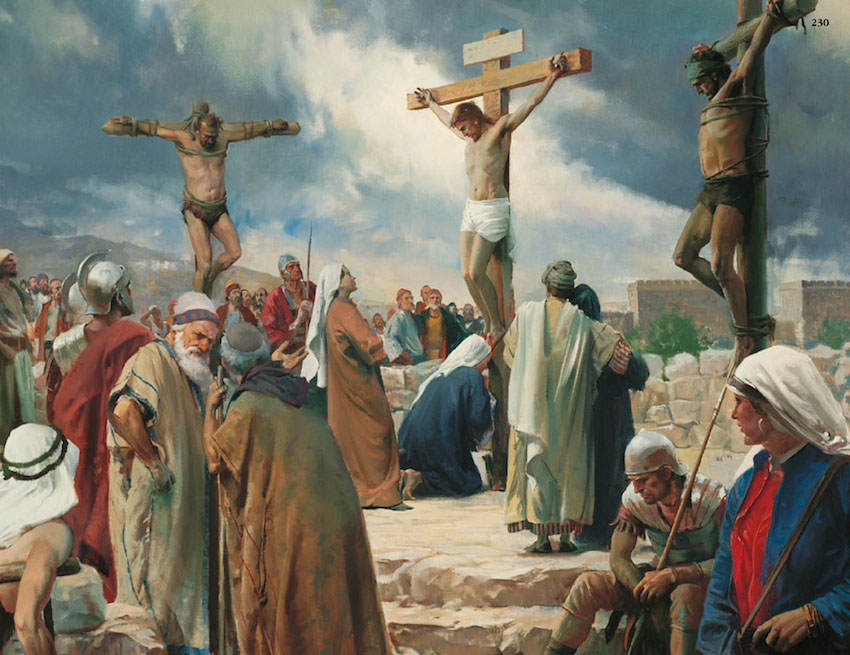
What’s the earliest depiction of the crucifixion?

The earliest depiction of Jesus’ crucifixion doesn’t, in fact, come from a Christian source. It is known as Alexamenos Graffito and, as the name suggests, it’s a piece of graffiti. It was found near Rome’s Palatine Hill and is dated sometime between 1st and 3rd Century:

AlexGraffito

The text underneath the picture says in Greek “Alexamenos worships [his] God”. The picture itself shows Jesus on a cross with a donkey’s head, with another person on the left (presumably “Alexamenos”) raising his hand in worship. It’s clear that this was written by someone who knew Alexamenos and wanted to mock him and his Christian faith.

Read more

Sunday Lectionary: Saving Shepherd

Producing these Lectionary Notes has been taking too long again. Therefore I’m giving myself a time limit of a few hours. Let’s do this…

Fourth Sunday of Easter: April 29th, 2012

The Readings at Mass this week focus around the person of Jesus Christ and his unique, fundamental place in Salvation History. In our First Reading, St. Peter boldly proclaims that There is no salvation through anyone else”. In our Psalm we sing the words quoted by Peter in that speech to the Sanhedrin, declaring that Jesus is “the stone rejected by the builders [which] has become the cornerstone”. In the Gospel Reading, Jesus declares that He is “the good shepherd”  who “lays down his life for the sheep” and, as we hear in our Second Reading, because of this we may truly be called “the children of God”.

At this Sunday’s Mass, confident in the goodness of our Shepherd, let us firmly put our trust in Him.

The LORD is my shepherd, I lack nothing.
He makes me lie down in green pastures, he leads me beside quiet waters, he refreshes my soul.
He guides me along the right paths for his name’s sake.
Even though I walk through the darkest valley, I will fear no evil, for you are with me; your rod and your staff, they comfort me.

You prepare a table before me in the presence of my enemies.
You anoint my head with oil; my cup overflows.
Surely your goodness and love will follow me all the days of my life,
and I will dwell in the house of the LORD forever – Psalm 23

Read more

PWJ: S2E3 – TGD 2 – “The bus ride in the clouds”

When we last left Lewis, he had got on a bus in a grey town and was now flying through the sky towards an unknown destination. In today’s episode we learn more about the passengers on the bus.

S2E3: “The bus ride in the clouds” (Download)

If you enjoy this episode, you can subscribe manually, or any place where good podcasts can be found (iTunesGoogle PlayPodbeanStitcherTuneIn and Overcast).

Read more

The Epistle of Joy – Episode #18 (Video)

Nearing the end of Chapter 4 of Philippians:

Yet it was kind of you to share my trouble. And you Philippians yourselves know that in the beginning of the gospel, when I left Macedonia, no church entered into partnership with me in giving and receiving except you only; for even in Thessalonica you sent me help once and again. Not that I seek the gift; but I seek the fruit which increases to your credit. I have received full payment, and more; I am filled, having received from Epaphroditus the gifts you sent, a fragrant offering, a sacrifice acceptable and pleasing to God. And my God will supply every need of yours according to his riches in glory in Christ Jesus. To our God and Father be glory for ever and ever. Amen. – Philippians 4:4-20

Here is my commentary:

For an audio-only version of this video, please click here.

Previous Episode | Next Episode

The Epistle of Joy – Episode #14 (Video)

Today we finish Chapter 3:

Brethren, join in imitating me, and mark those who so live as you have an example in us. For many, of whom I have often told you and now tell you even with tears, live as enemies of the cross of Christ. Their end is destruction, their god is the belly, and they glory in their shame, with minds set on earthly things. But our commonwealth is in heaven, and from it we await a Savior, the Lord Jesus Christ, who will change our lowly body to be like his glorious body, by the power which enables him even to subject all things to himself. – Philippians 3:17-21

Here’s my reflection:

For an audio-only version, please click here.

Previous Episode | Next Episode

Lectionary Notes: Feeding The Hungry

Things have been a bit non-stop this last week, so I’m afraid these notes are late, slightly shorter than usual and a little bit rushed, but as GK Chesterton said, “If something is worth doing, it’s worth doing badly”…

18th Sunday in Ordinary Time: 31st July, 2011

Reading 1: Isaiah 55:1-3

After Jeremiah, Isaiah is my favourite prophet. This book is often called “The Fifth Gospel” and, with a passage like this, it’s easy to see why. Here, God gives a beautiful invitation to His people to come and be satisfied, to return to Him, to come and be filled free of charge! Why settle for anything less?

When we recognize our hunger and our dependence on God, He will fill us and give us life.

Thus says the LORD:

“All you who are thirsty, come to the water!
You who have no money, come, receive grain and eat;
Come, without paying and without cost, drink wine and milk!

Why spend your money for what is not bread; your wages for what fails to satisfy?
Heed me, and you shall eat well, you shall delight in rich fare.
Come to me heedfully, listen, that you may have life.
I will renew with you the everlasting covenant, the benefits assured to David”

Suggested Questions:

  • What is the general invitation of this passage?
  • What does this food and drink cost? What does this say about God?
  • What do you think the “water” here represents?
  • What do you think the “grain” here represents?
  • What do you think the “wine” here represents?
  • What do you think the “milk” here represents?
  • In what way do we “spend [our] money on what is not bread”?
  • Why do we do spend our “wages for what fails to satisfy”?
  • What is promised together with this food?
  • What was the promise God made to David?
  • How do we experience the invitation of this passage today?

Read more

1 16 17 18 19 20 172