What does it mean “to pray to a Saint”?

This blog post is meant as a supplement to my earlier earlier posts on the subject of Saintly intercession (read here and here)…

all_saints

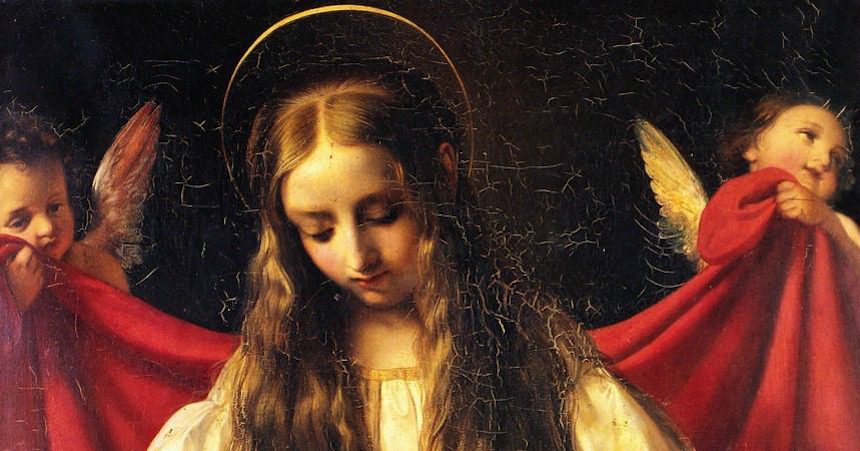
One issue we have in Catholic-Protestant dialogue concerning the Saints is the language we use. You will often hear Catholics talking about “praying to Saints”. However, it is important to point out that what we really mean is that we’re asking the Saints to pray for us.

What’s in a name?

Part of the problem is the use of the verb “to pray”. It can mean two different things, depending on context. The word itself comes into English from the Latin word “precari”, which means “obtained by entreaty”. To pray, therefore, means to ask for something.

This is aptly demonstrated in my favorite Shakespeare play, A Much Ado About Nothing (Act 2, Scene 3):

BENEDICKAn he had been a dog that should have howled thus, they would have hanged him: and I pray God his bad voice bode no mischief…

DON PEDRO: Yea, marry, dost thou hear, Balthasar? I pray thee, get us some excellent music…

Here you see both uses of the word “pray”. In the first, Benedick petitions God, and in the second, Don Pedro asks Balthasar for music. In the former, a request is made to God, in the latter, to man.

A better dialogue

While I think that pointing out this distinction goes a long way to further Catholic-Protestant dialogue, I think that Catholics should go the extra mile and be careful with the way they speak around Protestants, so as to communicate the Catholic Faith as clearly as possible.

When talking with Protestants about praying to Saints, it might be worth spelling out exactly what you mean, saying explicitly that you’re asking the Saints for their intercession before the throne of God. Rather than talking about “Praying to the Saints”, you might speak about “Praying with the Saints”. Most Protestants are used to talking about praying with friends, so when expressed in these terms, the Catholic devotion will seem less alien and more accessible.

All you angels and saints, pray for us.

Things that make me happy

The other day I was thinking about things which make me happy. It’s actually quite a difficult exercise – if you don’t believe me, give it a go. What are the things which make you really, truly happy? Where are the places you can always find joy?

After sitting down and writing the list I’ve concluded that I’m actually quite easy to please. Although in many ways I’m extremely demanding of myself and others, it doesn’t actually take a whole lot to make me happy:

Read more

Quick Apology: Chained Bibles

In today’s Quick Apology post I wanted to turn to the subject of history…

Objection

When speaking about the Catholic approach to Scripture, some Protestants will make the following accusation:

“The Catholic Church used to chain up Bibles!”

Response

The statement is absolutely true; it was not uncommon prior to the Reformation for Bibles to be chained up. When I am told this in a discussion I concede the point, but I then ask the person speaking if they know why this was done…

It is not uncommon to receive as a response, “They chained them up to stop people reading the Bible!”. While the initial statement was true, this explanation as to why Bibles were chained is completely incorrect. In fact, Bibles were chained for completely the opposite reason. Bibles were chained up so that more people had access to the Scriptures!*

You see, prior to the Fifteen Century and the invention of the movable type printing press, Bibles were hand-written. This was an colossal undertaking and therefore extremely costly. This meant that Bibles were expensive items liable to be stolen by thieves. Therefore, in an attempt to provide people with access to the Scriptures, it was common for a Bible to be made available in or around a church building, but to prevent theft, it was chained to a heavy object. If you had a Bible worth tens of thousands of dollars, would you want to leave it unsecured and unattended in a public building?!

If you visit a post office or a bank, you will often see pens chained to immovable services. Do these institutions chain these pens because they don’t want you to use them? Of course not! They want you to use the pens, but they want to make sure nobody steals them! Why? Because if they are stolen then other people won’t have the opportunity to use the pens. It is the same logic at work concerning the chaining of Bibles.

Chained Bible

* It is probably worth pointing out that literacy rates were also extremely low even until the 19th Century. It is for this reason that the most common way of learning the Bible throughout Christian history has been the hearing the Scriptures proclaimed at the Eucharistic liturgy.

Story Time!

While I was in Washington DC for the March For Life last year, I was invited to a party. Honestly, this English accent of mine gets me in everywhere… 🙂

Anyway, each guest was asked to come prepared with a relatively unknown Saint story to share with the everyone else. Clearly this party was organized by my kind of Catholic nerd! Naturally, I told the story of this blog’s patron, St. Drogo.

However, I also came prepared with another story, not about a Saint, but about a Saint’s brother. Since it was recently the ordination anniversary of my former Pastor, Fr. Robert, I thought it would be appropriate to share that story today.

Jerome

Many of you might have heard of St Jerome. He was a great biblical scholar of the Early Church and he was the one who produced the Vulgate, the official translation into Latin of the original Biblical texts. This story is about Jerome’s younger brother Paulinian, sometimes known as Paulinanus.

Read more

Way of the Warrior

I’ve been working my way through my Blog’s “Drafts” folder in an effort to try and finish some of the many half-completed entries I have there. At the time of writing I still have 226 left… :-/

In looking through these drafts I came upon two entries, both concerning movies for which I was fortunate enough to see advanced screenings. The first movie was Warrior and the second was The Way. I’ll write about at The Way later this week, but today I’d like to look at Warrior.

The Warriors

The story of Warrior concerns Paddy and his two sons. The film begins with Paddy leaving church after Mass. We soon find out that Paddy used to be a horrible husband and father as well as an abusive drunk, but now, many years later, has found God and is 1,000 days sober.

“A friend loves at all times, and a brother is born for a time of adversity.” –  Proverbs 17:17

Paddy’s two sons, Brendan and Tommy are both talented athletes who are soon set on a collision course towards the same Mixed Martial Arts (MMA) tournament.

Read more

Reading the Bible in a Year

After doing so badly on my New Year Resolutions this year, I’ve decided to keep it simple next year. That doesn’t mean that it’s going to be easy though! I’ve decided that in 2014 I am going to read the entirety of the Bible, both Old and New Testaments.

I’ve spent the last hour or so looking at different reading plans online. Many that I’ve found have been Protestant and have unfortunately therefore lacked the Deuterocanon.  If I were to use any of those I would have to squeeze in the extra books (Tobit, Wisdom, Maccabees, etc.) at some point in the year. Moving on…

Some reading plans, such as YouVersion, don’t actually cover the entire Bible and instead just cover the majority of the text. While practical, that also seems a bit “meh”. Moving on…

I also found one plan which has quite a mix of daily readings. Each day there there are two Old Testament readings, a Psalm and a New Testament reading. That is contrasted with the plans from Presentation Ministry and Catholic Doors, both of which assign one book at a time.

As far as I can tell, the most popular plan is one which is put out by the Coming Home Network, which is available in PDF here and which some nice person converted into hypertext format here. It has an Old Testament reading, New Testament reading and then something from the Wisdom literature, such as Psalms or Proverbs. I think this is the plan for me. It even has the option of reading through the Catechism too…but maybe I’ll think about that for 2015!

If anyone else has the same goal for 2014, please leave a message below 🙂

JeromeSt. Jerome, pray for me!

 UPDATE 05/20/14: Meg Hunter-Kilmer has added an article on this subject and presents an alternative reading plan.

1 129 130 131 132 133 137