Thanks for the memories (Part 1 of 2)

The other day a friend asked me how, in my experience, non-Catholic Christians memorize Sacred Scripture. This is a very reasonable question. It is common to hear Catholics say how impressed (and intimidated) they are when their Protestant work colleges or classmates quote Scripture at them chapter and verse.

Answer

I responded initially with the suitably vague answer saying that, in my experience, it varies from denomination to denomination and from congregation to congregation. There are certainly some groups which emphasize Scripture memorization more than others.

“Memory! All alone in the moonlight…”

Personally, I’ve never been very good at Scripture memorization, at least as an activity in its own right. When I quote Scripture, it’s usually a rough paraphrase and it’s pretty rare that I can give the chapter, let alone the verse.

Read more

Catholic Bucket List #2: Try a Tridentine Mass

Continuing my Catholic Bucket List series from the other day, this week’s suggestion is:

Bucket List Item #2: Attend a Tridentine Mass

A little background

So what’s a “Tridentine Mass”?

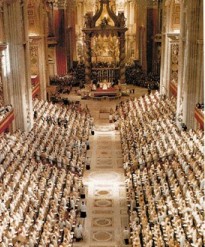
Well, when Joe Catholic attends a Mass today, he typically attends a “Novus Ordo” (“New Order”) Mass. This formulation of the liturgy was brought about in the Seventies through Pope Paul VI after the Second Vatican Council.

Read more

Giving Thanks

For those of you not living in the United States, today is Thanksgiving.

A few days ago, after making a snide remark about the upcoming national holiday, a friend suggested to me that, given that I have a lot to be thankful for, I really shouldn’t be so curmudgeonly about Thanksgiving. My friend was quite right. After all, if the central focus of Catholic worship is “Eucharist” (literally “Thanksgiving”), then perhaps I should be a bit more enthusiastic about a yearly national holiday in which people call to mind all things for which they are thankful….not forgetting, of course, that Squanto was Catholic! Mea culpa.

Pray, tell me

So, since today focuses on “thanksgiving”, I’d like to take this opportunity to find out your thoughts about “giving thanks” for your food when out in public

Do you pray before you begin a meal at a restaurant? If so, do you pray out loud or in silence? Catholics usually begin and end their prayers with a sign of the cross – do you omit that when you’re in public or just do a very small, quick one? What about if you’re with other people, some of whom aren’t Catholic or Christian?

Religious Oppression

Our new Bishop, Bishop Flores, when speaking to all the Young Adults at the “Mega Mass”, spoke about a time when he went to dinner with a group of young adults and was rather surprised when they just began eating their food without saying grace. When he queried this, one of his dinner companions said that they didn’t do it because they didn’t want to “impose their religion” upon other people in the restaurant!

Table Manners

Growing up, we generally said grace before meals when we sat down together as a family. I grew a bit slack during my teenage years, but in my twenties I started to pray much more regularly before eating, one of the good habits which arose from dating a wonderful and extremely faith-filled lady.

However, I still didn’t generally say grace when I was out at restaurants or when I was with non-Christians. I just felt too awkward. This all changed when I once saw a small group in a restaurant saying grace. I found something extremely touching about them bowing their heads in prayer, thanking God with gratitude for their meal, unashamed of any odd looks this might draw. So, inspired by their example, I now just get over myself and pray regardless, throwing in a nice large sign of the cross at the beginning and end to boot 🙂

So what’s your opinion? Do you have any particular blessings you pray before eating? Leave your comments below!

Bible alone? Part 2

Yesterday I began speaking about the doctrine of Sola Scriptura. A lot could be written concerning the problems with this Formal Principle of the Reformation, but I will leave that to better minds. Instead, over the next two days I would just like to focus on the two main problems which drove me to consider more deeply the validity of the doctrine. After being involved in the Protestant world for a few years, two problems nagged at me:

Problem #1: Correct interpretation

This first problem was one that I saw first-hand. In my various non-Catholic wanderings, I had encountered some great pastors: faithful, holy and insightful. I was greatly encouraged by their witness and learned a great deal from them.

However, I began to notice that, even within the same parish, there was quite often a considerable diversity in theological opinions. Within the home groups there was also considerable latitude in belief and when a dispute arose, there wasn’t a clear path towards finding a resolution other than asking one of the church staff, and even then you couldn’t guarantee that you’d get the same answer from two different staff members. There was also a mild form of dissension in that the Pastor’s Sermon was often critiqued after the service and it would be discussed as to whether or not everyone agreed with it.

Denomination Diversity

These are only personal, anecdotal impressions, of course. However, when you consider different denominations, these interpretive disputes can be seen more clearly. Some denominations believe in infant baptism, others do not. Some denominations believe that baptism actually does something in the soul of the one being baptised, others affirm that it is just an outward symbol. Likewise, some denominations affirm some concept of Jesus’ real presence in the Eucharist, while others say that it is, again, just a symbol. Some denominations have female pastors, others say that’s invalid. Some affirm the Trinity, others deny it. This lack of doctrinal unity in the Protestant world concerned me greatly.

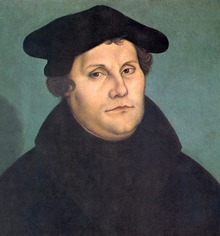
Right at the dawn of the Reformation you had Luther and Zwingli, two early leaders of the Reformation, disagreeing over the correct interpretation of “This is my body” – Luke 22:19. Each presented his own private, fallible interpretation of that passage, but with no Church Authority to resolve the dispute, there was no possible way to resolve the deadlock.

Read more

Sunday Lectionary: Arise and shine!

4th Sunday of Lent, 18th March 2012

In our First Reading last week we read about the giving of the Ten Commandments and this week we continue our Lenten tour through the high points of Old Testament Salvation History.

Our First Reading begins on a rather somber note. The Kingdom of Judah had abandoned God’s Law and, as a result, the Jerusalem Temple was destroyed and the people led into captivity. All of God’s promises to King David seemed to be lost! We hear the people’s song of lament in today’s Psalm.

However, because of God’s mercy and through His divine providence, the pagan King Cyrus decides to grant the Jews their freedom, releasing them from bondage.

In the light of the New Testament, we know that God’s promises to King David were not forgotten, but that they all found their fulfillment in Jesus of Nazareth, both Son of David and Son of God! The freedom granted to God’s people by King Cyrus was simply a foreshadowing of Jesus’ work of salvation. It is through the King of Kings that we are released from the bondage of death and brought to new life.

In our Second Reading, St. Paul tells use that because of the great love he had for us, even when we were dead in our transgressions, [He] brought us to life with Christ”.  These words of St. Paul are themselves only an echo of the Master’s teaching. In this week’s Gospel Reading, during His discourse with Nicodemus, Jesus reveals the heart of the Father: For God so loved the world that he gave his only Son, so that everyone who believes in him might not perish but might have eternal life.

Full of confidence, therefore, in God’s mercy and love, let us approach this week’s Eucharistic liturgy with the joy of those who have been granted new life 🙂

Read more

1 128 129 130 131 132 172