Brethren, join in imitating me, and mark those who so live as you have an example in us. For many, of whom I have often told you and now tell you even with tears, live as enemies of the cross of Christ. Their end is destruction, their god is the belly, and they glory in their shame, with minds set on earthly things. But our commonwealth is in heaven, and from it we await a Savior, the Lord Jesus Christ, who will change our lowly body to be like his glorious body, by the power which enables him even to subject all things to himself. – Philippians 3:17-21
Twenty-first Sunday in Ordinary Time: August 26th, 2012
The Readings this Sunday ask a basic question: whom do you choose?
In the First Reading, Joshua asks this question of Israel. Whom will they serve? Yahweh or some other god? In the Gospel Reading, after hearing the “hard teaching” of the Lord about His Body and Blood, Jesus asks the Twelve if they wish to leave along with some of the other disciples. Peter answers the question in the same way I hope we would all answer: “Lord, to whom shall we go? You have the words of eternal life”.
We have a fundamental choice in life. Do we choose God, or do we choose something or someone else? As we hear God’s Word this week and gather around the altar to “taste and see that the Lord is good”, let us renew our commitment to the Lord and say with Peter “We have come to believe and are convinced that you are the Holy One of God”.
You know, there’s a reason why this blog’s theme tune is a song written by Audrey Assad…
The original lyrics for this song were written by Civilla Martin. The sparrow referred to in the song is a reference to Jesus’ teaching recorded in Matthew’s Gospel:
“Look at the birds of the air; they do not sow or reap or store away in barns, and yet your heavenly Father feeds them. Are you not much more valuable than they?…Are not two sparrows sold for a penny? Yet not one of them will fall to the ground outside your Father’s care. And even the very hairs of your head are all numbered. So don’t be afraid; you are worth more than many sparrows”- Matthew 6:26; 10:29-31
I came across a moving description by the author concerning the song’s inspiration:
“Early in the spring of 1905, my husband and I were sojourning in Elmira, New York. We contracted a deep friendship for a couple by the name of Mr. and Mrs. Doolittle—true saints of God. Mrs. Doolittle had been bedridden for nigh twenty years. Her husband was an incurable cripple who had to propel himself to and from his business in a wheel chair. Despite their afflictions, they lived happy Christian lives, bringing inspiration and comfort to all who knew them.
One day while we were visiting with the Doolittles, my husband commented on their bright hopefulness and asked them for the secret of it. Mrs. Doolittle’s reply was simple: “His eye is on the sparrow, and I know He watches me.”
The beauty of this simple expression of boundless faith gripped the hearts and fired the imagination of Dr. Martin and me. The hymn “His Eye Is on the Sparrow” was the outcome of that experience” – Civilla Martin
Maybe it’s just me, but I think there’s definitely a stigma attached to Country Music. There is the perception that the music is quite hokey and that every song is about how the singer has lost his woman, his pickup truck, his favourite horse and/or dog.
A while ago, a girl whom I was rather rather sweet on, unashamedly declared that she really liked Country Music. For this, of course, I mercilessly teased her. In fact, that reminds of a joke…
Q. What happens when you play a country song backwards? A. The guy gets his wife back, his truck back, stops drinking, and his dog comes back to life.
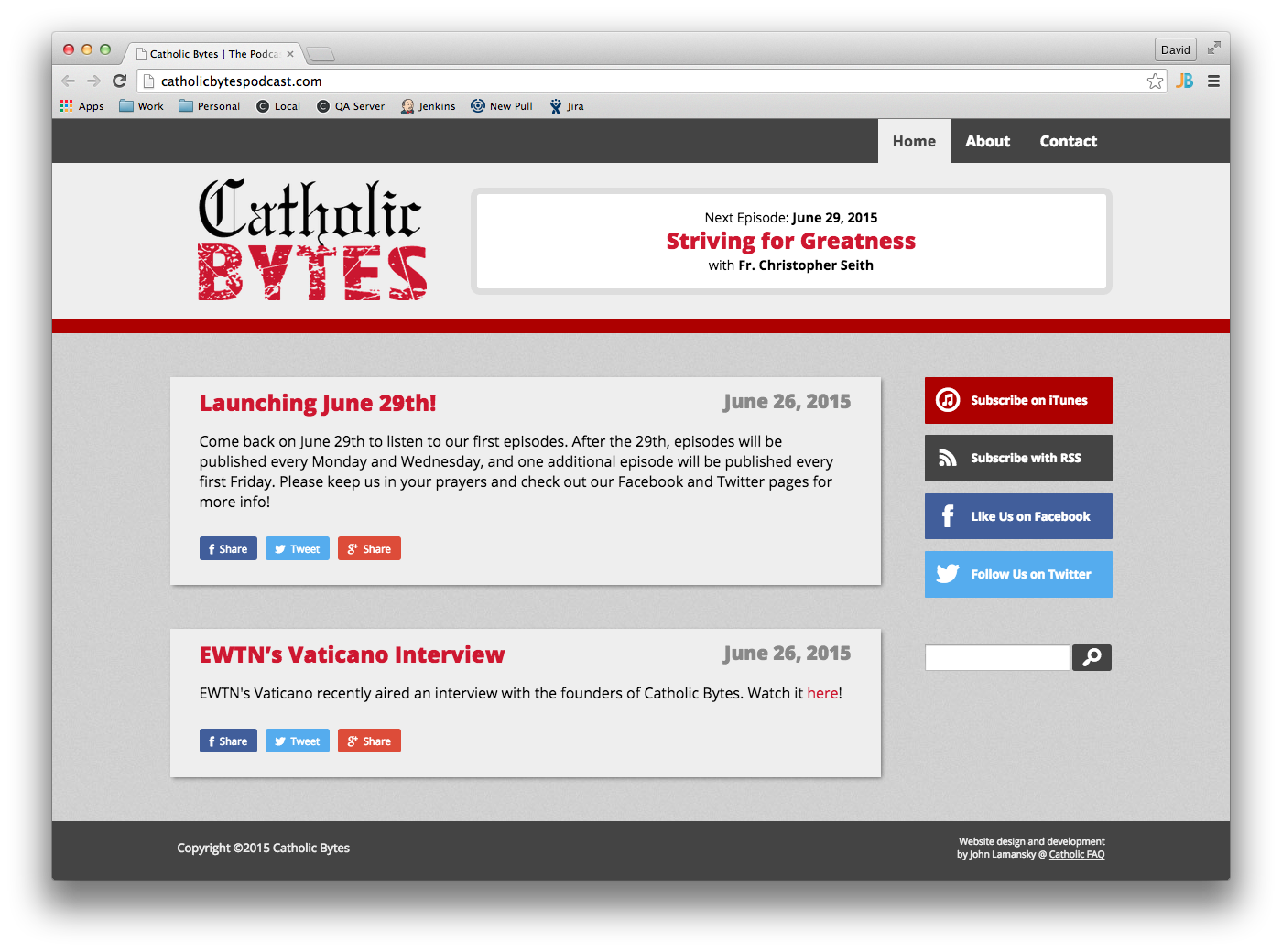
My friend Joe is studying at the North American College in Rome, where he’s surrounded by brilliant English-speaking Catholics from around the globe: classmates, professors, and various luminaries who pass through their halls while doing more important things. Together with some of his classmates, they’ve decided to take advantage of this fact and create a regular Catholic podcast: interviewing experts in liturgy, theology, Church history, and several other fields.
The result is Catholic Bytes podcast (CatholicBytesPodcast.com): it’s designed to be frequent (once or twice a week), short (under 10 minutes), clear (we’ve got multiple reviewers doing quality control), and orthodox. Oh, and the first episode got released today…enjoy 🙂
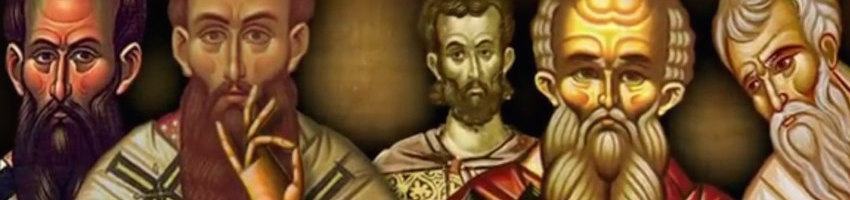
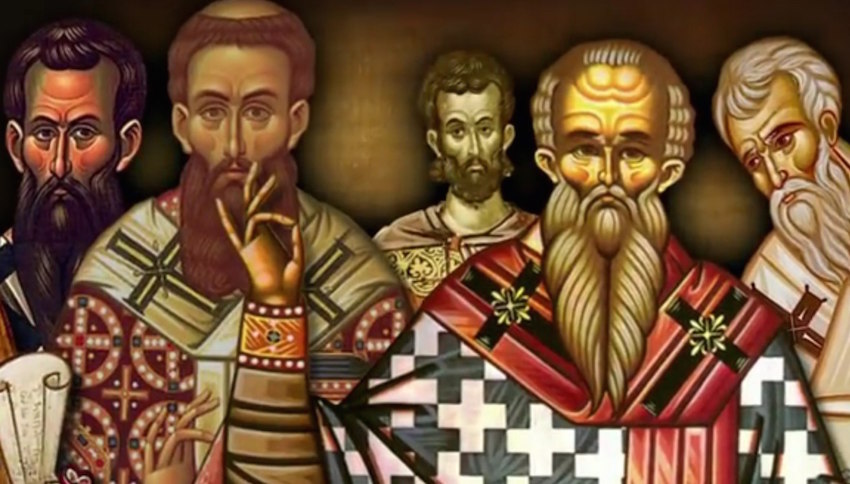
In this week’s episode, we return to the Early Church and discuss the successors to the Apostles, known as the Early Church Fathers. Somehow Nessa manages to talk about relationships… :-/
* I mentioned my article I’ve written called “Before 300” where I outline 21 documented beliefs of Christians prior to the rise of the Emperor Constantine:
Part #1: The Church
1. The Church is Catholic
2. The Church has a three-fold structure of leadership
3. There is unity through episcopal authority and schism is evil
4. Sacred Tradition is authoritative
5. Worship is liturgical
6. There is Apostolic Succession
7. Peter has Primacy
Part #2: Salvation & Sacraments
1. The Eucharist is a Sacrifice
2. Jesus is truly present in the Eucharist
3. The Eucharist is taken to the sick
4. Infants are to be baptized
5. Baptism actually washes away sin
6. Priests forgive sins
7. Works are involved in salvation
Part #3: The Saints and Our Lady
1. Prayers are said for the dead
2. There is purgation after death
3. Relics are venerated and Saints are celebrated
4. Mary is the New Eve
5. Mary was a perpetual virgin
6. Mary is the Mother of God
7. Prayers are made and songs are sung to Mary
1. Antiquity Did this person live sometime between the time of Christ and the end of the 8th Century? This span of time is called the “Patristic Era” (“Patristic” simply means relating to the Early Church Fathers).
2. Sanctity Did this person live a life of outstanding holiness? Is this person a canonized Saint?
3. Orthodoxy
Did this person hold heretical views? Tertullian and Origen are two early Christians who are typically disqualified here due to some of their erroneous beliefs. We therefore instead give them the title of “Early Ecclesiastical Writers”.
4. Church Recognition and Approval Has the Church and Christians throughout history generally referred to this person as a Father of the Church?
* There were about one hundred Early Church Fathers.
* The Early Church Fathers of the 1st and 2nd Centuries are usually called the “Apostolic Fathers” since they were born during the era of the Apostles.
* We then briefly spoke about three Apostolic Fathers:
1. St. Clement of Rome
* A successor to St. Peter as Bishop of Rome
* He wrote a letter to the Church at Corinth (AD ~96) in response to the ejection of their clergy
* In the letter he gives many Old Testament examples of those who flaunted God-given authority and who suffered the consequences
* In a particularly beautiful passage reminiscent of 1 Corinthians 13, Clement exhorts the Corinthians to love. I had a small rant about 1 Corinthians 13, pointing out that Paul is speaking of “agape” love rather than “eros” love.
2. St. Ignatius of Antioch
* A successor to St. Peter as Bishop of Antioch
* Taken to Rome in chains (AD ~107) to be thrown to wild animals
* Wrote seven letters, one to St. Polycarp (see below), several to nearby Churches and one to the Church in Rome
* In his letter to the Roman Church he begs them to not interfere with his coming martyrdom: “I beseech of you not to show an unseasonable goodwill towards me. Suffer me to become food for the wild beasts, through whose instrumentality it will be granted me to attain to God. I am the wheat of God, and am ground by the teeth of the wild beasts, that I may be found the pure bread of God”
* In the account of his martyrdom, the Governor tells Polycarp to say “Caesar is Lord”, but Polycarp knew that “Christ/Jesus is Lord”. He was told to “revile Christ”, but he responded: “Eighty-six years have I served Him, and He never did me any wrong: how then dare I blaspheme my King and my Saviour?”
* Prior to being burned alive, Polycarp gives a prayer which sounds an awful lot like a Eucharistic Prayer.
* As he was burned, people reported the smell of baking bread.
* Some Jews claimed that the Christians might start worshipping Polycarp after his death. The author of the Martyrdom account says the following: “They did not realize that we could never abandon Christ, He who suffered for our salvation – the blameless one for sinners! – or worship any other. Him we worship as being the Son of God, the martyrs we love as being disciples and imitators of the Lord; and deservedly so, because of their unsurpassable devotion to their King and Teacher. May it be our good fortune, too, to be their companions and fellow disciples!”
* After his death, the Christians gathered Polycarp’s relics and and interred them in a fitting place: “There the Lord will permit us, as far as possible, to assemble in rapturous joy and celebrate his martyrdom – his birthday – both in order to commemorate the heroes that have gone before, and to train the heroes yet to come…”
* In last week’s episode, we spoke about another Early Church Father, St. Basil of Caesarea.
* If you would like to read what the different Fathers wrote about the Sunday Gospel, you can look it up using the Catena Aurea (“Golden Chain”), a collection of patristic commentary which was assembled by St. Thomas Aquinas. You can also get it on your mobile!
I know I said I wouldn’t be posting during Lent, but this weekend I gave a talk, “Evangelization for the terrified”, at the San Pedro Calungsod Young Adult Retreat in San Diego and promised that I’d upload the audio the following week, together with links to the resources I mentioned in my talk.
The Talk
Evangelization For The Terrified – Extended Edition (Download)
Unfortunately, the original recording has the last ten minutes cut off… 🙁 Fortunately, I just re-recorded the entire talk here at home. Since I didn’t have the time restrictions I had on the retreat, this recording is a little longer. Think of it as the Director’s Cut or the Extended Edition, which includes ten minutes of never-before-heard material!

 Today we finish Chapter 3:
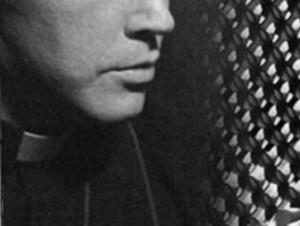 I have a confession.


 I began my talk by referencing the Papal Encyclical