Non-Biblical Sources for Jesus

"We are travellers…not yet in our native land" – St. Augustine
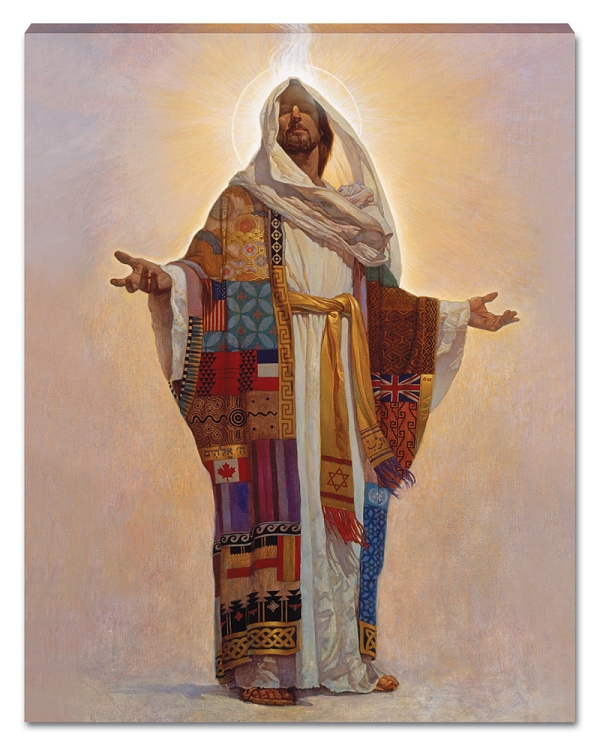 MAN WARNING! THIS POST WILL BE ABOUT CLOTHES…
This last weekend I went to see the Andrew Lloyd Webber musical, Joseph and the Amazing Technicolour Dreamcoat in San Diego.
It was an extremely nostalgic experience for me, since as a child I watched this show countless times at the theatre, as well as performing in it in a summer school production. Naturally, in that production I played the role of Pharaoh, the show’s coolest character by far. I even had my own backup dancers and everything! 🙂
In preparation for the trip to see the show, a few days before in Bible Study, we read through the Biblical text of the story found at the end of Genesis, beginning around chapter thirty-seven and continuing for about ten chapters.
Today is the Feast Day of probably my favourite Early Church Father, St. Ignatius of Antioch:
Today in the Office of Readings we read a section of one of the letters he wrote on his way to martyrdom sometime around AD 107:
“I am writing to all the churches to let it be known that I will gladly die for God if only you do not stand in my way. I plead with you: show me no untimely kindness. Let me be food for the wild beasts, for they are my way to God. I am God’s wheat and shall be ground by their teeth so that I may become Christ’s pure bread. Pray to Christ for me that the animals will be the means of making me a sacrificial victim for God.
“No earthly pleasures, no kingdoms of this world can benefit me in any way. I prefer death in Christ Jesus to power over the farthest limits of the earth. He who died in place of us is the one object of my quest. He who rose for our sakes is my one desire. The time for my birth is close at hand. Forgive me, my brothers. Do not stand in the way of my birth to real life; do not wish me stillborn. My desire is to belong to God. Do not, then, hand me back to the world. Do not try to tempt me with material things. Let me attain pure light. Only on my arrival there can I be fully a human being. Give me the privilege of imitating the passion of my God. If you have him in your heart, you will understand what I wish. You will sympathize with me because you will know what urges me on.”
– Ignatius of Antioch, Letter to the Romans
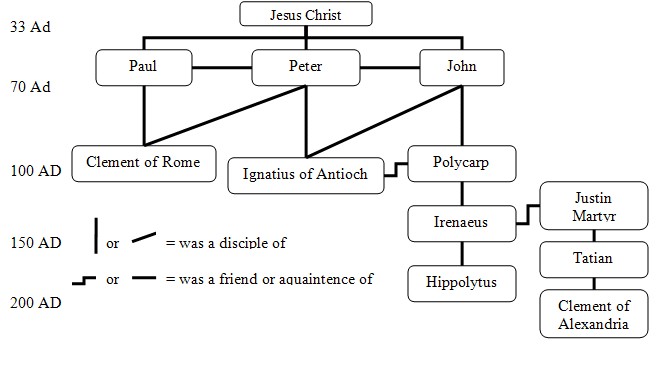
Here is a diagram showing the relationships between Jesus, His Apostles, Ignatius of Antioch and some of the other Early Church Fathers:
If you would like to read more of St. Ignatius’ writings, or listen to them free on MP3, be sure to check out the Church History section of this blog.


Last week, Joseph Heschmeyer, who works for Holy Family School of Faith and is the author of the blog Shameless Popery, came to San Diego to speak to the Immaculata Young Adult Bible Study Group. His talk was on the subject of theosis, the title of his talk being “That man may become God”.
Theosis can seem like a daunting subject, but it really is essential to understanding Christianity and Joe gave a really fantastic presentation. Afterwards, many people told me that it was one of the best talks they’d heard in ages…
That Man May Become God (Download)


This past week I was responding to someone in the comments section of my blog and I came across an issue I hadn’t encountered before…
It turns out that some groups will argue that Jesus didn’t die on Good Friday, but on the Wednesday before. I’ve noticed this chiefly among Fundamentalists and Messianic Jews. The case is made from Jesus’ own words in Matthew’s Gospel:
“For as Jonah was three days and three nights in the belly of the whale, so will the Son of man be three days and three nights in the heart of the earth.”
Matthew 12:40
It is argued that in order for Jesus’ words to be true, we must work backwards three full days and three full nights from Resurrection Sunday. If we do this, we would conclude that Christ’s Crucifixion took place, not on Friday, but Wednesday:
Some of these folks will say that Christians of past generations simply made a mistake in placing the Crucifixion on Good Friday, but others go further, arguing that this was an attempt to Paganize Christianity (although, as is typical with such assertions, I’m rather at a loss as to what this achieves).
So, how might we respond to this claim?
Read more
Below is the reflection I gave on 22nd January 2005 during the Week of Prayer for Christian Unity in response to the follow passage of Scripture:
After saying this, Jesus raised his eyes to heaven and said:
… Consecrate [those you have given me] in the truth; your word is truth….I pray not only for these but for those who through their teaching will come to believe in me.
May they all be one, just as, Father, you are in me and I am in you, so that they also may be in us, so that the world may believe it was you who sent me. I have given them the glory you gave to me, that they may be one as we are one. With me in them and you in me, may they be so perfected in unity that the world will recognise that it was you who sent me and that you have loved them as you loved me.
…. I have made your name known to them and will continue to make it known, so that the love with which you loved me may be in them, and so that I may be in them – John 17:1, 17-23, 26
This is the week of prayer for Christian unity, so I intend to speak for only a couple of minutes so we can get back to the business of prayer. I wanted to say just a few words about the reading that was chosen for tonight’s service.
I meant to post this blog entry a long time ago, but it became one of the many posts to hide itself away in my Drafts folder. I came across it yesterday and, given the recent horrific events in Connecticut, I thought it was an appropriate time to finally post it.
Back in May of 2011, there was a great stir after a parishioner of a parish in Florida requested a Mass to be said for the soul of Osama Bin Laden.
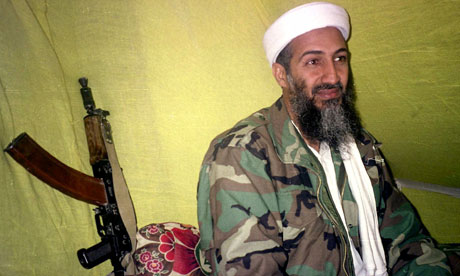
This request caused all kinds of uproar among other parishioners:
“I think it’s totally wrong, he doesn’t belong in the Catholic religion. For what he did to Americans, he doesn’t belong anywhere…”
“It’s unconscionable, it’s sacrilegious…”
While I can understand the gut reaction of those who objected to this proposed Mass intention, how compatible are these statements with the Catholic faith?