Last month was the anniversary of Roe v Wade, the landmark abortion legislation here in the United States. In response to this, there were various pro-life events such as the March for Life in Washington DC and the Walk for Life in San Francisco.
I was over the moon to find out that there was a special event being organized here in San Diego‘s Balboa Park. The turnout was quite good, approximately 3,000 people attended and many organizations were represented.
I remember thinking how nice it was to be back around non-Catholic Christians again. In England I had a lot of contact with Christians of other denominations, both from attending non-Catholic services and from various ecumenical activities. But what with one thing and another, this hasn’t happened so much since I moved to the United States, my religious social circle being made up almost exclusively of Catholics. It was therefore really wonderful to see Christians of different denominations coming together on a Saturday morning to bear witness to the sanctity of human life.
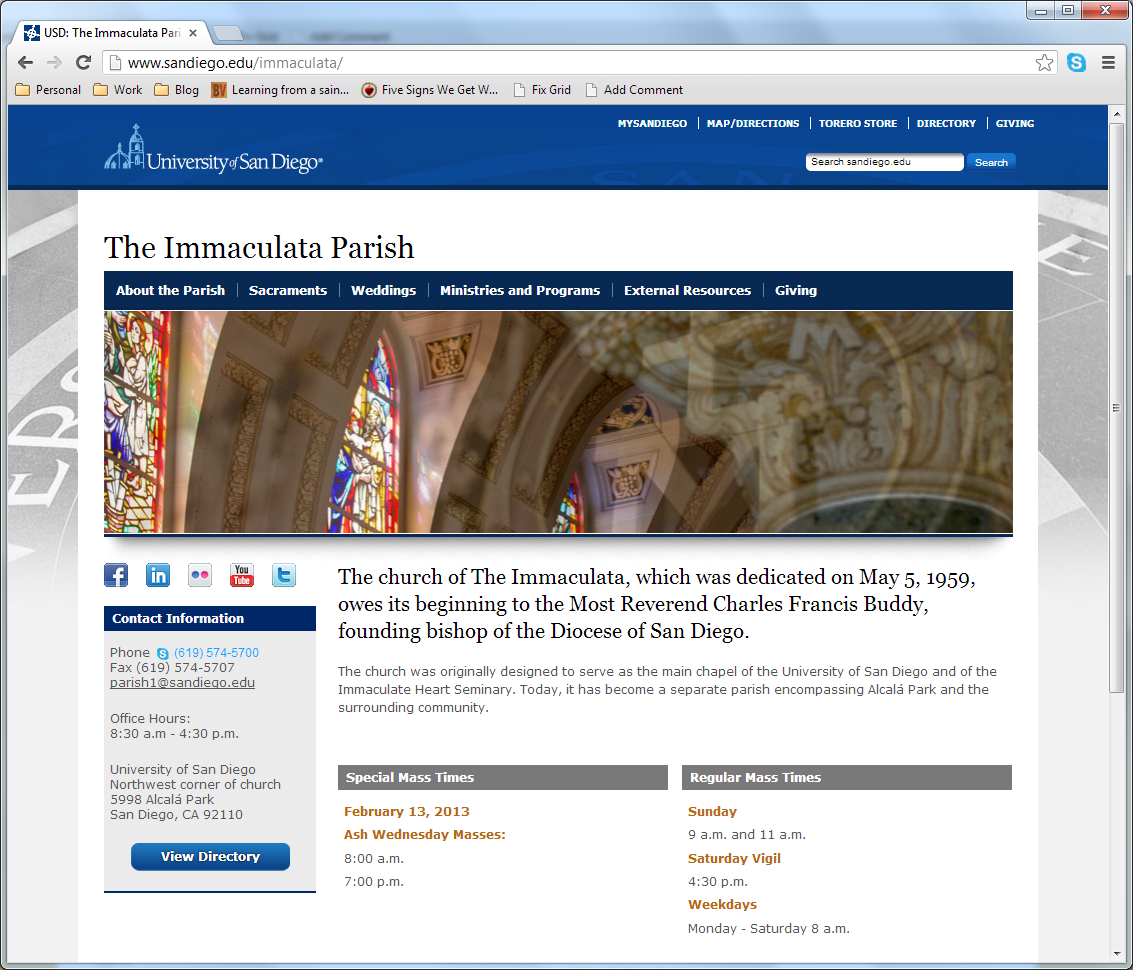
Bad parish websites. They have to stop. Seriously.
I never fail to be amazed at how little time, attention and money is devoted to the websites of some Catholic parishes. It’s 2013 people! Bad parish websites are now simply unacceptable.
If you arrived at a parish for Mass for the first time and you walked through the front door and are greeted by 70’s decor, peeling paint and a sparsely populated notice board containing only out-of-date notices, what conclusions would you reach about that parish? Well, having no website or an extremely poorly produced or out-of-date website is the digital equivalent of that today. A parish’s website, or lack thereof, is the first impression most people will have of that parish.
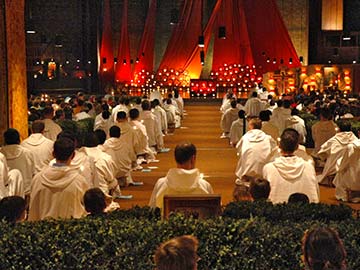
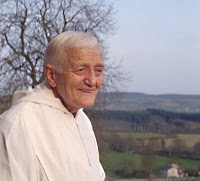
Next week is the anniversary of the death of Brother Roger of Taizé in France. If you have never heard of this man then you have really been missing out…
Although he lived much of his life in France, Brother Roger was originally from Switzerland, the son of a Protestant Pastor. In 1940, after studying Reformed Theology in Strasbourg and Lausanne, Roger felt God calling him to go to Taizé, a small town south of Paris. For two years he lived a life of prayer and helped those fleeing from the Germans into unoccupied France.
Founding of a community
After being forced to leave Taizé, Roger returned in 1944 where he began to found a group of men living together in community. This eventually flowered into the ecumenical monastic community which forever after would be associated with the name “Taizé”. The focus of this community is prayer, silence, peace, social justice and reconciliation. Brother Roger wrote many books on these topics.
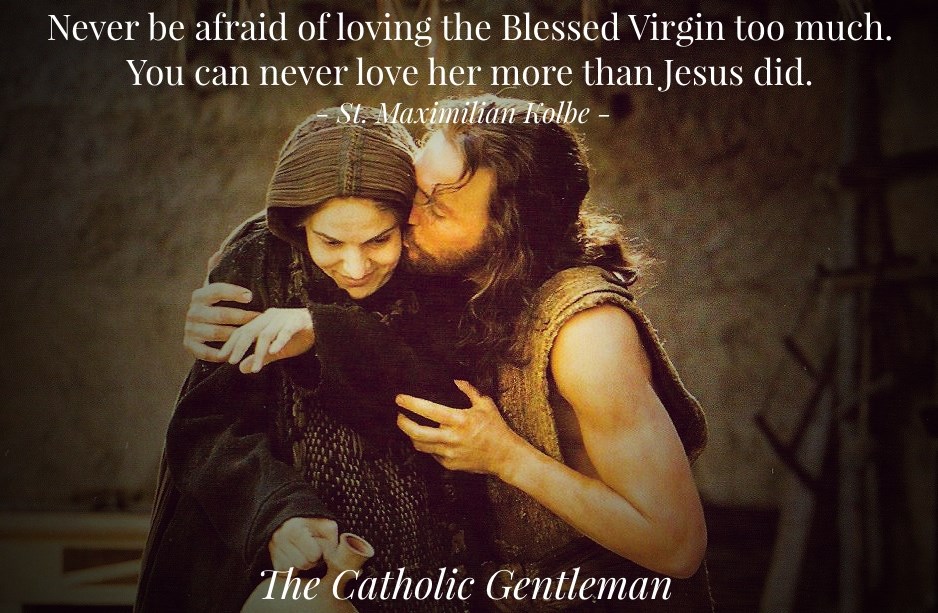
This should be the last Marian “Quick Apology” I’ll be doing for a while. After all, I have other things I want to write about! However, before we leave the subject of Mary, I wanted to address the claim that Catholics think that Mary is divine…
Objection
On this blog I’ve received comments like the following:
“Catholics basically think that Mary is divine. It’s like the Trinity has been replaced with a quartet – Father, Son, Spirit and Mary”
How might you respond?
Response
The simplest way to respond to an assertion like this is to ask for any official Church document which teaches this. Can the objector produce a reference in the Catechism, a Council or a Papal Encyclical? I can guarantee you they cannot.
When they are unable to provide the evidence you request, I would suggest that you then point them to the binding teaching of the Catechism:
488 “God sent forth his Son”, but to prepare a body for him, he wanted the free co-operation of a creature. For this, from all eternity God chose for the mother of his Son a daughter of Israel, a young Jewish woman of Nazareth in Galilee…
The Father of mercies willed that the Incarnation should be preceded by assent on the part of the predestined mother, so that just as a woman had a share in the coming of death, so also should a woman contribute to the coming of life.*
[This is a beautiful teaching from the Early Church, where the Fathers referred to Mary as being a kind of “New Eve”]
489 Throughout the Old Covenant the mission of many holy women prepared for that of Mary…Eve…Sarah…Hannah…Deborah; Ruth; Judith and Esther….
Mary “stands out among the poor and humble of the Lord, who confidently hope for and receive salvation from him. After a long period of waiting the times are fulfilled in her, the exalted Daughter of Sion, and the new plan of salvation is established.”
A friend recently expressed interest in getting to know the Early Church Fathers so I said that I would put together a brief (hah!) list of resources.
I was first introduced to the Early Church Fathers by Marcellino D’Ambrosio while I was on a retreat in England. He regaled us with some of the many colourful stories from the Early Church, such as the election of St. Ambrose to Bishop of Milan. Since St. Ambrose will be my roommate’s Patron Saint when he’s received into the Church next year I’ll make sure I write about that sometime soon…
Audio Resources
This initial introduction to the Fathers by Dr. D’Ambrosio was later supplemented by the excellent lecture series given by Dr. Lawrence Feingold to the Association of Hebrew Catholics. Dr. Feingold takes the listener through a tour of the Early Church, focussing upon the issues in that Church, such the call to martyrdom, as the relationship between faith and reason, and the Arian heresy.
If you would like to get a deeper grounding in Christian history (which is, itself, the story of the Fathers), I highly recommend the extensive series of lectures by Fr. Michael Witt. If you get through the Early Church period, don’t worry! You don’t have to stop there since he also covers Church history up until the present day… 🙂
So those are a number of audio resources, but what about books?
Websites
There are several websites which provide a handy concordance for the Fathers, such as ChurchFathers.org.
Books
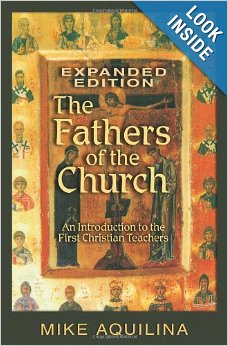
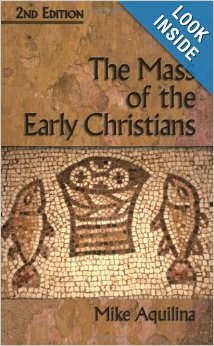
Mike Aquilina has written a number of very accessible books on the subject and I would particularly recommend his book The Fathers of the Church as it gives a good, brief survey of the Patristic period. If you’re interested in the worship of the Early Church he also has a very readable book entitled The Mass of the Early Christians.
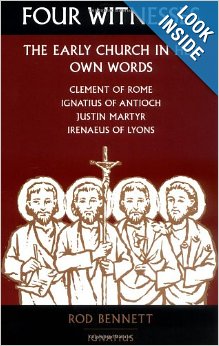
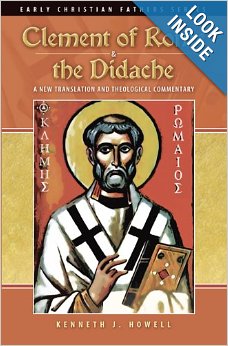
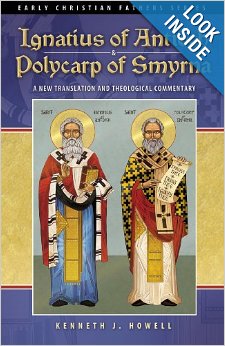
I know a lot of people were first introduced to Patristics through The Four Witnesses by Rod Bennett, which focusses just four Fathers: Clement, Ignatius, Justin and Irenaeus. Likewise, if you would like to focusses more in depth on specific Fathers, Dr. Howell has a great couple of books which focus on Clement, Ignatius and Polycarp.
a
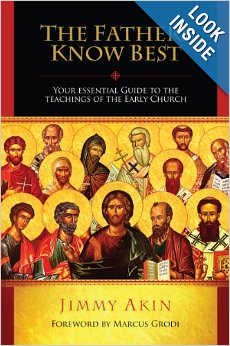
A new excellent reference book came out recently from Jimmy Akin entitled The Fathers Know Best. It is a book which arranges the writings of the Church Fathers by topic. For example, have you ever wanted to know what the Fathers thought about contraception? Well, with Jimmy’s book you can just flip to that topic and read, in chronological order, extracts from the Fathers on that subject.
Ad Fontes!
Finally, I would invite anyone wishing to get to know the Fathers better to actually get down and read the works themselves. I have several works available on this website in my Patristics section, together with MP3 recordings of the text. If you want to see what the Fathers thought about the Gospel readings at Mass each week, I’d suggest consulting the Catena Aurea. For further reading, I would recommend the Ancient Christian Writers series. The translation is excellent and there are a good number of explanatory endnotes.
So there you go! Hopefully that wasn’t too overwhelming! Pick which way works best for you and get stuck in! Get to know your Christian family 🙂
I recently told this story to a friend of mine. As I was driving home afterwards, I thought that it might be worth sharing here too…
When I was living back in England, my parish had a Hospital Visiting Ministry with which I was involved, run by the Society of St. Vincent de Paul. Every Saturday we would hand out free newspapers, identify the patients who would like to receive Holy Communion the following day and spend some time speaking with them. This would be done by two different people every week, each covering half of the hospital.
Out of all the wards we visited, the one I hated visiting the most was the ASU, where stroke victims were treated. I think I disliked visiting this ward more than any other because it was often a very frustrating experience.
I’ve always placed a very high premium on communication, and those in the ASU usually had difficulty with speaking, a common consequence of suffering a stroke. It frustrated them not being able to make themselves easily and fully understood and it frustrated me in not always being able to understand them.
Yesterday I wrote a post about the importance of parish websites and how they can play a key role in attracting people to your parish and integrating them into parish life.
Today I would like to follow up on this topic and speak a little bit about some of the thought which should go into the construction and structure of your website. Having a website is not enough. It must also be functional and engaging.
With that in mind, here are my top five tips for parish websites:
1. “When’s Mass?”
If I’m going to a parish’s website, chances are I’m looking for the Mass and Confession times. Please don’t make me have to click around for five minutes and dig into submenus before finding them.
 Okay, small rant alert…
 Next week is the anniversary of the death of Brother Roger of