Twenty-first Sunday in Ordinary Time: August 26th, 2012
The Readings this Sunday ask a basic question: whom do you choose?
In the First Reading, Joshua asks this question of Israel. Whom will they serve? Yahweh or some other god? In the Gospel Reading, after hearing the “hard teaching” of the Lord about His Body and Blood, Jesus asks the Twelve if they wish to leave along with some of the other disciples. Peter answers the question in the same way I hope we would all answer: “Lord, to whom shall we go? You have the words of eternal life”.
We have a fundamental choice in life. Do we choose God, or do we choose something or someone else? As we hear God’s Word this week and gather around the altar to “taste and see that the Lord is good”, let us renew our commitment to the Lord and say with Peter “We have come to believe and are convinced that you are the Holy One of God”.
Twenty-Sixth Sunday in Ordinary Time: September 25th, 2011
The readings this week focus on God’s mercy and exhort us to humility and obedience in following God’s way. There isn’t much technical stuff to deal with in these passages. Instead, these readings are an opportunity for the group to share with one another their struggles in this area and to encourage one another.
“There are two ways, one of life and one of death; but a great difference between the two ways”
– The Didache, c. 65 AD
Reading I: Ezekiel 18:25-28
This section of Ezekiel comes from a longer section entitled “The soul who sins will die” where Ezekiel affirms personal responsibility for one’s own soul and the Prophet outlines all the things that Israel must not do . This long section concludes with the passage below. God affirms that He is indeed just and that, in sinning, it is Israel that is disrupting the right order of things. However, God also affirms that He takes no pleasure in the destruction of sinners. He continually holds out His offer to those who will repent, that he will forgive their sin and spare their life.
Thus says the LORD:
You say, “The LORD’s way is not fair!”Hear now, house of Israel: Is it my way that is unfair, or rather, are not your ways unfair?When someone virtuous turns away from virtue to commit iniquity, and dies, it is because of the iniquity he committed that he must die.But if he turns from the wickedness he has committed,he does what is right and just,he shall preserve his life;since he has turned away from all the sins that he has committed,he shall surely live, he shall not die.
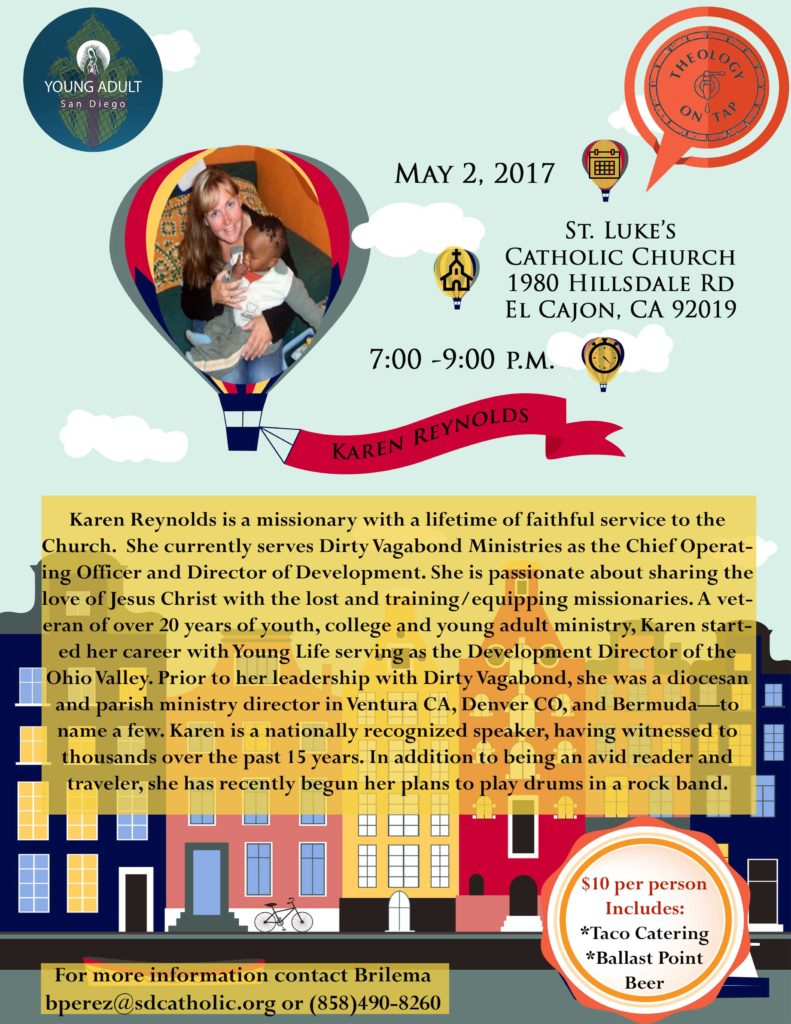
Karen Reynolds is a missionary with a lifetime of faithful service to the Church. She currently serves Dirty Vagabond Ministries as the Chief Operating Officer and Director of Development. She is passionate about sharing the love of Jesus Christ with the lost and training/equipping missionaries.
A veteran of over 20 years of youth, college and young adult ministry, Karen started her career with Young Life serving as the Development Director of the Ohio Valley. Prior to her leadership with Dirty Vagabond, she was a diocesan and parish ministry director in Ventura CA, Denver CO, and Bermuda – to name a few.
Karen is a nationally recognized speaker, having witnessed to thousands over the past 15 years. In addition to being an avid reader and traveler, she has recently begun her plans to play drums in a rock band.
It has been a while since I’ve done a “My favourite people” post. Today will just be a short one on one of my favourite comedians, Jim Gaffigan. If you have no idea who this guy is, this short video should give you a feel for what he’s like:
As he mentions in the interview, Jim is Catholic and that naturally spills out over into his comedy, particularly with regards to his material on dating, marriage and especially family:
Yesterday I told the story of a friend of mine who asked me about how non-Catholics memorize Scripture.
I began by offering a few techniques that I’ve used in the past for committing Bible passages to memory. I then went on to explain that, memory techniques aside, non-Catholics tend to be more familiar with Scripture simply because they make it more of a priority in their lives.
Today I’d like to take a look at the Catholic response to this…
The Catholic Response
First of all, what does the Church teach on the subject? The Catechism says:
The Church “forcefully and specifically exhorts all the Christian faithful. . . to learn the surpassing knowledge of Jesus Christ, by frequent reading of the divine Scriptures…” – CCC #133
Well, you can’t really get much more forceful than that! The Church says that “all” Catholics should get to know Jesus better through “frequent” reading of the Bible. The Catechism then goes on to sum up the Church’s position beautifully and succinctly with a quotation from one of the Church’s greatest biblical scholars, Jerome:
“Ignorance of the Scriptures is ignorance of Christ” – St. Jerome, Commentary on Isaiah
The natural loves are not self-sufficient. Something else…must come to the help of the mere feeling if the feeling is to be kept sweet… It is no disparagement to a garden to say that it will not fence and weed itself, nor prune its own fruit trees, nor roll and cut its own lawns.
Natural loves as rivals to God
There were two reasons for my delay… [The] older theologians were always saying very loudly that (natural) love is likely to be a great deal too much. The danger of loving our fellow creatures too little was less present to their minds than that of loving them idolatrously. In every wife, mother, child and friend they saw a possible rival to God. So of course does Our Lord
…For most of us the true rivalry lies between the self and the human Other, not yet between the human Other and God. It is dangerous to press upon a man the duty of getting beyond earthly love when his real difficulty lies in getting so far.
But to have stressed the rivalry earlier in this book would have been premature in another way also… The loves prove that they are unworthy to take the place of God by the fact that they cannot even remain themselves and do what they promise to do without God’s help… Even for their own sakes the loves must submit to be second things if they are to remain the things they want to be.
Disagreeing with St. Augustine
…[For the] older theologians… the danger of loving our fellow creatures too little was less present to their minds than that of loving them idolatrously. In every wife, mother, child and friend they saw a possible rival to God. So of course does Our Lord.
In words which can still bring tears to the eyes, St. Augustine describes the desolation in which the death of his friend Nebridius plunged him. Then he draws a moral. This is what comes, he says, of giving one’s heart to anything but God. All human beings pass away. Do not let your happiness depend on something you may lose…. Of course this is excellent sense… [However,] if I am sure of anything I am sure that [Jesus’] teaching was never meant to confirm my congenital preference for safe investments and limited liabilities… Would you choose a wife or a Friend – if it comes to that, would you choose a dog in this spirit? One must be outside the world of love, of all loves, before one thus calculates
We follow One who wept over Jerusalem and at the grave of Lazarus, and, loving all, yet had one disciple whom, in a special sense, he “loved”… Even if it were granted that insurances against heartbreak were our highest wisdom, does God Himself offer them? Apparently not. Christ comes at last to say “Why hast thou forsaken me?” Read more



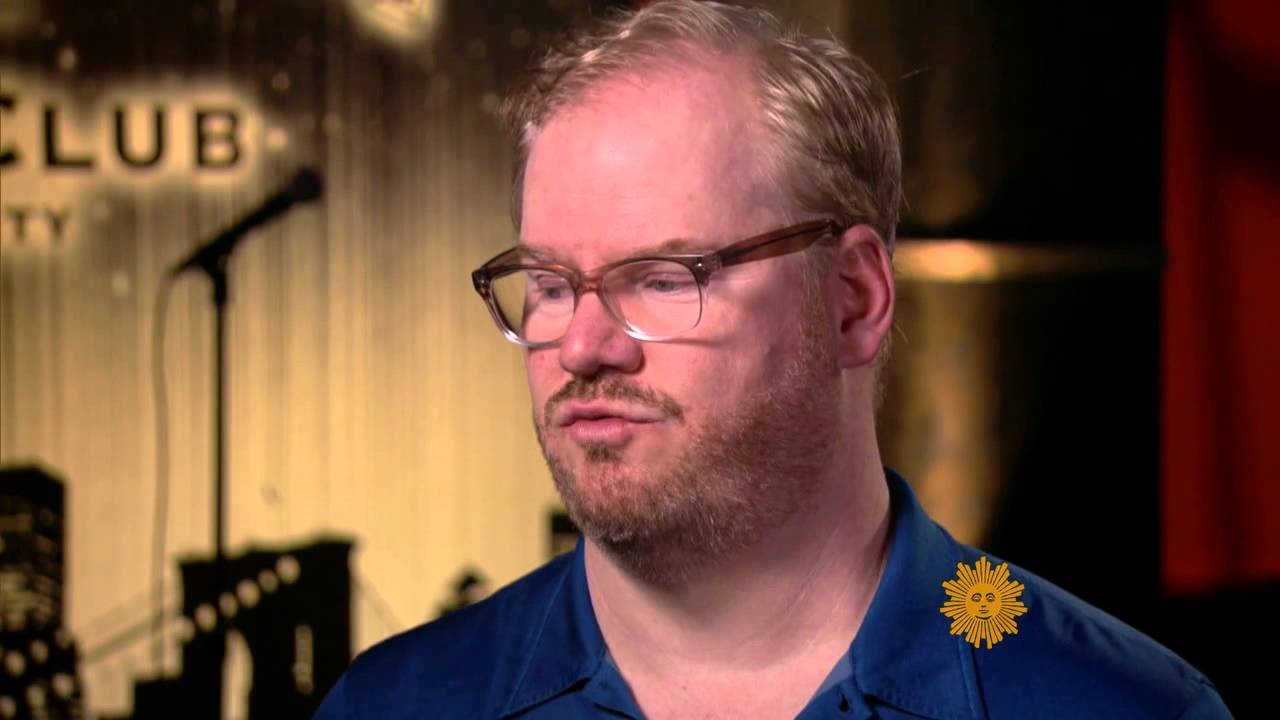 It has been a while since I’ve done a “My favourite people” post. Today will just be a short one on one of my favourite comedians, Jim Gaffigan. If you have no idea who this guy is, this short video should give you a feel for what he’s like: