I’ve got a longer article in progress on the subject of abortion, but today’s post is an extremely short entry on a point I’ve been wanting to mention for some time…
Whenever you see an abortion debate, either in a formal setting or on Facebook, it’s not long before you hear someone, typically from the pro-choice side, talk about “fertilized eggs”. I only note this because I think it’s always worth pointing out that “fertilized egg” is something of a misnomer…
I say this because once an egg is fertilized, it ceases being an egg. It is now a new, distinct human organism. Calling it a “fertilized egg” is rather like referring to a man as a “married bachelor”. It’s nonsensical since, once married, a man ceases to be a bachelor. Likewise, we would never refer to someone being a “born fetus” because once the child is born it ceases to be a fetus.
In the last post I began to examine the responses of Mack, a recent commentator on my Once Saved, Always Saved post who offered some constructive criticism concerning the Scripture passages I presented.
I previously looked at Mack’s commentary of 1 John 5:16-17 and 2 Peter 2:20-22. I will now look at his analysis of several other passages which I offered in defense of the idea that it is possible to lose one’s salvation. Mack basically attempted to disqualify these texts since they were drawn from letters addressed to groups of people.
So, grab another cup of tea and we’ll look at what he had to say…
The Qur’an speaks about Allah helping the followers of Jesus and keeping them “uppermost”, but this presents a dilemma since, historically, this has to refer to Trinitarian Christians… which is a very strange thing for Allah to support. If it wasn’t Trinitarian Christians, who exactly has remained “uppermost” since the time of Christ?
O believers! Stand up for Allah, as Jesus, son of Mary, asked the disciples, “Who will stand up with me for Allah?” The disciples replied, “We will stand up for Allah.” Then a group from the Children of Israel believed while another disbelieved. We then supported the believers against their enemies, so they prevailed. – 61:14
ËąRememberËş when Allah said, “O Jesus! I will take you and raise you up to Myself. I will deliver you from those who disbelieve, and elevate your followers above the disbelievers until the Day of Judgment. Then to Me you will ËąallËş return, and I will settle all your disputes. – 3:55
The earliest depiction of Jesus’ crucifixion doesn’t, in fact, come from a Christian source. It is known as Alexamenos Graffito and, as the name suggests, it’s a piece of graffiti. It was found near Rome’s Palatine Hill and is dated sometime between 1st and 3rd Century:
The text underneath the picture says in Greek “Alexamenos worships [his] God”. The picture itself shows Jesus on a cross with a donkey’s head, with another person on the left (presumably “Alexamenos”) raising his hand in worship. It’s clear that this was written by someone who knew Alexamenos and wanted to mock him and his Christian faith.
This month in the United States we celebrate Thanksgiving, so I thought it was a good time to do a post where I celebrate the top five things Americans say (or don’t say) which make me me raise my eyebrows, tut slightly and set about making myself a comforting a cup of tea 🙂
Back in 2017 I was an avid listener to Buffering the Vampire Slayer, a podcast where the hosts would discuss each episode of Buffy the Vampire Slayer in turn. As a teenager I had rather enjoyed the campy movie starring Kirsty Swanson and, although I was suspicious at first, I soon came to really enjoy the TV series starring Sarah Michelle Gueller.
Buffering Mail…
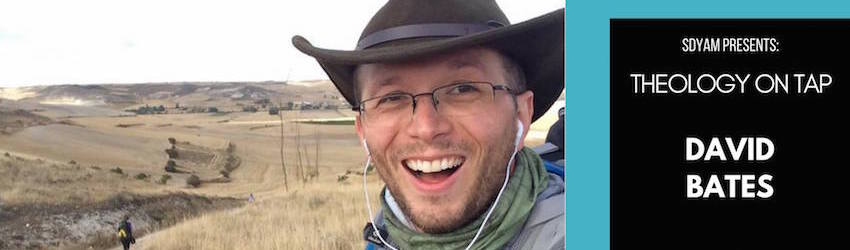
I listened to the first few episodes of the Buffering the Vampire Slayer while I was walking the Camino, and I even sent them an email which they read out on the show. I eventually wrote to them again, this time after listening to Episode 3.08…
In that episode of Buffy the Vampire Slayer, there is a funeral. In their commentary episode, the podcast hosts where shocked to hear the word “Hades” mentioned in the reading at the graveside. They were shocked because the context was clearly Christian, yet the hosts associated the word with the occult. They wondered out loud what Christian denomination this might be.
To the library!
I sent them an email pointing out that the text comes from the first chapter of the Book of Wisdom, also known as The Wisdom of Solomon:
“…because God did not make death, and he does not delight in the death of the living. For he created all things that they might exist, and the generative forces of the world are wholesome, and there is no destructive poison in them; and the dominion of Hades is not on earth. For righteousness is immortal” Â
Wisdom of Solomon 1:13–15
I went on and explained that the word “Hades” was simply the Greek name used to describe the realm of the dead. In Hebrew, the word is “Sheol” which is translated in English as either “the grave” or “the dead”.
The fact that this reading comes from the Book of Wisdom gives us a big clue as to the Christian denomination of the person conducting the burial. The Wisdom of Solomon belongs to a collection of books known as the Deuterocanon which was removed from the Bible at the Reformation in the 16th Century. It therefore most likely isn’t a Protestant funeral (Lutheran, Baptist etc.). That pretty much leaves either Catholic or Eastern Orthodox and, given the appearance of the priest, I’d say he it’s a pretty safe bet to assume he was Catholic.
Here’s the clip of the hosts reading out my email on their mailbag episode: