19th Sunday in Ordinary Time
Reading 1: 1 Kgs 19:9a, 11-13a
The events of this passage take place after Elijah has defeated the Prophets of Baal (1 Kings 18:22-40). As a result of this humiliating defeat, Princess Jezebel has sworn to kill him (1 Kings 19:1-2). Elijah flees into the desert where, dejected and overcome by fear, he tells God that he may as well let him die (1 Kings 19:3-4). He then goes to sleep, but is awoken twice in the night by an angel who gives him bread and water. Strengthened by this food, he travels for 40 days to Mt. Horeb (1 Kings 19:5-8), also known as Mt. Sinai, the mountain where God revealed the Law to Moses.
Whereas Moses interceded for the Israelites (Exodus 32:11-13), Elijah appears to have reached the end of his tether (1 Kings 19:10). Elijah complains about his lack of success, saying that the people have abandoned God and he effectively condemn them. In saying this, there is the subtle implication that God’s promises have failed…
Then in the passage assigned for this Sunday, God reveals Himself to Elijah, indicating his patience, mercy and gentleness with His people. In the text that follows afterwards, God gives Elijah instructions as to what to do next.
At the mountain of God, Horeb, Elijah came to a cave where he took shelter. Then the LORD said to him, “Go outside and stand on the mountain before the LORD; the LORD will be passing by.”
A strong and heavy wind was rending the mountains and crushing rocks before the LORD— but the LORD was not in the wind.
After the wind there was an earthquake— but the LORD was not in the earthquake.
After the earthquake there was fire— but the LORD was not in the fire.
After the fire there was a tiny whispering sound. When he heard this, Elijah hid his face in his cloak and went and stood at the entrance of the cave.
Suggested Questions:
- What is this “mountain of God” mentioned? Does it have another name? What other events have also taken place there? Why does Elijah go there?
- What do you think is the significance of the “wind…earthquake…fire”? Why was the Lord not “in” them?
- What do you think is the significance of the “tiny whispering sound”?
- Why does Elijah hide his face?
Read more
 Hippolytus was an Early Church Father who lived in 3rd Century Rome and the story of his life is a particularly colourful one. He was the first Anti-Pope of the Catholic Church, setting himself up as Bishop of Rome in competition with with Pope Callixtus, and later with his successors Urban and Pontianus.






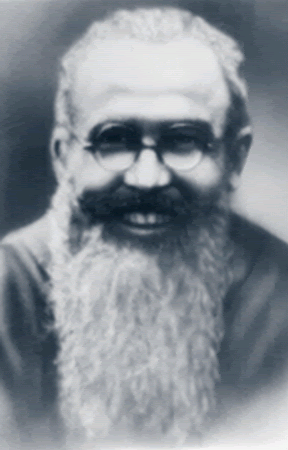 Today is the feast day of one of my favourite Saints, the great St. Maximilian Kolbe.