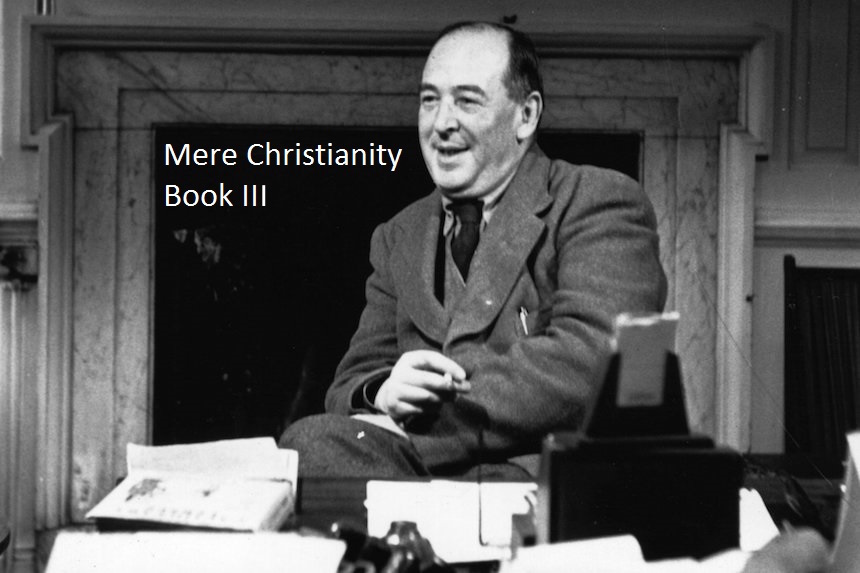
Picking back up my notes for C.S. Lewis’ “Mere Christianity”…
Notes & Quotes
1. Maybe it is forgiveness, rather than chastity, is the most unpopular thing in Christianity
(a) Because Christian forgiveness involves forgiving our enemies
…we come up against this terrible duty of forgiving our enemies. Every one says forgiveness is a lovely idea, until they have something to forgive… And then, to mention the subject at all is to be greeted with howls of anger”
(b) People sometimes complain not that it’s not too hard, but just that it’s simply unfair!
“It is not that people think this too high and difficult a virtue: it is that they think it hateful and contemptible. ‘That sort of talk makes them sick,” they say. And half of you already want to ask me, ‘I wonder how you’d feel about forgiving the Gestapo if you were a Pole or a Jew?'”
2. But this is Christianity!
“I did not invent it. And there, right in the middle of it, I find “Forgive us our sins as we forgive those that sin against us.” There is no slightest suggestion that we are offered forgiveness on any other terms. It is made perfectly clear that if we do not forgive we shall not be forgiven. There are no two ways about it. What are we to do?”
3. In order to develop our ability to forgive, start small…
“When you start mathematics you do not begin with the calculus; you begin with simple addition. In the same way, if we really want (but all depends on really wanting) to learn how to forgive, perhaps we had better start with something easier than the Gestapo. One might start with forgiving one’s husband or wife, or parents or children, or the nearest NCO*, for something they have done or said in the last week. That will probably keep us busy for the moment”
* Non-Commissioned Officer in the army
3. There are misconceptions as to what it means to “love your neighbour as yourself”
“…how exactly do I love myself?”… I have not exactly got a feeling of fondness or affection for myself, and I do not even always enjoy my own society…. Do I think well of myself, think myself a nice chap? Well, I am afraid I sometimes do… but that is not why I love myself. In fact it, is the other way round: my self-love makes me think myself nice, but thinking myself nice is not why I love myself…. I can look at some of the things I have done with horror and loathing”
4. There is a distinction between the person and his/her actions
“I remember Christian teachers telling me long ago that I must hate a bad man’s actions, but not hate the bad man: or, as they would say, hate the sin but not the sinner.
…how could you hate what a man did and not hate the man? But years later it occurred to me that there was one man to whom I had been doing this all my life-namely myself… In fact the very reason why I hated the things was that I loved the man. Just because I loved myself, I was sorry to find that I was the sort of man who did those things. Consequently, Christianity does not want us to reduce by one atom the hatred we feel for cruelty and treachery. We ought to hate them… But it does want us to hate them in the same way in which we hate things in ourselves: being sorry that the man should have done such things, and hoping, if it is anyway possible, that somehow, sometime, somewhere, he can be cured and made human again”
5. Loving my neighbour does not mean refusing to punish him
“No, for loving myself does not mean that I ought not to subject myself to punishment-even to death. If one had committed a murder, the right Christian thing to do would be to give yourself up to the police and be hanged. It is, therefore, in my opinion, perfectly right for a Christian judge to sentence a man to death or a Christian soldier to kill an enemy”
(a) This does not contradict “Thy shalt not kill”?
“There are two Greek words: the ordinary word to kill and the word to murder. And when Christ quotes that commandment He uses the murder one… And I am told there is the same distinction in Hebrew. All killing is not murder any more than all sexual intercourse is adultery. When soldiers came to St. John the Baptist asking what to do, he never remotely suggested that they ought to leave the army: nor did Christ when He met a Roman sergeant-major-what they called a centurion”
4. If people What then, is the difference?
I imagine somebody will say, “Well, if one is allowed to condemn the enemy’s acts, and punish him, and kill him, what difference is left between Christian morality and the ordinary view?” All the difference in the world. Remember, we Christians think man lives for ever. Therefore, what really matters is those little marks or twists on the central, inside part of the soul which are going to turn it, in the long run, into a heavenly or a hellish creature. We may kill if necessary, but we must not hate and enjoy hating. We may punish if necessary, but we must not enjoy it. In other words, something inside us, the feeling of resentment, the feeling that wants to get one’s own back, must be simply killed. I do not mean that anyone can decide this moment that he will never feel it any more. That is not how things happen. I mean that every time it bobs its head up, day after day, year after year, all our lives long, we must hit it on the head. It is hard work, but the attempt is not impossible. Even while we kill and punish we must try to feel about the enemy as we feel about ourselves- to wish that he were not bad. to hope that he may, in this world or another, be cured: in fact, to wish his good. That is what is meant in the Bible by loving him: wishing his good, not feeling fond of him nor saying he is nice when he is not.
5. What’s the bottom line?
“I admit that this means loving people who have nothing lovable about them. But then, has oneself anything lovable about it? You love it simply because it is yourself, God intends us to love all selves in the same way and for the same reason: but He has given us the sum ready worked out on our own case to show us how it works. We have then to go on and apply the rule to all the other selves. Perhaps it makes it easier if we remember that that is how He loves us. Not for any nice, attractive qualities we think we have, but just because we are the things called selves. For really there is nothing else in us to love: creatures like us who actually find hatred such a pleasure that to give it up is like giving up beer or tobacco. …”
Discussion Questions
1. Why is the Christian doctrine of forgiveness so unpopular?
2. How does Jack suggest we start?
3. What does it mean to forgive your enemies and what does it not mean?
4. Does this mean we should be against capital punishment?
5. Why should we forgive others?
C.S. Lewis Doodle
No doodle!




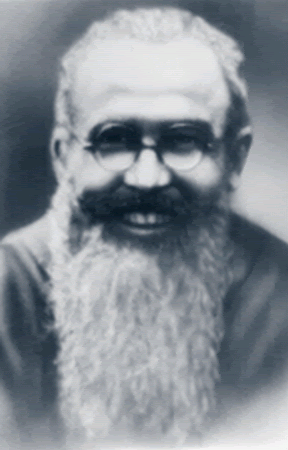 Today is the feast day of one of my favourite Saints, the great St. Maximilian Kolbe.