Bible Alone? Part 4

Over the last few days I’ve been looking at the subject of Sola Scriptura. Today I would like to discuss the alternative to Sola Scriptura which I realized made more sense of both history and the Biblical data…

The Alternative: Apostolic Authority

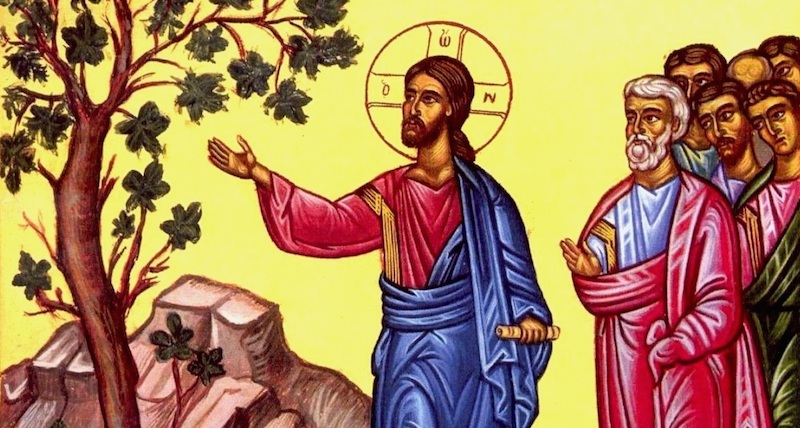
Ironically, the answer itself was in Scripture. After the Ascension, writing the New Testament wasn’t the priority because it wasn’t what Jesus commanded the Apostles to do. At the Great Commission Jesus told His disciples to “teach” all nations what He had taught them (as opposed to write a book). If you wanted to know the truth in c. 30AD you would go to Jesus. Who would you go to after the Ascension? You would go to the Apostles He taught and commissioned. It was this living Tradition that sustained the Church – primarily by orally passing on to others what Jesus had taught. Jesus wanted to found a Church, not a book club.

In the Book of Acts, when there was a disagreement over the question of Gentile circumcision, the Christians didn’t use Scripture to decide the answer, but called a Church Council. I could only think of one Church today which still calls [Ecumenical] councils to resolve matters of doctrine and practice…

The more I read Scripture, the clearer it became that the Early Church was one which exercised authority (1 Corinthians 16:16, Hebrews 13:17) given to her by Christ – to forgive sins, no less! Even in my most anti-Catholic moments I could still clearly see that Matthew 16 showed Christ giving Peter a special authority. I could only think of one Church today which claimed to still have that same authority passed on from Peter….

“If a man does not hold fast to this oneness of Peter, does he imagine that he still holds the faith? If he deserts the Chair of Peter upon whom the Church was built, has he confidence that he is in the Church?” – St. Cyprian (A.D. 251)

Read more

Canon Dates

Since I’m going to be discussing the question of the canon with some Jehovah Witnesses this weekend, I thought I’d post a few of the important dates which I often need to look up when talking about the setting of the canon of Scripture:

AD 170
The Muratorian fragment describes a New Testament canon which includes all of today’s books, with the exception of Hebrews, James, and 3rd John.

AD 180
Melito of Sardis provides a list of Old Testament books, including Wisdom but excluding Esther.

AD 367
Bishop Athanasius of Alexandria lists in his 39th Festal Letter the canon.  His Old Testament canon generally excludes the deutercanon, but includes Baruch and excludes Esther. He includes the entire New Testament canon.

AD 382
The Synod of Rome lists the 73 books of the Catholic Canon.

AD 393
The Council of Hippo lists the Catholic Canon. As with the other local councils, the pronouncements of the council were sent to Rome to be ratified by the Pope.

AD 397
The Council of Carthage confirms the pronouncements of Council of Hippo.

AD 405
Bishop of Toulouse requests a list of all the books of Scripture from the Bishop of Rome. Pope Innocent I sends him the list of 73.

Jerome completes the Latin Vulgate translation of the Bible.

AD 419
The Second Council of Carthage confirms the Catholic canon.

AD 1441
The Council of Florence also lists the 73 book canon.

AD 1563
The Council of Trent also lists the current day Catholic canon.

r_seaman@hotmail.com

For a detailed list of books used in the Early Church, please check out this post from Shameless Popery.

PWJ: S4E59 – AH – “Barfield Buffet” (Part 1)

As we near the end of Barfield Month, a number of different Barfield fans and scholars share their thoughts on this Inkling.

S4E59: “Barfield Buffet” (Part 1) (Download)

If you enjoy this episode, you can subscribe manually, or any place where good podcasts can be found (iTunesGoogle Play, AmazonPodbeanStitcherTuneIn and Overcast), as well as on YouTube. The roadmap for Season 4 is available here.

More information about us can be found on our website, PintsWithJack.com. If you’d like to support us and get fantastic gifts, please join us on Patreon.

Read more

Contraception and Erectile Dysfunction

Another day, another meme… Here’s a picture which a friend posted last week:

10636105_811028922302954_4413799127541192536_n

As with all memes, before clicking “Share”, it’s worth taking a moment to fully-articulate the argument which is being made. So, what does this meme claim?

The meme draws an equivalency between pregnancy and impotence. We are told that if pregnancy is God’s will, then so is impotence. It implies that Christians are inconsistent if they’re okay with tax dollars being available for the purchase of viagra, but not for contraceptives or abortions.

So…does this argument hold water? There are three points which I think are worth making.

1. Ordained or “ordered towards”
Is it true that “pregnancy is God’s will”? My suspicion is that what we have here is a misunderstanding (or, at worst a caricature) of the Christian understanding of sex. Sex has two ultimate purposes: the union of the spouses and the the siring of children. We would say that the sexual act is ordered towards procreation. By this, we mean that a natural consequence of the sexual act is the conceiving of children.

So, we can say “pregnancy is God’s will”  insofar as God invented sex and children are the natural result of sex. However, the very fact that women have periods of infertility during the month shows that God does not will that every sexual union result in the conception of a child.

2. Both diseases? 
Now that we’re spoken a little bit about sex in the natural order, it can hopefully be seen how ridiculous it is to compare pregnancy and impotence. Pregnancy is not a disease! If a couple has sex and the fruit of this union is a child then everything is working as it should! It is a natural consequence of the sexual act.

Impotence, in contrast, is a malfunction, a disruption of the intended sexual union. A better parallel would be to compare impotence with ovarian cysts, since the presence of these cysts prevents a woman’s body from functioning properly.

3. Different consequences
Finally, if this meme is being used as an argument in favour of abortion, it is hopefully clear to see the massive disparity between the moral consequences of paying for medication to allow a couple to have a heathy sex life and paying for medication which causes an unborn life to be snuffed out.

It’s the end of an era…

Hey everyone…

On 11th June 2010, I posted my first article on this blog. As hard as it is to imagine, that was ten years ago

I began with a free WordPress blog over at thisrestlesspilgrim.wordpress.com, and then I upgraded to get my own domain. I started posting once or twice a week, but after a few months committed to publishing something every day. To date, I have posted a little over 3,600 posts…

Well, today things come to an end. As you may know, in a few months I’ll be getting married and entering a new phase of life. In light of this, while will still from time-to-time still write articles, I’ve decided to stop posting here every day. Since today is my birthday, it seemed like a good day to draw things to a close.

This new chapter in my life will require my full attention…and it’s going to be great 🙂

Cheers,

David.

1 124 125 126 127 128 172