"Coming Soon"
As the Labo(u)r Day weekend and my personal mini-retreat draws to a close I’ve just finished the book I’ve been chipping away at for the last few weeks: “Coming Soon” by Dr. Michael Barber:
"We are travellers…not yet in our native land" – St. Augustine
As the Labo(u)r Day weekend and my personal mini-retreat draws to a close I’ve just finished the book I’ve been chipping away at for the last few weeks: “Coming Soon” by Dr. Michael Barber:
*sigh*…the Vatican website has been updated again…and it’s still terrible.

Here’s a selection of my favourite comments about this that I’ve seen on Facebook:
At World Youth Day, Pope Francis did say, “Go, make a mess!”
The Vatican web-designers took him literally.
What the… Great, now I need to go to confession.
There are no ‘boing’ noises when I move the cursor to a hyperlink. Why are there no ‘boing’ noises?
I thought Lent was over? Why are we still being made to suffer?
The church should recognize that IE 6 makes Jesus cry.
Look, someone discovered how to use the <table> tag in HTML!
I’m not too keen on the Times Roman font. They really should be using Comic Sans!
You know, for an outfit that’s big on infallibility, this really doesn’t bolster their cred…
Meet the new website, same as the old website.
Maybe they used the folks who did the new translation of the roman missal.
Still Better Than Obamacare
 This post will be a little longer than usual. Today I will be closing the series by offering some final thoughts on some of the issues I see within the Catholic dating world.
Why is it that there don’t seem to be many Catholic couples dating and, by extension, why is the number of couples receiving the Sacrament of Matrimony plummeting?
As I’ve mentioned before, there are many different, complicated explanations as to why this is so, but today I would like to focus on the subject of analysis paralysis, as well as our attitude towards dating and courtship.
 For western Christians, today is the “Feast of The Epiphany” where we commemorate the visitation of the Magi:
“After Jesus was born in Bethlehem in Judea, during the time of King Herod, Magi from the east came to Jerusalem and asked, ‘Where is the one who has been born king of the Jews? We saw his star when it rose and have come to worship him.’
When King Herod heard this he was disturbed, and all Jerusalem with him…
… On coming to the house, they saw the child with his mother Mary, and they bowed down and worshiped him. Then they opened their treasures and presented him with gifts of gold, frankincense and myrrh. And having been warned in a dream not to go back to Herod, they returned to their country by another route” – Matthew 2:1-12
Since the earliest times the appearance of the Magi has been interpreted by Christians as speaking of the universal nature of the God’s Kingdom and a foreshadowing of the incorporation of the gentiles into the promises of Israel.
 MAN WARNING! THIS POST WILL BE ABOUT CLOTHES…
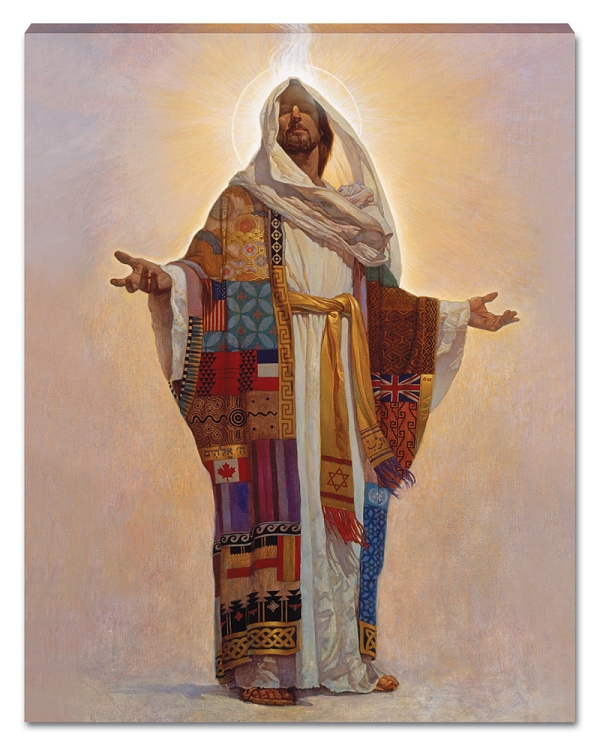
This last weekend I went to see the Andrew Lloyd Webber musical, Joseph and the Amazing Technicolour Dreamcoat in San Diego.
It was an extremely nostalgic experience for me, since as a child I watched this show countless times at the theatre, as well as performing in it in a summer school production. Naturally, in that production I played the role of Pharaoh, the show’s coolest character by far. I even had my own backup dancers and everything! 🙂
In preparation for the trip to see the show, a few days before in Bible Study, we read through the Biblical text of the story found at the end of Genesis, beginning around chapter thirty-seven and continuing for about ten chapters.
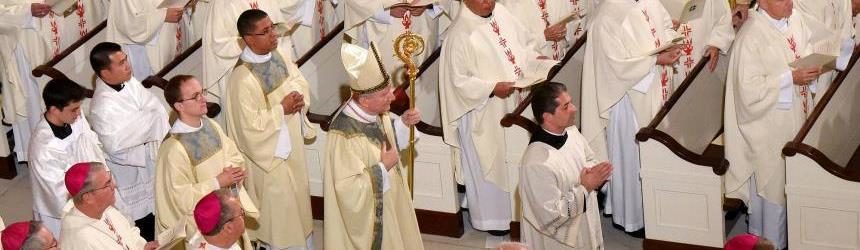
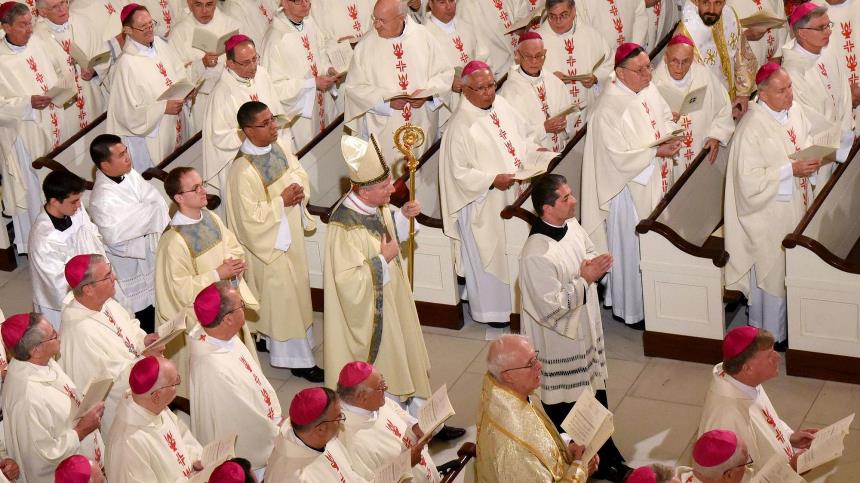
Earlier this week, I wrote a post on Facebook saying that I had spent the first few days of 2019 writing letters to different bishops, and invited others to do the same.
The purpose in writing these letters was to encourage our bishops to be fearless in the exercise of their office, to teach Catholic doctrine faithfully and to protect their flocks from physical and spiritual abuse, all the while being respectful of their office.
My friend Noelle asked me for an outline of what I wrote. Unfortunately, each letter had been different in content. However, I thought it might be helpful to post a synthesis of what I had written over the course of the different letters…
Your Excellency,
There is no sugar-coating it, the Church is in a state of crisis. Unfortunately, much of this relates to the laity’s wavering confidence in the episcopacy, as well as their faith in the upper echelons of the Church’s hierarchy. I am grieved to say that over the past year, both the sin and utter timidity of many, many bishops has continued to be on full display for all the world to see. The results of this have been devastating. Catholics are leaving the Church. Of those who remain, many are withdrawing their financial support. Those in RCIA are reconsidering their choice. Many souls are at risk.
If ever there was a time when the Church cried out for strong and fearless leadership, it is now. The flock need to see the faces of their shepherds and hear their voices. We need to be reassured that the Diocese is in good hands. We need to know that those who would prey on innocents will be swiftly removed and automatically reported to the secular authorities. Not only that, we need to have complete confidence that Catholic teaching will be upheld without exception in every parish, particularly in the extremely unpopular area of personal morality. We need to know that our shepherds will not cower in fear, but will defend us from the wolves.
St. Ignatius, on his way to execution in AD 107, wrote a letter to encourage his fellow bishop, Polycarp. I humbly offer these words to you as an encouragement to be fearless as you shepherd the Diocese over the coming year:
“The times call for you…as one tossed with tempest seeks for the haven, so that both you and those under your care may attain to God. Be sober as God’s athlete: the prize set before you is immortality and eternal life”
Thank you, your Excellency, for giving this letter your attention. You are in my prayers and I am always at your service. I look forward to hearing from you as to how I may assist in your effort to comfort and strengthen the Church.
God bless,
David Bates
The other night I went to see the movie Courageous with a bunch of other guys on a “man trip” ;-). I’ve written about this movie before, but over the next few weeks I’d like to mention a few other thoughts which came to mind while watching the film…
In the story, a group of four men decide to sign a Resolution, a statement of conduct (derived from Scripture) which they promise to follow as both men and as fathers.
In a certain scene, one of the men shows a copy of the Resolution to his wife. She gets really excited and then starts asking him lots of questions. What will the final Resolution look like? What is he going to wear when he signs it? etc. The man gives his wife a look of complete incomprehension and confusion. It’s clear that he hadn’t even considered these things. To this she responds:
“If you’re gonna do this, then do it right. Something like this requires…ceremony!”
I had to smile at this, since, to my Catholic ears, I heard:
“If you’re gonna do this, then do it right. Something like this requires…liturgy“ 🙂
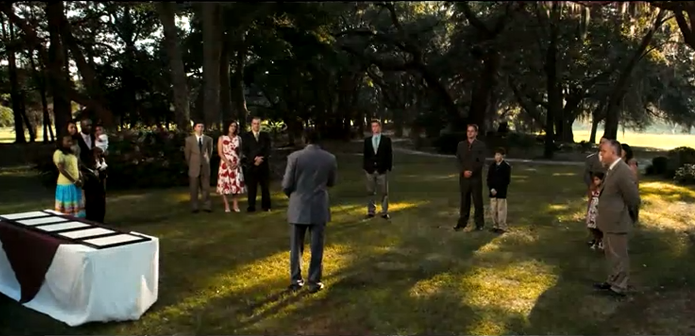
Later in the film we see what this ceremony looks like…
All the men are wearing suits and their family members are present, also in formal attire. They meet in a beautiful park underneath some trees. A long-time friend and minister to one of the men officiates, calling each of the men forward one-by-one. Each man then repeats the Resolution out loud in the presence of his family and pastor, after which he signs a framed copy of the Resolution written in beautiful calligraphy, which he later hangs in a prominent place in his home.