Some more “life verses”…

Yesterday I wrote a post in which I suggested some possible life verses. Today I thought I’d do a quick follow-up with a few more…

Lazy Students

Most people choose life verses which are inspiring, which call them forth to greatness and holiness…but what if that’s not what you really want? What about if you’re happy and comfortable with failure and laziness? Well, in that case, this is the life verse for you…

Of making many books there is no end, and much study is a weariness of the flesh.
– Ecclesiastes 12:12

The recently-shaved

I go bearded from time-to-time. After I shave it off, I always think of this passage:

When it was told David, he sent to meet them, for the men were greatly ashamed. And the king said, “Remain at Jericho until your beards have grown, and then return.”  – 2 Samuel 10:5

Housemates

I live in a house with three other guys. I’m going to recommend one of them in particular to adopt the following passage as his life verse:

He who blesses his friend with a loud voice, rising early in the morning, it will be counted a curse to him.  – Proverbs 27:14

Garlic Lovers

If you overindulge in smelly foods, then this is the life verse for you..

“My breath is offensive to my wife, And I am loathsome to my own brothers. – Job 19:17

Read more

Staying Fetus-Focused

Continuing the series of posts on the subject of abortion, I would like to discuss a strategy which you might consider adopting when talking about abortion with those who are pro-choice.

Types of Objection

I would suggest that, when we’re talking about abortion, the discussion really needs to focus on the unborn themselves. What actually are they? In the process of having an abortion, what exactly is being killed?

Embryo

You see, when pro-choice advocates object to the pro-life position, their objections fall into one of two categories:

1. On-topic Objections
These objections are fetus-focussed. For example, if someone says “It’s just a clump of cells”, their objection is on-topic and allows us to discuss the central issue: the unborn child.

2. Off-topic Objections
These objections relate to some peripheral issue and don’t concern the unborn themselves. For example, these following arguments are sometimes given in favour of abortion:

(a) “The world is overpopulated”

(b) “Raising a child is extremely expensive”

(c) “Not all children will have a stable home life”

(d) …

All of these objections are off-topic.

With regards to the off-topic objections, pro-lifers and pro-choicers will, by and large, agree that the problem being raised does need to be addressed by society. For example, both groups want to see poverty eradicated, vulnerable women protected, children born into stable, nurturing homes. However, the difference is those who are pro-life don’t think that the problem raised is sufficient justification for the killing of a defenseless, innocent life.

Read more

Polycarp Parallels

In the introduction to the Martyrdom of Polycarp, the author tells us that “By almost every step that led up to Polycarp’s martyrdom, the Lord intended to show us anew the type of martyrdom narrated in the Gospel” (Mart. Pol 2.1).

We’re currently working our way through this martyrdom account in the JP2 Group so I thought I’d put together a post highlighting all the parallels I’ve found between Jesus’ death and Polycarp’s witness (martyrdom) to his Lord.

The full text and audio of the Martyrdom is available here.

Some of these parallels are much stronger than others (I put a star rating next to each one of them). In many ways, the fact that there are many inexact parallels actually adds to the credibility of the martyrdom account. Were it fabricated, one would expect the parallels to be “tidied up” a bit more and closer to that of our account of Jesus’ Passion.

Both foretold their deaths (Rating: *****)
In the Martyrdom of Polycarp, after seeing a vision of his pillow aflame, Polycarp turns to his companions and states “I must be burnt alive” (Mart. Pol 5.2). Jesus, likewise, foretold his own death saying “We are going up to Jerusalem, and [I]  will be delivered over to the chief priests and the teachers of the law. They will…hand [me] over to the Gentiles to be mocked and flogged and crucified” (Matt 20:18-19).

Both were betrayed (Rating: **)
Jesus was betrayed, of course, by Judas (Matt. 26:15). The author of the Martyrdom points out that “those who betrayed [Polycarp] were of his own household” and directly compares the betrayer to Judas (Mart. Pol 6.2). Both betrayers accompany the arresting party. However, I can’t help but think that this comparison is a little unfair. Polycarp’s betrayal was neither malicious nor for profit. The slave didn’t reveal Polycarp’s location until he had suffered abuse at the hands of the policemen. In fact, you might call this a “tortured” parallel… 😉

Both begin in an upper room (Rating: *)
When the police arrive for Polycarp he’s in the “upper room of a certain little house” (Mart. Pol. 7.1). Jesus’ Passion was preceded by the Last Supper held also in an Upper Room (Luke 22:12).

Read more

PWJ: S4E17 – TSL 10 – “Friends in Low Places”

The patient has been making new friends of whom Screwtape very much approves…

S4E17: Letter #10 – “Friends in low places” (Download)

If you enjoy this episode, you can subscribe manually, or any place where good podcasts can be found (iTunesGoogle Play, Amazon, Podbean, Stitcher, TuneIn and Overcast), as well as on YouTube. The roadmap for Season 4 is available here.

More information about us can be found on our website, PintsWithJack.com. If you’d like to support us and get fantastic gifts, please join us on Patreon.

Read more

Sunday Lectionary: Holy Trinity Sunday

Fairly terse notes today, I’m afraid…

The Solemnity of the Most Holy Trinity: June 3, 2012

Last week we celebrated the Feast of Pentecost and this week we have another great celebration: Trinity Sunday. The Holy Trinity is one of the central truths of the Christian faith, declaring that there is only one God and in that Godhead there are three persons: Father, Son and Spirit.

The truth of the Trinity was something which was revealed by Christ, although there are hints found in the Old Testament. For example, the use of the first person, plural pronouns found in the Creation account:

Then God said, “Let us make mankind in our image, in our likeness, so that they may rule over the fish in the sea and the birds in the sky, over the livestock and all the wild animals, and over all the creatures that move along the ground.” So God created mankind in his own image, in the image of God he created them; male and female he created them. – Genesis 1:26–27

Some Fathers also saw a hint of the Trinity in the call of the angels before God’s throne:

 I saw the Lord, high and exalted, seated on a throne; and the train of his robefilled the temple. Above him were seraphim, each with six wings: With two wings they covered their faces, with two they covered their feet, and with two they were flying. And they were calling to one another: “Holy, holy, holy is the Lord Almighty; the whole earth is full of his glory.” – Isaiah 6:3

Although revealed in the New Testament, the word “Trinity” is not found in Sacred Scripture. However, the word “Trinity” does describe the truth which is found in Scripture. The word is first used to describe God in the third century by Tertullian (although the word first makes its appearance in Christian theology in 170 AD through the writings of Theophilus of Antioch).

At every Mass we confess the truth of the Trinity in the Nicene Creed when we confess that Christ is “God of God, Light of Light, very God of very God, begotten, not made, being of one substance (homoousios) with the Father”.

This Trinity is one God from Whom, through Whom, and in Whom all things exist – St. Augustine 

Read more

The God Debate Download

Over the last week or so, quite a few people have asked me for my reaction to The God Debate which took place between Trent Horn and Dan Barker, entitled “God: Supreme Being or Imaginary Friend?”.

I think it’s a hard to review a debate objectively, but I can definitely say that I enjoyed the experience. It was certainly well-attended, with both the debating chamber and the overflow room being standing room only. Apart from one cheap shot from Dan towards the end, it was a calm and respectful dialogue.

There were a few things as to the debate format that I would have liked to have been different. I’ve listened to a lot of debates on various subjects and I always end up wishing that there could be more time for cross examination, since I think that’s where the real debate actually happens. However, I know a lot of people think the debate is more constructive when the debaters speak in rounds.

The section I would have particularly liked to have structured differently was the Q&A. I thought the time allotted for each section should have been halved, reducing the time to a sixty second answer and thirty second rebuttal. In my opinion, the questioners were given a little too much freedom and probably should have been moderated a little more heavily. There seemed to be a disproportionate number of questions to each debater and those who asked Trent questions were often wildly off topic, raising issues such as contraception and limbo! This was actually something which Dan did during the debate as well, straying from the topic at hand (the existence of God) and instead wandering into areas such as Biblical criticism, the efficacy of prayer etc. On the occasions when Dan spoke about the Bible I was a little horrified by some of his Biblical interpretations, particularly given that he used to be pastor. For example, he asserted that Jesus told people that they should castrate themselves. I really hope he didn’t preach that message when he led a congregation!

With regards to the debaters themselves, both presented themselves well. Dan had the far greater debating experience and I think this came across in his early delivery, whereas Trent took a little more time to warm up coming into his own later, although this might perhaps be due to the fact that arguments for theism first require the laying of a sound philosophical base.

Looking at my notes from the debate, I could say much more, but you don’t have to read my analysis when you could listen to the debate yourself! The MP3 of the debate is now available for $5 from Catholic Answers:

trent-debate-digital

Artwork of God’s Artwork

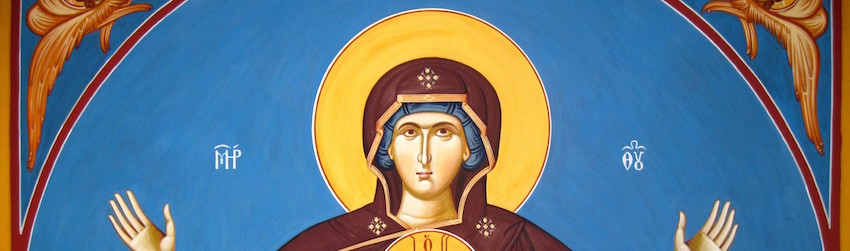
In a previous post I explained the meaning of the text “IC XC” which is found in Eastern icons. I thought today I would do a quick follow-up to explain the letters which commonly appear around the Theotokos…

The Theo-what?

“The Theotokos” (pronounced “th-ay-oh-to-kos”) is the name that Eastern Christians (both Orthodox and Catholic) typically give to Jesus’ mother, Mary. It was also the word used in the proclamation of the Council of Ephesus in 431 AD. In the Western Church, “Theotokos” is often loosely translated into English as “Mother Of God” (whereas it literally means “God-bearer”).

Giving Mary the title “Mother of God” has certainly caused some heated arguments in the history of Christianity. Some have mistakenly seen this title as an elevation of Mary to a height even greater than that of Jesus (if such a thing were possible!). Yet the title “Mother Of God” is really much more about Jesus than Mary, since to say that Mary is not the mother of God is to say that she gave birth only to His humanity, which would indicate  some kind of rupture between Jesus’ human and divine natures. That’s kind of a weighty topic…I think I’ll come back to that another time….

Read more

1 59 60 61 62 63 172