Today’s post is another entry in response to a recent Facebook conversation. This post won’t be as long as yesterday’s post, but I would like to say a few words about Jesus’ unsettling teaching in Chapter 18 of Matthew’s Gospel:
“…if your hand or your foot causes you to sin cut it off and throw it from you; it is better for you to enter life maimed or lame than with two hands or two feet to be thrown into the eternal fire.
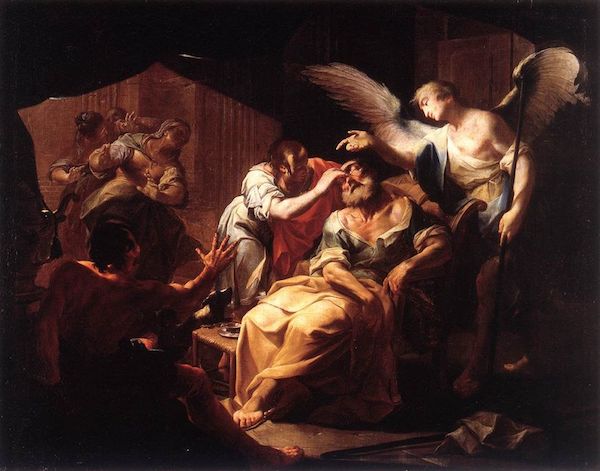
And if your eye causes you to sin, pluck it out and throw it from you; it is better for you to enter life with one eye than with two eyes to be thrown into the hell of fire. – Matthew 18:7-9
This passage from Matthew’s Gospel is rather interesting in that, in my experience, it’s a verse which fundamentalists never take literally (along with John 6 and Acts 2:38). Now, you’ll find pockets of Christians who handle snakes (Mark 16:18), but I have yet to meet someone to apply the same literalistic hermeneutic to that passage. The funny thing about this passage is that the literal sense here is clear – it is better to lose everything in this life rather than to lose Heaven – even hands and eyes.
The central message Jesus teaches here is that we can’t take sin lightly. You can’t treat sin as though it were something with which you can negotiate. You don’t negotiate with cancer! You don’t sit down with a tumour and ask it not to grow too large. No, you cut that stuff out! You eradicate it as quickly as possible because, if left unchecked, it’ll be your ruin. The same is true with sin.
What might be an application of this passage? Well, I would say that we can understand this passage in the context of what is known in Catholic circles as “the near occasions of sin”, which the times and places where we know we can easily fall from grace. In particular, I’d like to apply this passage to the issue of porn.
If you know you are tempted to watch porn when staying a hotel, the best thing to do is cut it off at the source, literally, by phoning ahead and asking the hotel to put a block the channels on the TV. I remember Matt Fradd referencing this passage when speaking about the temptation to watch porn on a smart phone:
“If your iPhone causes you to sin, disconnect it and throw it from you; it is better for you to enter life with a dumb phone and poor connectivity, rather than to be thrown into the eternal fire with a touchscreen and wifi access”
Thus far we have been reading the letters this inspirational martyr wrote from the city of Smyrna, but we must now follow him to Troas where he will write his last three letters before completing his journey to Rome and to the mouths of the wild beasts!
Ignatius now addresses the schism and the Judaising attempts at the church in the city of brotherly love, Philadelphia. Here is my abridged version of the letter:
I’m a regular reader of the website The Art of Manliness. I love their content, but wish that more of it was made available in audio format, in particular the “manvotionals”. At the moment I’m trying to get hold of the guys who run the site to make this request and also to offer my services as part of the team who’ll provide the audio version of their posts.
As part of my pitch, I’ve recorded a recent “manvotional” posted on their website from the autobiography of a man who is consistently voted as being the greatest Briton of all time, Sir Winston Churchill.
A couple of days ago I posted some of the important dates concerning the setting of the Biblical canon. Closely related to the subject of the canon is the issue of the deuterocanon, the books referred to by Protestants as “the apocrypha”, which were removed from the canon at the time of the Reformation.
I haven’t done a “Quick Apology” post this week, so here goes. However, rather than dealing with just one objection in this post, today I’m going to provide a series of brief rebuttals of the top ten most common objections raised….
Protestants typically say that the deuterocanonical books shouldn’t be included in the Bible because…
In this post I would like to give a little bit of my testimony. The full story of my faith journey is obviously quite long, so today I would just like to share with you the genesis of my walk with God.
“In The Beginning…” – Genesis 1:1
I grew up in a home with a mother who was a practising Catholic and a father of somewhat nominal Anglican background. My mother took my sister and me to Mass every week and always encouraged both of us in our faith. At our parish, my sister sang in the choir and I was an altar server. Some of the most vivid memories of my childhood are of the three of us praying together at home and singing along in the car with Psalty the Singing Songbook … 🙂
As a teenager I never had any real rebellion against religion. Sure, I had some doubts at times, but on the whole I enjoyed going to Mass. I took my altar serving duties very seriously and enjoyed the stillness of the Saturday Vigil and the otherwordliness of the Sunday morning celebrations at the Abbey Church.
I then went to University. Although I had been a believer up until this point and prayed pretty regularly, something was about to change…
In my second year of university I moved out of the campus accommodation into a house that was owned by, and situated next to, a Catholic church in the city. As well as having a student Mass, a prayer group was inaugurated shortly after my arrival by an Irish missionary named Maeve who played a significant role in my formation while at University. It was at one of these tiny prayer meetings, in the small back room of the church, that my faith was ignited.
The format of the prayer group was as follows. After an opening prayer, one of the Verbum Dei missionaries would give a short reflection on a particular topic, such as “The Holy Spirit” or “Faith”. Afterwards we would spend some time in silence reading a handout containing some verses of Scripture related to the topic for that week.
Called By Name
It was during one of these times of silence that my eyes came to rest upon the following passage from the prophet Jeremiah:
The word of the LORD came to me, saying, “Before I formed you in the womb I knew you, before you were born I set you apart; I appointed you as a prophet to the nations.”
– Jeremiah 1:5
This wasn’t an unfamiliar passage to me – I had taken Religious Studies at school and learned a whole bunch of Scripture by heart for my exams. However, that night, those words had special power in them. This wasn’t just something God had said to Jeremiah in Judah in ~600 BC, but it was something that He was saying to me in that little room, that night, two and a half thousand years later.
Restless Heart
That night I truly knew that I was known by God and that my life had purpose. It was like someone had turned on a homing beacon inside of me. Sixteen hundred years earlier, St. Augustine wrote in his “Confessions”:
“You made us for Yourself O Lord, and our hearts will wander restless…until we rest in You”
That night I began to recognise the deep restlessness of my heart, and the space inside it that only God could fill. And so began my adult journey of faith and my love affair with Sacred Scripture. The Word is “alive” indeed…
Several months ago I had a lively online exchange with a Protestant from the Reformed tradition. The conversation got really interesting and I had intended to write a series of posts based on our discussion. Alas, before I could do this, his blog was suddenly taken down, meaning that I was unable to use the record of our exchange to save me some work in constructing my posts (yes, I’m rather lazy).
To make sure the same thing doesn’t happen again, today I wanted to do a short post which is effectively a slightly expanded reproduction of my comments on an article over at Reformed Reader, in response to the blog author’s claims concerning Christian history and the Early Church Fathers.


 Ignatius is moving!