Institute of Catholic Culture

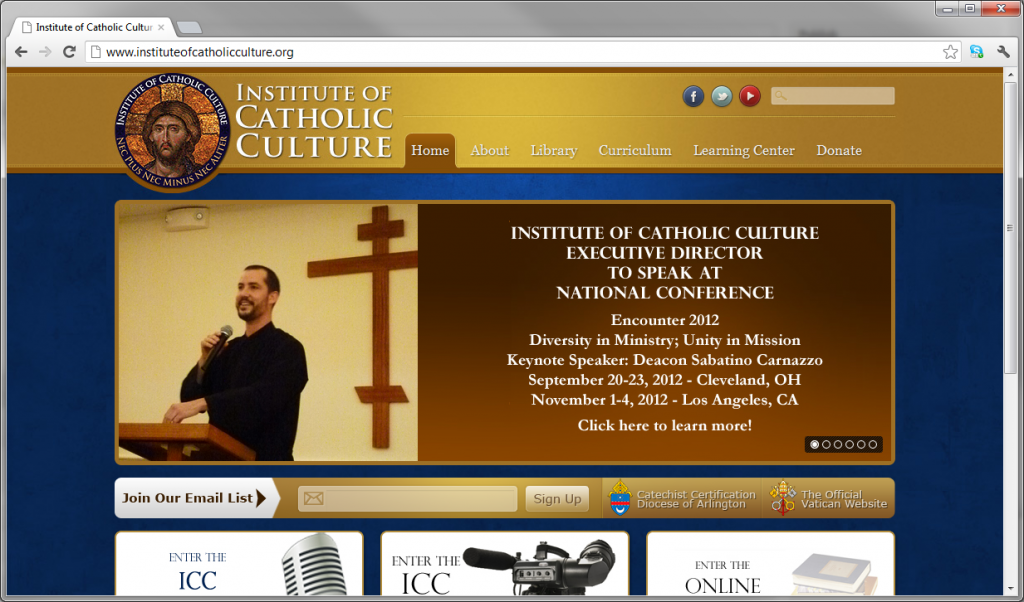
Today I would like to draw your attention to one of the best online sources for Catholic education, the Institute of Catholic Culture.

The Institute was founded by Rev. Franklyn McAfee and Deacon Sabatino Carnazzo. The activities of the institute are centered on the east coast of America, not too far away from where I used to live in Washington DC. However, their work and reach is extended through the magic of the Internet. Their website hosts a huge library of lectures on theology, philosophy, history, Scripture and many other topics. In fact, the website recently underwent a redesign and it is now even possible to watch the lectures live.
Institute Of Catholic Culture

I think I first encountered the Institute through Joe Heschmeyer, Catholic blogger extraordinaire and recent Kansas City seminarian. After he once mentioned the Institute I immediately began consuming all their talks, especially those on Sacred Scripture and the Early Church Fathers. So much great stuff! Here have been some of my favourite talks:

Lives of the Apostolic Fathers
Protestant Revolution | Kingdom of the Cults
Shadows of the Virgin | St. Augustine’s Just War Theory: Then & Now

Anyone who has attended the JP2 Group within the last two years will certainly be familiar with the Institute since I have mentioned them frequently and distributed many of their talks on CD.

The topics are varied, the content is solid and the speakers are engaging. So, if you wish to gain a better understanding of the Catholic faith and experience more of its riches, I would thoroughly recommend that you check out the Institute of Catholic Culture.
Real Food, Real Drink

Today I’d like to talk a little bit about Jesus’ Real Presence in the Eucharist.

A little a while ago I was conversing via email with a non-Catholic called Gerry. We spoke briefly about the Eucharist and he graciously agreed to allow me to post some of our conversation here. Here’s what he said:

“And the mother of it all, in my opinion, is the Eucharist. Transubstantiation. Utterly abominable. Christ was a “victim” once and it was sufficient forever!

The mass is as unholy as a thing can be. We eat His flesh and drink His blood in the spiritual sense, not literal. And to think they even bow down and worship and kiss that cracker because it is (supposedly) Christ in the flesh. And God won’t judge these abominations?!” – Gerry, Email #2

I’m not going to offer a complete defense of the Eucharist here, many other more capable than I have done that already. Instead, today I’d just like to ask a couple of questions concerning one Scripture passage and then on Friday to take a brief look at Christian history.

Below is part of the “Bread of Life” discourse given by Jesus in John’s Gospel:

I am the living bread that came down from heaven. Whoever eats this bread will live forever. This bread is my flesh….Very truly I tell you, unless you eat the flesh of the Son of Man and drink his blood, you have no life in you. Whoever eats my flesh and drinks my blood has eternal life, and I will raise them up at the last day. For my flesh is real food and my blood is real drink. Whoever eats my flesh and drinks my blood remains in me, and I in them.  – John 6:51-54

There are two main questions I’d like to raise here:

1. How did Jesus’ audience understand Him?
After giving this sermon, many people who had been following Jesus left Him. Why did they leave? It’s because they took Him at His word! They believed that He was saying that they had to actually eat His flesh and drink His blood.They took his words literally!

Souls were lost that day because they assumed Jesus wasn’t speaking metaphorically. This begs the question: if Jesus was speaking figuratively, why did He allow so many to leave Him over a something that was just a misunderstanding? Would God really be that cruel?

2. What would He have had to say if He wanted to speak literally?
When speaking with people who interpret John 6 figuratively, I propose the following thought experiment. Firstly, I assume that they are correct in their interpretation of John 6. Jesus was speaking figuratively. However, I then offer the following challenge: if you wanted to go back and alter John 6 to make Jesus speak literally about His flesh, what would you change? Or, put another way, if Jesus had wanted to speak of his flesh literally, what could He have said to convince you that he was speaking literally and not figuratively? I mean, how could His language have been any more extreme than “my flesh is real food“?

So that’s an extremely brief look at John 6. On Friday we’ll look at the Christian witness of the Eucharist in the first two centuries.

worship

 The article Real Food, Real Drink first appeared on RestlessPilgrim.net

New Catholic Dating Website Launched!

For the last couple of months, I have been helping beta test a website which is being launched by a friend of mine. Normally, I’m the one writing the code, so it was a lot of fun having an opportunity to find the bugs in someone else’s work!

Although I’ve known people to find their spouse on CatholicMatch.com, I also know of a lot of people who have found the whole online dating experience frustrating. If this is you, you might like to try CatholicChemistry…

Click on the link above and sign up with the promo code “JMJ”, you’ll get a 6-month subscription for free. If you’re not sure how to start the conversation and get a date, you might like to try some of my favourite Catholic pick-up lines. You can thank me in your wedding toast… 😉

Chalking the doors

epiphany

Tomorrow is the celebration of Epiphany, the day in the Church’s calendar when we remember the visitation of the Wise Men to the infant Christ.

A couple of years ago I was at visiting a parish in Los Angeles for Epiphany and I encountered a tradition with which I was not familiar. As the priest entered the nave of the church, he ascended some portable steps and scribbled something in chalk above the doorway. This tradition is apparently quite common in other parts of the globe, but less common in the United States and I don’t ever recall coming across it in England.

The text

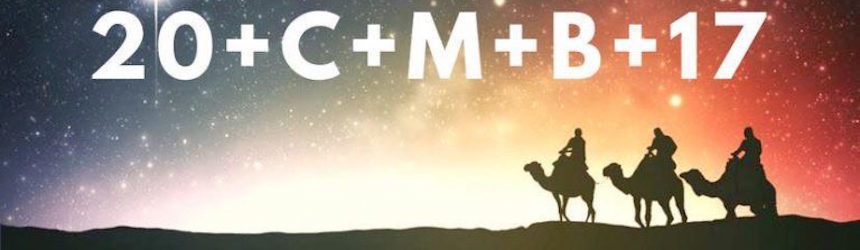
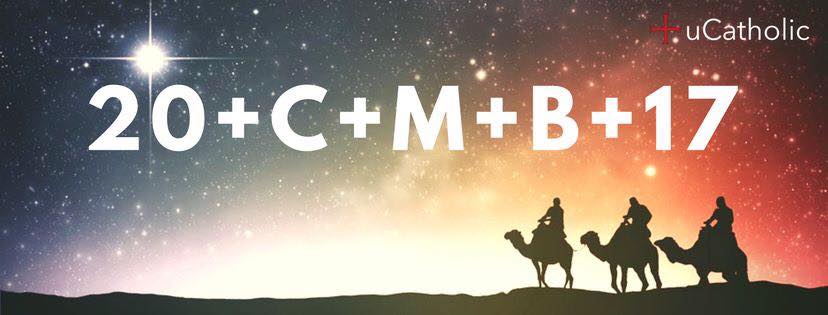
So what did the priest write above the doorway? Well, tomorrow you may see a priest write the following:

20 + C + M + B + 17

The 20 at the beginning and the 17 at the end refer to the new year, 2017. The C, M and B have a two-fold meaning:

1. The Initials of the Wise Men
CMB refers to the first letter of each of the traditional names for the Wise Men: Caspar, Malchior, and Balthazar.

2. Latin Abbreviation
It is also short for “Christus Mansionem Benedicat”, which means “Christ bless this home”.

The crosses between each of the letters naturally refer to the cross of Christ.

Not just on church doors…

In countries where the tradition is more prevalent, this doesn’t just take place at church, but it also happens in every home. All it takes is some chalk and a prayer.

This tradition represents another wonderful way in which to bring the Liturgy that we experience in church back into the home. It also provides a wonderful teaching opportunity for children. I think that, as a boy, I’d have been extremely excited at the possibility of writing on the walls outside the house without fear of repercussions!

Pro-Life March and Christian Unity

Today is the March For Life in Washington DC. This past Sunday, my priest noted the providential intersection between this event and the Week of Prayer for Christian Unity which began last week.

Although it can sometimes be a source of conflict, protection of the unborn and the pro-life cause is really an issue which can unite Christians of all denominations together, as well as with people of good will…

Catholics and Protestants

1 2 3 4 … 137