Empty Chairs At Empty Altars: Part 1

“Sedevacantists” are people who believe that there is currently no Pope, that the “Chair of Peter” is currently empty. In fact, the name “sedevacantist” itself comes from the Latin phrase, “sede vacante”, which literally means “empty seat”.

Sedevacantists typically assert that there hasn’t been a valid Pope since the death of Pius XII (1958), or sometimes even since the death of Pius X (1914). They reject all the Popes which followed (John XXIII, Paul VI, John-Paul I, John-Paul II, Benedict XVI and Francis) and usually accuse them of some kind of heresy, typically the heresy of Modernism.

At the end of last year I was contacted by a chap named Mike. I had been commenting on a YouTube video by Fr. Robert Barron concerning the Second Vatican Council and Mike started sending me private messages which quickly revealed his identity as a sedavacantist.

Mike

I decided to devote a few of posts here to my discussion with Mike. His emails were filled with large portions of text which he had copied and pasted from his website and there was also unfortunately some name-calling (mostly against the Church, although later against myself specifically), but fortunately within the midst of all that we actually did manage to have some real conversation. It is my hope that, in reviewing our exchange, if you ever meet someone like Mike you’ll know what sort of thing to expect…

Read more

Early Church and Receiving Communion

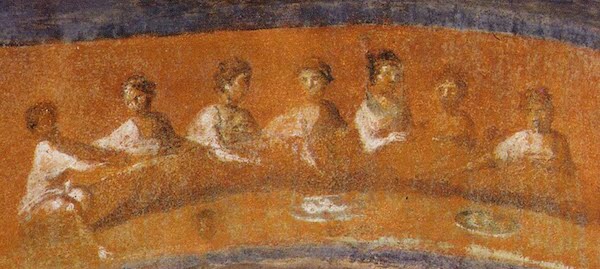
There’s a lot of discussion online at the moment about the conditions under which people may or may not receive communion. I have another post in draft on this subject, but I wanted to do a quick post outlining some of the earliest Church testimony on this subject.

In the First Century, the Didache teaches the following:

“On the Lord’s day, gather yourselves together and break bread, give thanks, but first confess your sins so that your sacrifice may be pure. However, let no one who is at odds with his brother come together with you, until he has reconciled, so that your sacrifice may not be profaned.” – Didache (Chapter 14)

So here we see that unrepentant sin or in a state of disunity cannot receive communion. We find Justin Martyr in the Second Century saying something very similar:

“This food we call Eukaristia [the Eucharist], and no one is allowed to partake but he who believes that our doctrines are true, who has been washed with the washing for the remission of sins and rebirth, and who is living as Christ has enjoined” – St. Justin Martyr, First Apology (Chapter 66)

Here we find the three basic conditions to receiving communion: baptized, assent to Church doctrine and right living.

Eucharist

I’ve got a more substantial post in the works on the subject of interdenominational communion which I’ll publish next week…

Prophecy of Gentile Priests?!

This post isn’t going to be a thoroughly formed article, but I need to get over my writer’s block and get into the habit of writing again…

Priest

I didn’t go to Divine Liturgy this week and instead went to a Roman Mass. During the Readings, something jumped out at me. The passage in question was the First Reading from Isaiah:

Thus says the LORD:
I know their works and their thoughts,
and I come to gather nations of every language;
they shall come and see my glory.
I will set a sign among them;
from them I will send fugitives to the nations…
that have never heard of my fame, or seen my glory;
and they shall proclaim my glory among the nations.
They shall bring all your brothers and sisters from all the nations
as an offering to the LORD…
to Jerusalem, my holy mountain, says the LORD,
just as the Israelites bring their offering
to the house of the LORD in clean vessels.
Some of these I will take as priests and Levites, says the LORD.
– Isaiah 66:18-21

It does sound like the Prophet Isaiah is foretelling a situation whereby the Children of Israel will go out to the nations to proclaim the Lord’s glory and, as a result, bring these Gentiles into relationship with the God of Abraham. Christians obviously find a fulfillment of this in the mission of the Church.

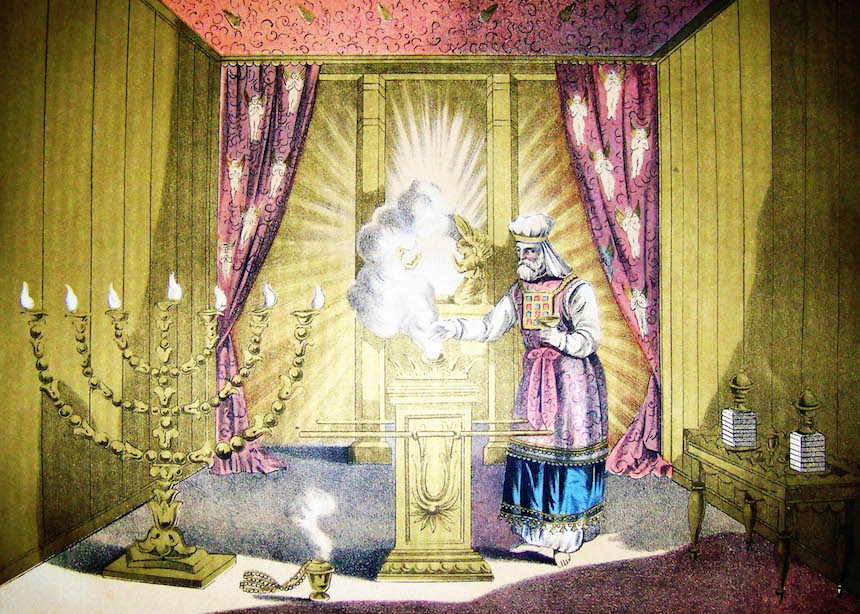
I haven’t done much research on it, but the bit which peaked my interest was the final sentence. The language is a little ambiguous but Isaiah appears to say that, of those Gentiles who believe, the Lord will choose a subset to be “priests and levites”, Gentile priests! This fits very well with the Coptic, Catholic and Orthodox Church’s understanding that, although like Israel we have a priesthood of all believers (Exodus 19:6), some members of that people are set aside for ministerial priesthood…

2013 Resolutions

The other day I did a review of my 2012 Resolutions and it’s now time to write some for 2013!

Resolution #1. Go dancing at least once a week.
Last year one of my less successful resolutions was to dance “more”. This year I’ve decided to continue the resolution, but this time be a bit more specific. I have to go somewhere at least once every seven days.

Resolution #2. Check bank statements once a week.
Like the entry above, this is a resolution carried over from 2012 which has been made a bit more concrete in an attempt to force me to do it properly. Last year I said “Keep better track of finances”. In 2013 I have to log into my Internet banking once a week.

Resolution #3. Complete Reading List
I’ll be publishing my 2013 reading list here later this week.

Resolution #4. Give up Facebook for Lent
Now that I’ve got my blog posts publishing directly to Facebook, I’ll have absolutely no reason not to get that digital monkey off my back…

Resolution #5. Guard free time more jealously
Last year was the “Year of Martha“. My schedule was packed and at times things got quite stressful. My aim this year is to make absolutely sure I don’t take on too much and that I get plenty of time to rest and recharge. This will involve a weekly Holy Hour, come what may. 2013 is going to be the “Year of Mary” 🙂

Resolution #6. Invest more time in friendships
This resolution flows from #5. I have some really good friends. I should spend more time with them.

Resolution #7. Blacklist TV Shows
Also flowing from #5, I’ve got to stop wasting time watching junk on TV. No more Scrubs, Family Guy, Always Sunny in Philadelphia etc.

Resolution #8. Run a half marathon and do a 15 minute plank
Here’s the mandatory fitness resolution.

Resolution #9. Cook a proper meal once a week
I really do enjoy cooking, but I don’t do it nearly as often as I should. That will change.

Resolution #10. Write the book
I’ve had “Write a book” on my bucket list for several years now and this year I’m going to finally cross it off. It’s going to be an expansion on my Leading Bible Study blog series and I’ll probably publish it with Lulu.com (although I will probably also send the manuscript to Ignatius Press just for fun of pretending to be a real author).

resolution

What are your resolutions for 2013?

Mere Christianity – Book IV – Chapter 6 (“Two Notes”)

Book-4

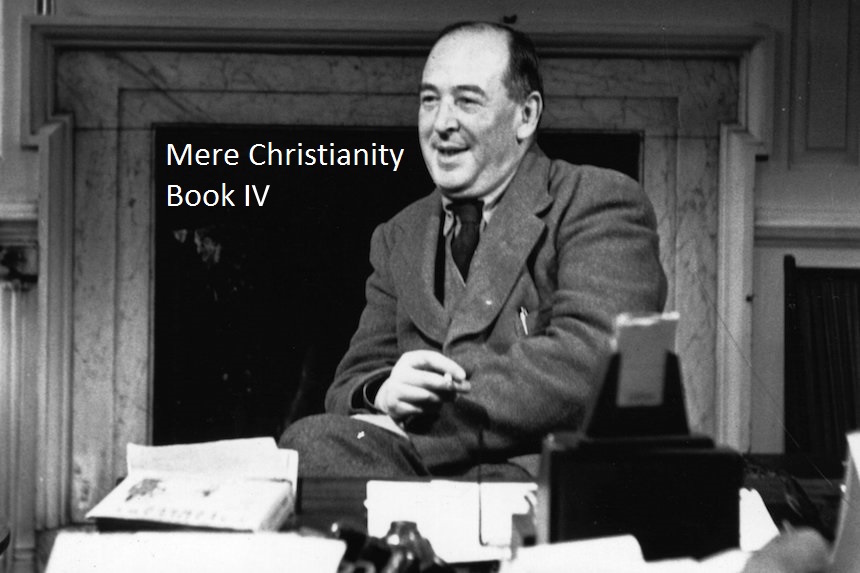
Picking back up my notes for C.S. Lewis’ “Mere Christianity”…

1. Why did God not beget many sons at the outset?

“…if God wanted sons instead of ‘toy soldiers,’ He did not beget many sons at the outset instead of first making toy soldiers and then bringing them to life by such a difficult and painful process”

(a) There are two kinds of answer:

(i) The easy answer

“The process of being turned from a creature into a son would not have been difficult or painful if the human race had not turned away from God centuries ago. They were able to do this because He gave them free will: He gave them free will because a world of mere automata could never love and therefore never know infinite happiness”

(ii) The answer beyond human knowledge

All Christians are agreed that there is, in the full and original sense, only one “Son of God.” If we insist on asking “But could there have been many?” we find ourselves in very deep water. Have the words “Could have been” any sense at all when applied to God? You can say that one particular finite thing “could have been” different from what it is, because it would have been different if something else had been different, and the something else would have been different if some third thing had been different, and so on. (The letters on this page would have been red if the printer had used red ink, and he would have used red ink if he had been instructed to, and so on.) But when you are talking about God-i.e. about the rock bottom, irreducible Fact on which all other facts depend- it is nonsensical to ask if It could have been otherwise. It is what It is, and there is an end of the matter. 

(b) How could there be many sons?

But quite apart from this, I find a difficulty about the very idea of the Father begetting many sons from all eternity. In order to be many they would have to be somehow different from one another. Two pennies have the same shape. How are they two? By occupying different places and containing different atoms. In other words, to think of them as different, we have had to bring in space and matter; in fact we have had to bring in “Nature” or the created universe. I can understand the distinction between the Father and the Son without bringing in space or matter, because the one begets and the other is begotten. The Father’s relation to the Son is not the same as the Son’s relation to the Father. But if there were several sons they would all be related to one another and to the Father in the same way. How would they differ from one another? One does not notice the difficulty at first, of course. One thinks one can form the idea of several “sons.” But when I think closely, I find that the idea seemed possible only because I was vaguely imagining them as human forms standing about together in some kind of space. In other words, though I pretended to be thinking about something that exists before any universe was made, I was really smuggling in the picture of a universe and putting that something inside it. When I stop doing that and still try to think of the Father begetting many sons “before all worlds” I find I am not really thinking of anything. The idea fades away into mere words. (Was Nature-space and time and matter-created precisely in order to make manyness possible? Is there perhaps no other way of getting many eternal spirits except by first making many natural creatures, in a universe, and then spiritualising them? But of course all this is guesswork.)

Read more

Lectionary Notes July 24th

Sorry it’s a bit late – it’s been a hell of a week…

17th Sunday in Ordinary Time: July 17, 2011

Reading 1: 1 Kgs 3:5, 7-12

Scripture:

The LORD appeared to Solomon in a dream at night. God said, “Ask something of me and I will give it to you.” Solomon answered:

“O LORD, my God, you have made me, your servant, king to succeed my father David; but I am a mere youth, not knowing at all how to act.  I serve you in the midst of the people whom you have chosen, a people so vast that it cannot be numbered or counted.  Give your servant, therefore, an understanding heart to judge your people and to distinguish right from wrong.  For who is able to govern this vast people of yours?”

The LORD was pleased that Solomon made this request.  So God said to him:

“Because you have asked for this— not for a long life for yourself, nor for riches, nor for the life of your enemies, but for understanding so that you may know what is right— I do as you requested. I give you a heart so wise and understanding that there has never been anyone like you up to now, and after you there will come no one to equal you.”

Suggested Questions:

  • Who was Solomon?
  • What does God tell Solomon to do?
  • What does Solomon ask for? What would you have asked for?
  • Why is Solomon’s reason for asking for wisdom?
  • How does God respond? Why do you think God responds in this way?
  • What lesson does this have to teach us in our own petitions to God?
  • Have you read any of the Bible’s wisdom literature? Maybe read a proverb or two each day?

Read more

Ugliness finally has a face!

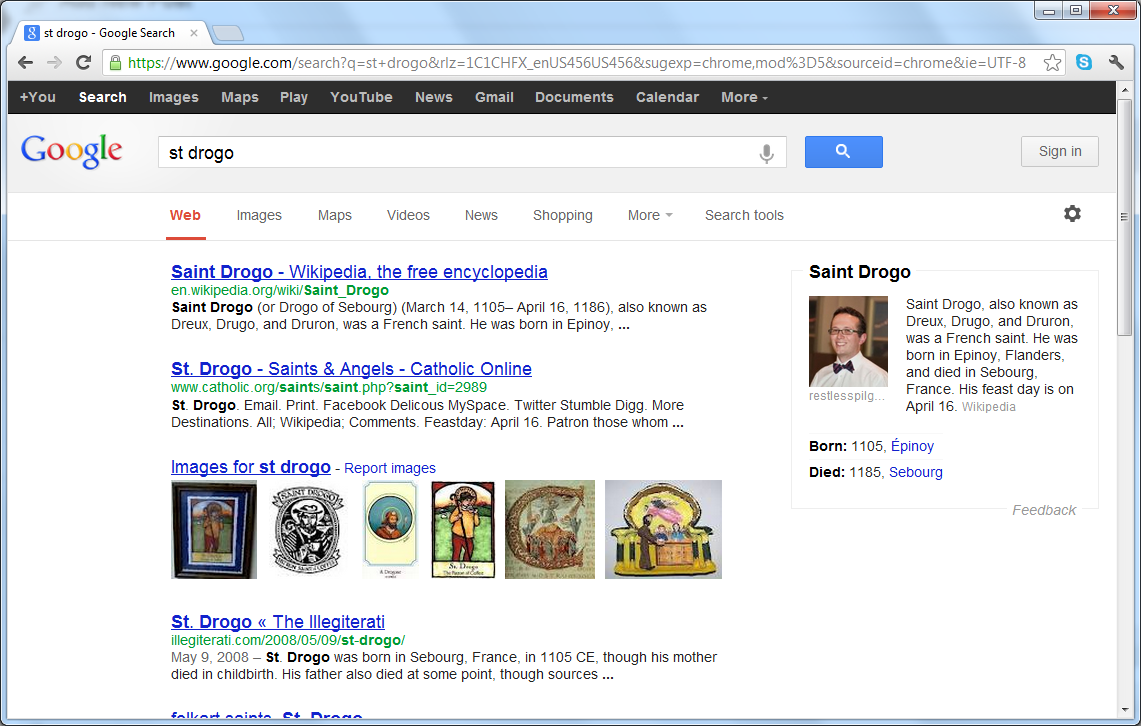
A while ago my friend Ricardo pointed out to me that I am, in fact, a canonized Saint. Even with my profound sanctity, not to mention my superlative humility, I was a little surprised when he said this. When I asked him about it, he told me that Google now shows a picture of me when you search for “St. Drogo”:

St Drogo was a Saint who lived in the 12th Century and has the dubious honour of being the patron Saint of ugly people! Over a year ago I wrote an article about him, declaring him to be the Patron Saint of this blog.

Well, it turns out that Google went looking for picture of St. Drogo, found my article and falsely concluded that my portrait was, in fact, a picture of this French Saint!

So, on the plus side, I’m now a canonized Saint! Unfortunately, it means I also died in 1185… :-/

1 150 151 152 153 154 172