Yesterday I began giving my suggestions as to what can be done to encourage those who have left the Catholic Church to return home. Today I would like to pick this back up again…
5. Don’t be a Ninja Catholic
The ninjas of Japan were known for their stealth, their ability to go unnoticed. In fact, there were many legends circulated that they could even make themselves invisible. Don’t imitate ninjas in this regard!
What do I mean by this? Don’t be ashamed to be identified as Catholic. It may be as simple as praying before meals, wearing a cross or talking with your friends about parish life.
“Let your light so shine before men…” – Matthew 5:16
How will someone ask you about your faith if they don’t even know you’re a Christian?!
The other day I received an email from a reader who had spoken to a non-Catholic with a rather rare point-of-view, and who asked for helpful suggestions when speaking to him…
Objection
During a discussion about the Saints, the Protestant in question made the following statement:
“…no one is in Heaven except Jesus, Enoch, and Elijah.”
This sort of theological position is rarely held by those in mainstream Protestantism, but how might we respond to this?
I just had a very strange interaction on Facebook… A friend of mine posted the following video of the Protestant evangelist Todd Friel:
One of his friends, a man called Simon, responded with the following curious assertions:
His response struck me as a strange for several reasons, but first and foremost because it demonstrated very clearly that Simon was rather unfamiliar with the New Testament! I responded by pointing out that Jesus would absolutely call other people wrong. In fact, at times He could be quite mean, even to the point of calling people names:
“Woe to you, scribes and Pharisees, hypocrites… You fools and blind men… For you are like whitewashed tombs which on the outside appear beautiful, but inside they are full of dead men’s bones and all uncleanness. Even so you too outwardly appear righteous to men, but inwardly you are full of hypocrisy and lawlessness… you brood of vipers”
Matthew 23:15, 17, 27-28, 33
He was even known on occasion to flip tables!
And making a whip of cords, he drove them all, with the sheep and oxen, out of the temple; and he poured out the coins of the money-changers and overturned their tables – John 2:15
John 2:15
Naturally, there are many other Scripture passages which I could have quoted, not least Jesus’ exclusive claims about Himself:
“I am the way, and the truth, and the life. No one comes to the Father except through me.”
John 14:6
With wearying predictability, rather than adjusting his statement, Simon immediately accused me of “judging” him. Some folks really love to jump to play the victim card even at the mildest of challenges. I wonder if he would have said exactly the same thing if I had pointed out an error in his arithmetic…
Amusingly, he then tried to quote Romans 2 to me:
You, therefore, have no excuse, you who pass judgment on someone else, for at whatever point you judge another, you are condemning yourself, because you who pass judgment do the same things. Now we know that God’s judgment against those who do such things is based on truth. So when you, a mere human being, pass judgment on them and yet do the same things, do you think you will escape God’s judgment?
Romans 2:1-3
At this point I suggested to him that, while I’d be happy to discuss that passage with him, it probably isn’t a good idea to quote the Bible at a Christian right on the heels of making a demonstrably false statement about Jesus. He then said that he didn’t want to discuss his beliefs with me any more, so I closed by saying that hopefully I had at least disabused you of the notion that “Jesus would never call other people wrong”. I concluded with a passage which denies this explicitly:
“[Jesus said] ‘You are in error because you do not know the Scriptures or the power of God'”
Matthew 22:29
…and, for good measure, I also included a passage where Jesus teaches His followers about judgement:
“Stop judging by mere appearances, but instead judge correctly”
John 7:24
Needless to say, he wrote with the following:
…and then thirty seconds later deleted the thread.
As I’m sure many of you know, this past month has been “Movember“, also known as “No Shave November“. It is a month in which guys grow facial hair (the more ridiculous the better), using the excuse that they’re raising money for prostate cancer research.
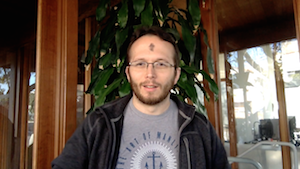
Together with a group of guys from the office in San Diego, I have been participating in Movember. Originally, I planned to not shave at all, but after two weeks the beard was itching and driving me crazy, so I trimmed it back to a ‘tache and a goatee:
Now, in the last couple of weeks a handful of friends have said they actually like my new facial furniture and that I should keep it. Others have said that they hate it and that I should get rid of it immediately.
I enjoy a lot of Frank Turek’s apologetics and listen to his weekly podcast, but he really does have a few blind spots. I recently came across this video which shows that the canon of Scripture is one such blind spot…
What he says here concerning the discernment of the canon isn’t entirely false, but he offers a very insufficient description of what took place. It was the Catholic Church who determined the canon in the early centuries of the Church. In fact, it’s a bit embarrassing that it’s the questioner who is the first person to bring up these councils!
His statement about the Protestant Bible lining up with the Jewish Old Testament is too simplistic, so much so that it’s misleading. The Protestant Old Testament matches the canon of the Jews today… but not of all the Jews in the First Century! After all, there were a number of different Jewish sects in the First Century, such as the Sadducees, Pharisees and Essenes. Each of these groups had a different canon of Scripture…
Now, the Protestant canon matches the canon settled by the rabbis in the Second Century, following the establishment of the Church and the destruction of Jerusalem by the Romans. However, this begs the question: why should Christians accept the opinion of this particular Jewish group? After all, these are the successors to those who rejected that Jesus was the Messiah! If they didn’t recognize the Word incarnate, why would they necessarily correctly recognise the written Word of God? Not only that, wouldn’t they have motivation to exclude books from the canon which very clearly prophesy the suffering of Jesus?
The really egregious error in this video is Frank’s assertion that Roman Catholics added books to the Bible at the Council of Trent. That claim is patently false and honestly I’d expect more from an apologist of Frank’s calibre. Catholics did not add books to the Bible at the Reformation, the Protestants removed them. This is just one of the worst arguments used against the Deuterocanon. Incidentally, Luther even tried to remove books from the New Testament, such as the Epistle of James because he couldn’t reconcile it with his novel theology of Sola Fide…
The Catholic Bible aligns itself to the Septuagint, the Greek translation of the Old Testament which is the translation most often quoted by the New Testament authors themselves. The Catholic Canon was declared by the early councils of the Church, as well as later ones such as The Council of Florence (AD 1431). You don’t have to wait for the Council of Trent (AD 1545). For further proof of this, just ask a Coptic or Eastern Orthodox Christian if they have the Deuterocanonical books in their Bible. These Churches separated from the Catholic Church long before the Reformation, yet still have these Deuterocanonical books…conclusive proof that what Frank said here is incorrect.
This is the first entry in what I hope to be a regular series of posts about the Early Church Fathers.
It is a good thing to study the Early Fathers because by reading their writings we can get a better picture of what the Church looked like during those early centuries, both during the years of persecution and the years of peace.
The Church Fathers speak to us of the Faith they learned from the Apostles and from their immediate successors. If we would sit and listen, their words can still instruct and inspire us today, just as they did for Christians under their care in their own time.
I would like to begin this series of entries with my favourite Early Church Father, the inspirational martyr and gifted writer, St. Ignatius of Antioch.
“Blessed is the man who perseveres under trial, because when he has stood the test, he will receive the crown of life that God has promised to those who love him.”
– James 1:12
My posts on the Fathers will not normally be this long, but reading St. Ignatius for the first time had some a profound effect on me I want to try and do him justice. Read to the end, it’ll be worth it, I promise.
I’m winding down for the evening, but I wanted to quickly share something from Divine Liturgy this morning. The Gospel today on the Byzantine Calendar was the healing of the woman with a haemorrhage:
And there was a woman who had had a flow of blood for twelve years, and who had suffered much under many physicians, and had spent all that she had, and was no better but rather grew worse.She had heard the reports about Jesus, and came up behind him in the crowd and touched his garment. For she said, “If I touch even his garments, I shall be made well.”And immediately the hemorrhage ceased; and she felt in her body that she was healed of her disease. – Mark 5:25-29
As I heard the Scriptures proclaimed today I had an epiphany, seeing an Old Testament connection to this passage which I had not previously seen:
And when [the priests] go out into the outer court to the people, they shall put off the garments in which they have been ministering, and lay them in the holy chambers; and they shall put on other garments, lest they communicate holiness to the people with their garments – Ezekiel 44:19
As you can see, in the Old Covenant the garments of the priests where to be kept away from the rest of Israel, but what a wonderful reversal we have with the New Covenant! Jesus, “our Great High Priest”, goes about among His flock, freely available to the people, with His vestments bringing healing and holiness.
There’s a beautiful practice in the Eastern Churches which is inspired by today’s Gospel. I first saw it at my old Ruthenian parish, but I’m told that it’s more common in Melkite and Antiochian churches. As the priest passes along the aisles, you’ll occasionally see members of the congregation reach out and touch the priest’s vestments, made holy not by his own sanctity, but by virtue of the office given to him by Christ through the Church.