Bible Translations

One of my friends sent me an email asking about Bible translations and requesting an introductory post on the subject. Well Ricardo, here you go…

Before we start talking about different translations, let’s begin by considering the language of the original Biblical manuscripts, which are known as “autographs”. In what language were these originals documents written? Despite what Henry Higgins suggests, the Bible was not originally written in English…

true story

So, if it wasn’t English, in what language was the Bible initially written?  Well, the original Biblical documents were, in fact, written in several languages. Different languages were used for the Old Testament and New Testament, so let’s look at them in turn…

Read more

Quick Apology: The Deuterocanon

A couple of days ago I posted some of the important dates concerning the setting of the Biblical canon. Closely related to the subject of the canon is the issue of the deuterocanon, the books referred to by Protestants as “the apocrypha”, which were removed from the canon at the time of the Reformation.

I haven’t done a “Quick Apology” post this week, so here goes. However, rather than dealing with just one objection in this post, today I’m going to provide a series of brief rebuttals of the top ten most common objections raised….

Tobit

Protestants typically say that the deuterocanonical books shouldn’t be included in the Bible because…

Read more

The Four Loves – Chapter 2 (Part 2: “Love of nature”)

Four Loves 2

Continuing my notes on The Four Loves, this is the first of two posts which continue my summary of Chapter 2 (“Likings and Loves for the subhuman”). In this post we will be looking at the section which Lewis devotes to the love of nature.

1. Some people have a special love of nature

For some people, perhaps especially for Englishmen and Russians, what we call “the love of nature” is a permanent and serious sentiment. I mean here that love of nature which cannot be adequately classified simply as an instance of our love for beauty.

(a) This is more than simply an appreciation of beauty

Of course many natural objects – trees, flowers and animals – are beautiful.

(i) Either of individual objects…

But the nature-lovers whom I have in mind are not very much concerned with individual beautiful objects of that sort. The man who is distracts them. An enthusiastic botanist is for them a dreadful companion on a ramble. He is always stopping to draw their attention to particulars. N

(ii) …or of vistas

or are they looking for “views” or landscapes. Wordsworth, their spokesman, strongly deprecates this. It leads to “a comparison of scene with scene”, makes you “pamper” yourself with “meagre novelties of colour and proportion”.

(b) For these lovers of nature, it is about the “Spirit” of the place

While you are busying yourself with this critical and discriminating activity you lose what really matters – the “moods of time and season”, the “spirit” of the place. And of course Wordsworth is right. That is why, if you love nature in his fashion, a landscape painter is (out of doors) an even worse companion than a botanist. It is the “moods” or the “spirit” that matter.

(c) Which is why beauty itself per se is the focus

Nature-lovers want to receive as fully as possible whatever nature, at each particular time and place, is, so to speak, saying. The obvious richness, grace and harmony of some scenes are no more precious to them than the grimness, bleakness, terror, monotony, or “visionary dreariness” of others. The featureless itself gets from them a willing response. It is one more word uttered by nature. They lay themselves bare to the sheer quality of every countryside every hour of the day. They want to absorb it into themselves, to be coloured through and through by it.

Read more

Chalking the doors

epiphany

Tomorrow is the celebration of Epiphany, the day in the Church’s calendar when we remember the visitation of the Wise Men to the infant Christ.

A couple of years ago I was at visiting a parish in Los Angeles for Epiphany and I encountered a tradition with which I was not familiar. As the priest entered the nave of the church, he ascended some portable steps and scribbled something in chalk above the doorway. This tradition is apparently quite common in other parts of the globe, but less common in the United States and I don’t ever recall coming across it in England.

The text

So what did the priest write above the doorway? Well, tomorrow you may see a priest write the following:

20 + C + M + B + 17

The 20 at the beginning and the 17 at the end refer to the new year, 2017. The C, M and B have a two-fold meaning:

1. The Initials of the Wise Men
CMB refers to the first letter of each of the traditional names for the Wise Men: Caspar, Malchior, and Balthazar.

2. Latin Abbreviation
It is also short for “Christus Mansionem Benedicat”, which means “Christ bless this home”.

The crosses between each of the letters naturally refer to the cross of Christ.

Not just on church doors…

In countries where the tradition is more prevalent, this doesn’t just take place at church, but it also happens in every home. All it takes is some chalk and a prayer.

This tradition represents another wonderful way in which to bring the Liturgy that we experience in church back into the home. It also provides a wonderful teaching opportunity for children. I think that, as a boy, I’d have been extremely excited at the possibility of writing on the walls outside the house without fear of repercussions!

If you’re happy and you know it…

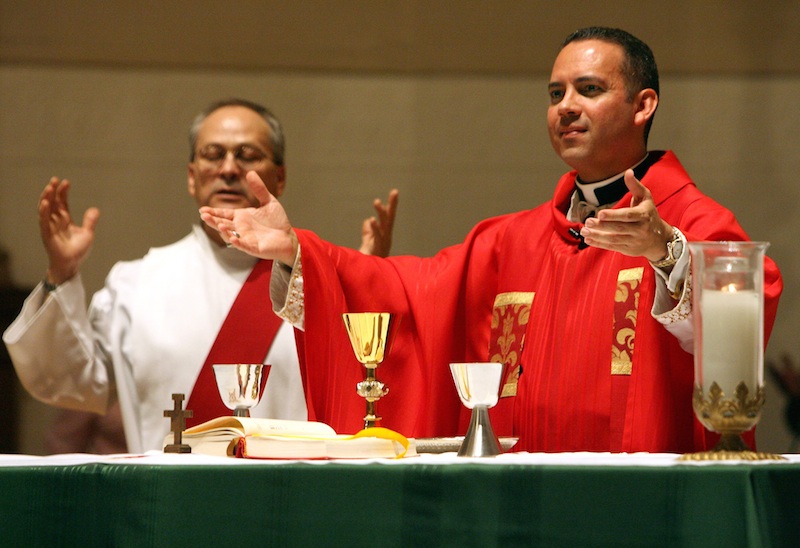
Something has been bugging me for some time now. The vast majority of Masses I’ve attended in the States have ended with applause. Back in England I encountered this fairly often among non-Catholic congregations, but quite rarely in Catholic parishes.

guitar

Here in San Diego I play the guitar in at a LifeTeen Mass and there is applause every week as we finish the final song. Now, there was a time when I wasn’t fussed about the clapping, but now it really rather bothers me… 

Read more

1 147 148 149 150 151 172