Catholic Dating: “Pursuit”

Today’s post may be somewhat controversial, but I’d like to talk about this particular topic because it was an aspect of dating which most infuriated me in my early twenties.

In an earlier post, I spoke about a counterfeit, passive masculinity which one often finds within Christianity. However, thanks to writers such John Elridge and Jason Evert, there has been a growing shift with regards to the expected behaviour of men within the Church.

As a result, the ladies are encouraged to expect a lot more from the guys. Courageous valour, rather than niceness is the order of the day. Related to this, you hear constant mention of one word in particular, “pursuit”.

Pursuit

Today I would like to address some of the potential hazards with the idea of pursuit and suggest what can be done to safeguard against them.

Read more

Bible Canon Questions

Today over at St. Joseph’s Vanguard Devin wrote an article about How Evangelicals Know Their Canon Is Correct. It describes an exchange Devin had with an Evangelical concerning which books belong in the Bible.

Now, not all Evangelicals will hold those views expressed in the article, but I have to say that Devin’s exchange bears a strong resemblance to conversations I myself have had with non-Catholics concerning Sacred Scripture…

In my experience, when a Catholic-Protestant dialog reaches this stage it often stagnates. You then spend a lot of time going round and round in circles… 🙁

In an effort to stop this from happening, I find that it is generally best to keep asking questions. These questions will hopefully reveal to the non-Catholic his unknown dependency upon Catholic Church with regards to the formation of the Canon.

You may recall a little while ago I wrote about an exchange I had with a chap called Jay. When we were talking about the Bible, these were some of the questions I asked him:

1.  Let’s say I don’t believe James should be in the Bible.  Show me why I’m wrong. What’s to stop me from just taking this book out of the Bible?

2.  Let’s say I believe that Clement’s letter to the Corinthians should be in the Bible.  Show me why I’m wrong.  He was alive during the time of the Apostles and Clement has strong credentials for being taught by them…

3. Who wrote the Letter to the Philippians? What about the Gospel of Mark? How do you know?

4. Who were the people who painstakingly copied the New Testament manuscripts throughout the centuries?

5. Have you checked the authenticity of every book in the Bible? Are you sure that we have all the available “inspired texts”? How did you reach your opinion over what and what isn’t the Word of God? Are you 100% certain? Can I trust your judgment on this? Because if you’re wrong I could be ignoring text which is the Word of God and reading text which isn’t…

6. Who assembled the canon of the New Testament and when? Please give me names and dates.

Don’t be too eager to hit "Send"

I had this blog entry in my “drafts” folder for over six months and it’s been quite some time since I posted an entry for the Stuff I’ve had to learn category. Today I would like to remedy this situation by presenting a piece of wisdom that I’ve been forced to learn over the years.

This bit of advice has certainly resolved many tense situations and has saved more than one friendship:

Don’t be too eager to hit…

Turbo-Charged Communication

Communication today is certainly quicker than it was in the past.  It is now extremely easy to fire off a quick message to someone on the other side of the world, whereas in times past it required the purchase of stationery equipment, the composition of a letter, the purchase of the appropriate stamp and delivery to the nearest postbox.  A substantial wait was then required before a reply would be received.

I’m all in favour of modern communication methods – cell phones, skype, email and text messaging make communicating with those in far-flung places both efficient and cheap. For me personally, it’s what makes living in America and staying in close contact with friends in England possible. However, I would suggest that our advances in technology sometimes make communication just a little bit *too* easy…

Read more

My response to John Fontain

John Fontain recently debated David Wood on the Islamic Dilemma, which points out that the Qu’ran both affirms the Torah and Gospel while contradicting them.

John has a rather different strategy from other Muslim apologists by positing that there was an Islamic Torah and Islamic Gospel present at the time of Muhammad. He claims these are the documents the Qur’an refers to and confirms.

At one point in the debate, John asked David Wood for proof that the documents in the Hejaz were today’s Torah and four-fold Gospel, rather than John’s hypothetical documents. Obviously it’s much easier to do this at leisure and when one isn’t in the hot seat, here’s the answer I would have given…

John, there are lots of things I can’t prove. For example, I can’t prove that there isn’t a small teapot orbiting the sun… but that doesn’t mean I should expect one to be there! 

While it is technically possible that unique documents might have been present in Mecca and Medina, I can say for certain that there is no proof of such documents existing prior to the coming of Muhammad. Consider the timeline for a moment. It means that, for six hundred years in the case of the Gospel and for a couple of thousand years in the case of the Torah, there is no evidence of such documents existing. We have no manuscripts of these Islamic works and no fragments either. Not only that, nobody references them, neither the People of the Book nor their enemies. Don’t you not find that strange? If the Qur’an is true and Allah promised to make the true believers of Jesus uppermost from the days of his ministry until the Day of Resurrection, how is possible that Isa’s message, Apostles, and Scripture left no trace in history


In Early Christianity there was no military power to crush dissenters and there was no central political power such as Caliph Uthman to enforce textual uniformity.  Documents were shared by Christians throughout the world in an uncontrolled fashion, yet we find nothing like an Islamic Gospel or Islamic Torah. We also know about the disputes and heresies in Early Christianity (Docetism, Marcionism, Nestoriamism, Modalism etc), yet we find nothing that looks like Islam. 

Despite this absence of evidence, you John could provide us with the much-needed evidence to substantiate your extraordinary claim that there was an Islamic Torah and an Islamic Gospel present in the Hejaz… just show it to us! If these scriptures were in the possession of the Muslims, they would have preserved them, right? Surely it would have been in their interest to preserve them! Firstly, these were the words of Allah! Secondly, these works would have provided additional information about the earlier prophets. Thirdly, these documents would have contained the detailed prophecies about the coming of Muhammad. And finally, they would substantiate the Qur’an’s argument for its divine origin by showing how the Qur’an truly does confirm the earlier scriptures!

But there’s a problem, isn’t there? You can’t show us these documents because you don’t have them! There is an additional unfortunate consequence to this… If your theory is true, it is Muhammad-believing Muslims who last had custody of the uncorrupted earlier scriptures, yet they seem to have inexplicably my lost them! So, even if you can explain how these documents survived in secret for thousands of years and then mysteriously turned up in the 7th Century Hejaz, you also have to explain why the Muslims failed to preserve them and also why we don’t find any early Islamic scholars lamenting the fact that is was Muhammad’s immediate followers who lost the best possible evidence to confirm the claims of Islam. 

I would suggest that it’s more logical to conclude that your theory is incorrect and your Islamic Torah and Gospel never existed. 

Bible alone? Part 1

sola scripturaToday I’d like to speak about “Bible Alone” Christianity, also known by its Latin name, “Sola Scriptura”.

Sola Scriptura is an important issue to discuss because it underpins virtually all of Protestantism. It was the Formal Principle of the Reformation. This topic has come up in every discussion I’ve ever had with non-Catholics. It is the major Protestant presupposition and, although the Catholic Faith can certainly be defended from Sacred Scripture, this presupposition really needs to be tackled early on in any Catholic-Protestant dialogue.

This article is another of those half-written posts which languished in my “Drafts” folder for a long, long time. I had intended to write a substantial and thorough article concerning Sola Scriptura since my own realization concerning the shortcomings of this doctrine was the tipping point in my return to the Catholic Church.

However, once again, my desire to write a thorough post has prevented me from writing anything at all. I resisted writing until I had time to do the subject matter justice. So, once again I am forced to return to the words of G.K. Chesterton “If something is worth doing, it’s worth doing badly”. Rather than waiting until I can do a perfect job I’m just going to sit down, write something and get it out there. So, please put on your crash helmets…here we go…

Read more

Quick Apology: Doing whatever you want with your body?

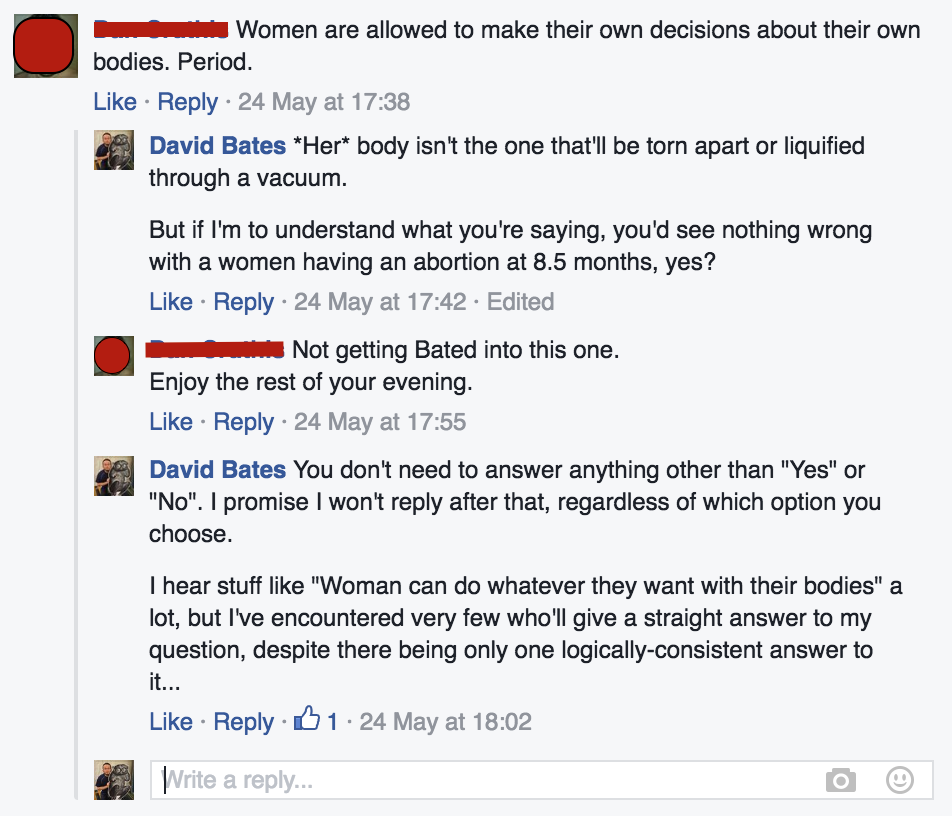
Today’s post is a follow-up to the one last Thursday. In response to my comments about the differences between circumcision and abortion, a friend-of-a-friend offered a reply. However, rather than responding to what I said, he simply trotted out a favourite slogan of the pro-choice moment. Here was our exchange:

Bodies

“My body, my choice” is one of the favourite sayings of those who favour the continued legal access to abortion. However, the statement is patently false and I would suggest that nobody really believes it.

Read more

Trusted Testimony?!

I’m reading through the Qu’ran one last time this year and wanted to follow along with a Tafsir. I discovered Quran Garden which was just the sort of thing I was looking for. Something was said early in the course which I found jaw-dropping:

Historically, as the Quran was being collected and written down in its book form, two rules were implemented for writing down each verse.  The first rule required that two people who had memorized the verse were present, and the second rule required that the verse was also found written down by one of the Prophet’s companions.  These two conditions were met for each and every verse in the Quran except for one.  This one verse was found written down; however, it was only memorized by one companion.  So, according to the rules, this verse should have been excluded from the Book.

But here comes an incident that shows the wisdom and mercy of God Almighty.  This particular verse was memorized by a man named  خزيمة (Khuzaima), and no one else.  The scribe who was writing down the Quran remembered that the Prophet, peace be upon him, said, “Whomever Khuzaima testified for, it should suffice.”  The Prophet had given Khuzaima’s testimony the weight of two testimonies.  This was based on an event that happened while he, peace be upon him, was alive.  The Prophet had borrowed money from a man and then repaid him the debt.  After some time, the man came back to the Prophet asking for his money back.  The Prophet told the man that he had already repaid him the debt in full.  So this man asked the Prophet to bring forward a witness who saw the transaction.  However, no one was with the Prophet at the time he repaid the debt.  This is when Khuzaima came forward and said, “I was present when the Prophet repaid you the money.”   After the man left, the Prophet turned to Khuzaima and said, “I know you were not present when I repaid my debt, no one was there.  How could you say that you were with me?”  Khuzaima looked at the Prophet and said, “How can I believe you in all the revelations you brought from the heavens, and then disbelieve you about a few coins?”   Khuzaima, through his wisdom, saw that the Prophet, the most honest and truthful man he knew, could not be dishonest about a small worldly matter when he was honest in delivering God’s message.  When the Prophet saw Khuzaima’s deep understanding and belief, he was delighted and said, “Whomever Khuzaima testified for, it should suffice.”

This is bizarre logic! Muhammad declared Khuzaima to always offer trustworthy testimony because he knew for a fact that he was a liar!

1 145 146 147 148 149 172