Several times recently I’ve had people speak to me about “the wealth of the Vatican”, either implying it’s wrong for the Church to have money or just openly condemning it. It is declared that it is hypocritical and somehow contrary to the teaching of Jesus. A lot could be said on this subject, but I would just like to briefly make a few points…
Well, this is kinda cool! I was having a little look at my WordPress statistics and noticed that somebody in Finland referred to a Restless Pilgrim post!
I started this blog a while back now, in June of 2010. Today I thought I’d advertise the blogs of some of my friends who also write here on the Internet.
1. Transformed In Christ
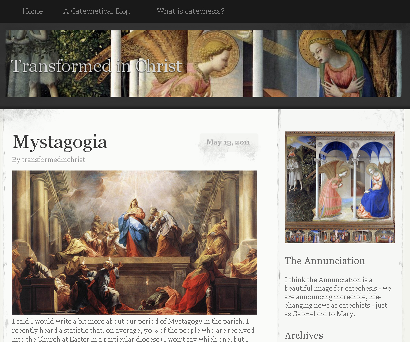
The first blog I’d like to share (and what prompted this post) is Hannah’s blog Transformed In Christ. I first met Hannah when I lived in Cheltenham back in 2003. She’s a graduate of Cambridge University and now lives in London. She hasn’t been blogging for very long, but she’s a smart cookie, so expect some good stuff here 🙂
We first had Dr. Louis Markos on the show during Season 2 when we spoke about imagery of Heaven and Hell in Western Literature. He also recently made an appearance on Barfield Month. Today he returns once more to talk about his new book, The Myth Made Fact: Reading Greek and Roman Mythology through Christian Eyes.
S4E69: “After Hours” with Dr. Louis Markos (Download)
A very short post today. I just wanted to share a little “ah hah!” moment I had recently.
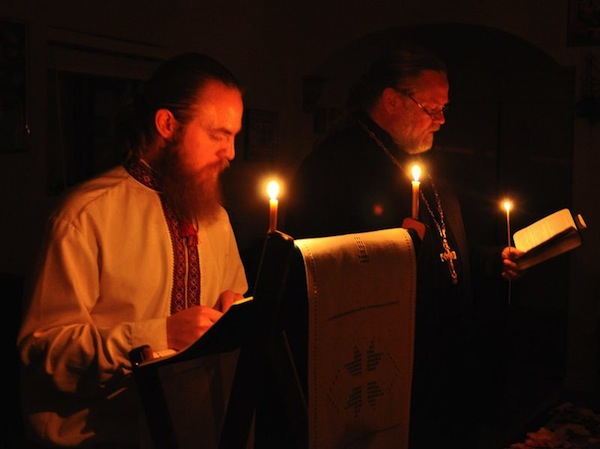
A little while back I went to vespers at an Eastern Orthodox parish. The format of the service was almost identical to that of my Eastern Catholic parish. The only real differences were alternative melodic forms and slightly different English translations.
During my visit I noticed something about the translation of one of the psalms. Several times Israel was referred to in the masculine form, “him”. This rather surprised me since I typically think of Israel as feminine, the people to whom God has espoused Himself and which, under the New Testament, flowers into the Church, the Bride of Christ.
…I will make a new covenant with the house of Israel and the house of Judah, not like the covenant which I made with their fathers…which they broke, though I was their husband, says the Lord. – Jeremiah 31:32
After Vespers a few of us were talking to the priest and I raised this question. We agreed that Israel was probably referred to using the masculine gender to highlight the relationship of sonship between God and Israel:
And you [Moses] shall say to Pharaoh, ‘Thus says the Lord, Israel is my first-born son, and I say to you, “Let my son go that he may serve me”…’ – Exodus 4:22-23
Under the Old Covenant, God became Father to Israel and Israel became God’s first-born son, the elder brother among the nations, to manifest the wisdom of God and to lead the Gentiles back home.
For my final month in San Diego, my Bible Study Group is going to be going through the epistles of St. John (1 John, 2 John, 3 John). However, this last week we reviewed our study of Ephesians. Here are the review questions the group came up with:
68. When was Ephesians written?
This letter is one of the “captivity epistles” and therefore was probably written during Paul’s Roman captivity in the early 60s.
69. What is significant about the destination of this epistle?
Mention of Ephesus in verse 1 is not found in the earliest manuscripts. It is therefore possible that this was a circular letter written to a number of congregations, one of which was Ephesus.
70. What was Paul’s relationship with Ephesian Church?
Christianity was present in Ephesus prior to Paul’s arrival. Paul used Ephesus as his base of operations for several years.
71. What does Paul write about in Ephesians?
Paul devotes most of the document to putting forth a vision of God’s redemptive work, brought about through Christ and manifested in the Church.
The Ephesians were mostly newly baptized Pagans and, because of this, some have referred to Ephesians as mystagogical catechesis.
Paul spends quite some time talking about “mystery”. This relates to Jesus’ sacrifice on the cross which draws man, both Jew and Gentile, back into relationship with God. This relationship is communicated through the Church, which has Christ as her head.
In anticipation of Season 4, Matt sat down and shared some of his favourite quotations from the book which we will be reading this Season, The Screwtape Letters…
There is no need to despair; hundreds of these adult converts have been reclaimed after a I brief sojourn in the Enemy’s camp and are now with us. All the habits of the patient, both mental and bodily, are still in our favour…
If once they get through this initial dryness successfully, they become much less dependent on emotion and therefore much harder to tempt.
The Screwtape Letters, Letter 2
Teach them to estimate the value of each prayer by their success in producing the desired feeling; and never let them suspect how much success or failure of that kind depends on whether they are well or ill, fresh or tired, at the moment.
The Screwtape Letters, Letter 4
He really does want to fill the universe with a lot of loathsome little replicas of Himself—creatures, whose life, on its miniature scale, will be qualitatively like His own, not because He has absorbed them but because their wills freely conform to His. We want cattle who can finally become food; He wants servants who can finally become sons. We want to suck in, He wants to give out. We are empty and would be filled; He is full and flows over.
The Screwtape Letters, Letter 8
…the Trough periods of the human undulation provide excellent opportunity for all sensual temptations, particularly those of sex
The Screwtape Letters, Letter 9
The Enemy’s demand on humans takes the form of a dilemma; either complete abstinence or unmitigated monogamy
The Screwtape Letters, Letter 18
It is the business of these great masters to produce in every age a general misdirection of what may be called sexual “taste”. This they do by working through the small circle of popular artists, dressmakers, actresses and advertisers who determine the fashionable type. The aim is to guide each sex away from those members of the other with whom spiritually helpful, happy, and fertile marriages are most likely.
The Screwtape Letters, Letter 20
You no longer need a good book, which he really likes, to keep him from his prayers or his work or his sleep; a column of advertisements in yesterday’s paper will do. You can make him waste his time not only in conversation he enjoys with people whom he likes, but in conversations with those he cares nothing about on subjects that bore him. You can make him do nothing at all for long periods.
You can keep him up late at night, not roistering, but staring at a dead fire in a cold room. All the healthy and outgoing activities which we want him to avoid can be inhibited and nothing given in return, so that at last he may say, as one of my own patients said on his arrival down here, “I now see that I spent most of my life in doing neither what I ought nor what I liked”.
The Screwtape Letters, Letter 12
You no longer need a good book, which he really likes, to keep him from his prayers or his work or his sleep; a All we can do is to encourage the humans to take the pleasures which our Enemy has produced, at times, or in ways, or in degrees, which He has forbidden
The Screwtape Letters, Letter 9
Indeed the safest road to Hell is the gradual one—the gentle slope, soft underfoot, without sudden turnings, without milestones, without signposts
The Screwtape Letters, Letter 12
Everything has to be twisted before it’s any use to us. We fight under cruel disadvantages. Nothing is naturally on our side.
The Screwtape Letters, Letter 22
To be greatly and effectively wicked a man needs some virtue.
The Screwtape Letters, Letter 29
You must therefore conceal from the patient the true end of Humility. Let him think of it not as self-forgetfulness but as a certain kind of opinion (namely, a low opinion) of his own talents and character
The Screwtape Letters, Letter 14
Surely you know that if a man can’t be cured of churchgoing, the next best thing is to send him all over the neighbourhood looking for the church that “suits” him until he becomes a taster or connoisseur of churches.
The Screwtape Letters, Letter 16
You should always try to make the patient abandon the people or food or books he really likes in favour of the “best” people, the “right” food, the “important” books.
The more often he feels without acting, the less he will be able ever to act, and, in the long run, the less he will be able to feel…





 For my final month in San Diego, my Bible Study Group is going to be going through the epistles of St. John (1 John, 2 John, 3 John). However, this last week we reviewed our study of Ephesians. Here are the review questions the group came up with: