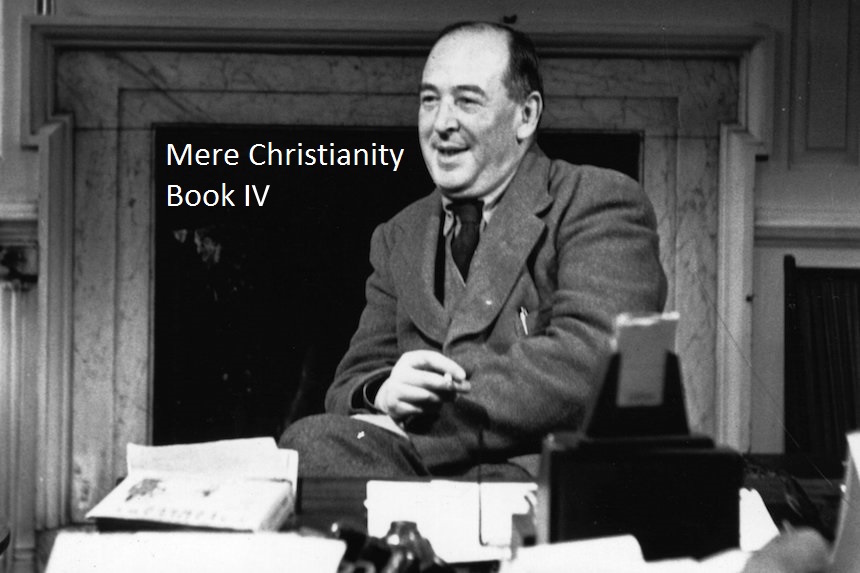
Mere Christianity – Book IV – Chapter 10 (“Nice People Or New Men?”)

Book-4

Picking back up my notes for C.S. Lewis’ “Mere Christianity”…

1. If Christianity is true, why are all Christians not obviously nicer than all non-Christians?

(a) Part of this question is very reasonable

“If conversion to Christianity makes no improvement in a man’s outward actions… I think we must suspect that his ‘conversion’ was largely imaginary…”

(i) Jesus told us to judge by results

“Fine feelings, new insights, greater interest in ‘religion’ mean nothing unless they make our actual behaviour better; just as in an illness ‘feeling better’ is not much good if the thermometer shows that your temperature is still going up… Christ told us to judge by results”

(ii) When we fail to live up to our calling, we make Christianity harder to believe for others

“When we Christians behave badly, or fail to behave well, we are making Christianity unbelievable to the outside world… Our careless lives set the outer world talking; and we give them grounds for talking in a way that throws doubt on the truth of Christianity itself”

(b) Part of this question is very unreasonable

But there is another way of demanding results in which the outer world may be quite illogical…. they should see the whole world neatly divided into two camps -Christian and non-Christian – and that all the people in the first camp at any given moment should be obviously nicer than all the people in the second.

There are several flaws with this kind of thinking…

Read more

PWJ: S4E65 – AH – “After Hours” with Alessandro DiSanto

Continuing his investigation into holy habits, Matt sat down for a drink and a chat with his friend, Alessandro DiSanto, one of the founders of Hallow app.

S4E65: “After Hours” with Alessandro Disanto (Download)

If you enjoy this episode, you can subscribe manually, or any place where good podcasts can be found (iTunesGoogle Play, AmazonPodbeanStitcherTuneIn and Overcast), as well as on YouTube. The roadmap for Season 4 is available here.

More information about us can be found on our website, PintsWithJack.com. If you’d like to support us and get fantastic gifts, please join us on Patreon.

Read more

Then End Is Nigh

It’s now less than a week until Judgement Day. Well, it is if you believe a chap called Harold Camping. Camping is the president and founder Christian Family Radio and asserts that Judgement Day is going to be this Saturday, May 21st. You may have seen the billboards or commercials around:

I hadn’t come across this group until Ι first visited San Diego when one of their leaflets was given to me Downtown by a street evangelist. Later that day, over an ice tea, I read the leaflet from cover-to-cover (I always try to read the stuff that guys like that give me). It didn’t contain anything about the end of the world, but did give me an introduction to the group’s rather “unique” way of interpreting Scriptural prophecy.

I remember that, through interpretation of some of the writings of the prophets, the leaflet asserted that the “Church Age” had now ended and that true believers should now leave their local congregations, study the Bible on their own and, as you might expect, listen to their radio station.

Read more

You’ve got (ancient) mail!

When reading any book of the Bible we must first talk about its literary genre. What kind of writing is it? Is it apocalyptic? Is it poetry? Is it historical? The literary genre to which a document belongs affects how we understand it.

If we get the literary genre wrong, it is extremely likely that our interpretation will be faulty. Therefore, when we are looking at a book of the Bible which is an epistle i.e. a piece of correspondence, we must read it as such. It is also extremely helpful when reading a biblical epistle to first examine the conventions of letter writing at the time of the Apostles.

A friend recently asked that we should study the First Epistle of St. Peter together. Since I’ve had to explain the mechanics of ancient letters a few times now, I’ve decided to devote a blog entry to the subject so that I can easily refer to it in future 😀

(There is a technical difference between an “epistle” and a “letter”…
but we’ll ignore that distinction in this post)

Snooping on Mail

To see the structure of ancient letters more clearly, let’s examine a short letter written by a Pagan in approximately AD 150:

Apion sends heartiest greets to his father and lord Epimachus.

I pray above all that you are well and fit; and that things are going well with you and my sister and her daughter and my brother.

I thank my Lord Serapis that he kept me safe when I was in peril on the sea.

As soon as I got to Misenum I got my journey money from Caesar – three goldpieces. And things are going fine with me. So I beg you, my dear father, send me a line, first to let me know how you are, and then about my brothers, and thirdly, that I may kiss your hand because you brought me up well, and because of that I hope, God willing, soon to be promoted.

Give Capito my heartiest greetings, and my brothers and Serenilla and my friends. I sent you a little picture of myself painted by Euctemon. My military name is Antonius Maximus. I pray for your good health. Serenus sends good wishes, Agathos Daimon’s boy, and Burbo, Gallonius’ son.

Deconstructing Apion

There are several distinct features in this letter:

1. Greeting. The author first identifies himself (“Apion”) and then identifies to whom he is writing (his father “Epimachus”):

Apion sends heartiest greets to his father and lord Epimachus.

2. Prayer. The author prays for the health and well-being of the recipients (his father, siblings and niece):

I pray above all that you are well and fit; and that things are going well with you and my sister and her daughter and my brother.

3. Thanksgiving. The author gives thanks to his god (“Serapis”):

I thank my Lord Serapis that he kept me safe when I was in peril on the sea.

4. Body. There is then the main contents of the letter. He speaks a little bit about military life and expresses gratitude to his father.

As soon as I got to Misenum I got my journey money from Caesar – three goldpieces. And things are going fine with me. So I beg you, my dear father, send me a line, first to let me know how you are, and then about my brothers, and thirdly, that I may kiss your hand because you brought me up well, and because of that I hope, God willing, soon to be promoted…

5. Personal greetings. The author asks that his greetings be conveyed to some other people. Finally, he sends greetings from those who are with him.

Give Capito my heartiest greetings, and my brothers and Serenilla and my friends...Serenus sends good wishes, Agathos Daimon’s boy, and Burbo, Gallonius’ son

Read more

PWJ: S4E16 – AH – “After Hours” with Metropolitan Kallistos Ware

Last Christmas I gifted myself a copy of “C.S. Lewis and The Church”, which was a collection of essays in honour of Walter Hooper. Among this collection was an essay by well-known Eastern Orthodox writer, Metropolitan Kallistos Ware. In his essay he spoke about aspects of Lewis’ theology which appeal to Eastern Orthodox readers. I loved the essay so I invited him onto the show to talk about it.

S4E16: “After Hours” with Metropolitan Kallistos Ware (Download)

If you enjoy this episode, you can subscribe manually, or any place where good podcasts can be found (iTunesGoogle Play, Amazon, Podbean, Stitcher, TuneIn and Overcast), as well as on YouTube. The roadmap for Season 4 is available here.

More information about us can be found on our website, PintsWithJack.com. If you’d like to support us and get fantastic gifts, please join us on Patreon.

Read more

New Testament Warm-Ups: Answers 28-42

Continuing the answers to the New Testament Warm-Up questions…

28. What appears after Thessalonians?
The four letters from St. Paul to individuals: Timothy (x2), Titus and Philemon. The first three of these (and sometimes all four) are commonly known as the “Pastoral Epistles”.

29. Who was Timothy?
Timothy was a constant companion of Paul, recruited during Paul’s 2nd missionary journey (Acts 16:1-3). He also traveled with Paul on the subsequent 3rd missionary journey.

30. What background information do you know about Timothy?
He was from Asia Minor with a Christian Jewish mother (“Eunice”) and a Greek (probably Pagan) father (2 Timothy 1:5; 3:15). Timothy was the co-sender of six of Paul’s letters (2nd Corinthians, Philippians, Colossians, 1st and 2nd Thessalonians, as well as this letter). Tradition asserts that Timothy was the first bishop of Ephesus and was martyred there as an old man.

31. Who was Titus?
Titus was a companion of Paul. He was a Gentile Christian who traveled with Paul and Barnabas from Antioch to Jerusalem and with Paul on his 3rd missionary journey.

32. Who was Philemon?
Philemon was man of Paul’s acquaintance. Paul was possibly instrumental in his conversion to the Faith (Philemon 1:19) and Philemon was possibly involved in some ministerial capacity (Philemon 1:2).

33. Where did Philemon most likely live?
The letter doesn’t indicate the exact location of Philemon and his family, but it is assumed that they were residents of Colossae or a neighbouring city in Asia Minor (modern Turkey). This assumption is based upon the common belief that the slave mentioned in this letter, Onesimus, is the same man delivering the Letter to the Colossians (Colossians 4:7-9).

34. What is the context of the letter?
Paul is sending back to Philemon his slave Onesimus. Additionally, Paul thinks that his captivity will soon be at an end, so he tells Philemon to prepare for his arrival (Philemon 1:22).

35. What was the name of Philemon’s slave?
Onesimus

36. What is the meaning of the slave’s name?
His name means “Useful” or “Benefit”. St. Paul makes a couple of puns on his name in the letter.

37. What does Paul ask of Philemon?
Paul requests that Philemon to forgive his runaway slave Onesimus (Philemon 1:9,17)

38. What book appears after Philemon?
The book of Hebrews.

39. Why does Hebrews appear here?
It appears at the end of the collection of Paul’s work (the “Pauline Corpus”) because of the dispute in the Early Church as to whether or not Paul was its author. Additionally, one would not really call it an epistle.

40. What literary genre is Hebrews?
It is a sermon.

41. What is the main theme of the book?
It explains Jesus in terms of the Old Covenant priesthood and sacrificial system.

42. What did St. Thomas Aquinas think about the authorship of this epistle?
“Catholic tradition holds that Luke redacted the final version of the anonymous epistle to the Hebrews on Paul’s behalf, a view endorsed by none other than Saint Thomas Aquinas.”Source

1-16 | 17-27 | 27-42 | 43-52 | 53-57 | 58-67 | 68-71 | 72-81
All Questions

The article New Testament Warm-Ups: Answers 27-42 first appeared on RestlessPilgrim.net

PWJ: S1E42 – MC R – “Retrospective”

Having completed Mere Christianity, Matt and I take this episode to discuss the book as a whole, share some of our favourite parts, as well as what it was like to read a book “in public” over the course of a year…

Please send any objections, comments or questions, either via email through my website or tweet us @pintswithjack or message us via Instagram!

Episode 42: Mere Christianity Retrospective (Download)

Read more
1 121 122 123 124 125 172