Bigger than Bob

I recently started to take a little bit more interest in Search Engine Optimization (SEO). This concerns itself with ensuring that when someone uses a search engine to look for something, if your site is at all relevant to the search, it will appear as close to the top of the search results as possible.

It was only after I decided to call my blog “Restless Pilgrim” that I found out that it’s also the name of a Bob Dylan biography. Well, today I’m pleased to announce that I’m bigger than Bob Dylan!

Okay, now to get that #1 spot…

Naming the books of Moses

I’ve recently started studying the first five books of the Bible in more depth. Almost as soon as I started, I had an “Oh, I never knew that!” moment which is the subject of today’s post.

Torah

The opening books of the Bible are known by the Greek word “Pentateuch”, which literally means “five volumes”. Unsurprisingly, there are five books which make up the Pentateuch:

1. Genesis
In Greek, “Genesis” means “Beginning”, which is an appropriate title for this book since it describes the Creation of all things. It also covers the lives of the early Patriarchs, up until the time of Jacob and the Twelve Tribes.

2. Exodus
The second book of the Bible describes the escape of the Children of Israel from Egypt and the giving of the Ten Commandments on Sinai. This is reflected in the book’s title, which literally means “Departure”.

3. Leviticus
If you’ve ever tried to read Leviticus, you’ll know that it goes into great detail concerning all the different sacrifices in the cultic worship of Israel. This worship was performed in the Temple by the priestly tribe of the Levites, which gave rise to the this volume’s title, “Book of the Levites”.

4. Numbers
This book recounts the events of Israel’s sojourn in the desert. Unlike the other volumes in the Pentateuch, its title is not very descriptive, being so named because the opening pages of the book concern a census that was taken among the people.

5. Deuteronomy
The final volume in the Pentateuch contains the Law given by Moses on the plains of Moab prior to his death and before the entry into the Promised Land.

My first “Oh, I didn’t know that!” moment was when I found out the meaning of this book’s title. The Greek word for “Law” is “nomos” and it’s the word used throughout the New Testament to refer to the Law of Moses. You can see this Greek word hidden away in the name of the book: “Deuteronomy“. The prefix, “deutero” means “second” (e.g. “deuterocanon” means “second canon”). Therefore, “Deuteronomy” means “Second Law”. It is so called because it’s the second major piece of legislative material in the Books of Moses.

I previously knew that the Jewish people often refer to the Pentateuch as “The Torah”, the Hebrew word for “Instruction”, “Teaching”, or “Law”. However, what I didn’t know was that the they have different names for each of these books. The names which I listed above (Genesis, Exodus, …) come from the Septuagint (LXX), the Greek translation of the Pentateuch sometime around 250 BC. Within Judaism, however, the following Hebrew names are used:

1. Bereshith (“In the Beginning”)
2. Shemuoth (“Names”)
3. Wayiqra (“And he said”)
4. Bamidbar (“In the desert”)
5. Debarim (“Words”)

As you might be able to guess from the translations in parentheses, the Jews follow the same naming convention used in Catholic Papal Encyclicals, naming the book after the opening words of the document.

Well, that’s enough nerding out for one day… 🙂

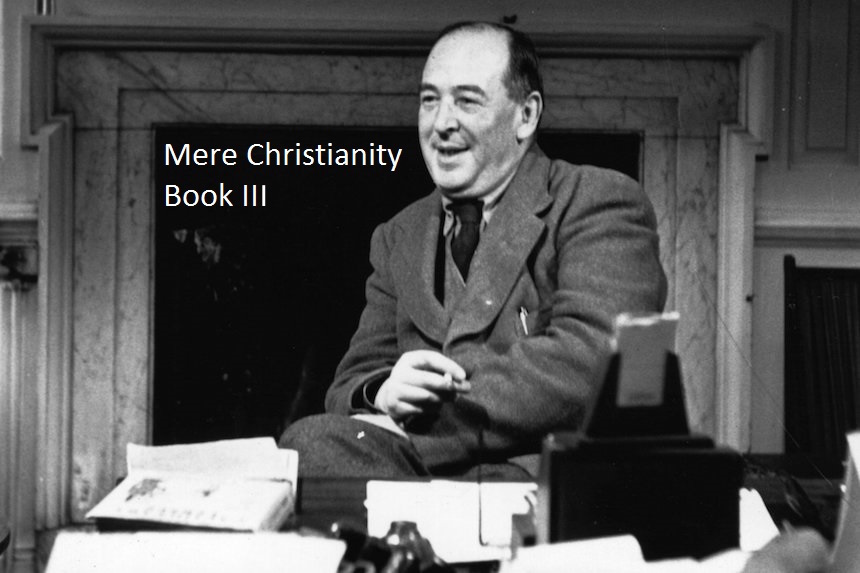
Mere Christianity – Book IV – Chapter 2 (“The Three-Personal God”)

Book-4

Picking back up my notes for C.S. Lewis’ “Mere Christianity”…

1. Many people believe in a God, but not in a personal God

“They feel that the mysterious something which is behind all other things must be more than a person”

(a) Christianity is the only system which offers an idea of what a God “beyond personality” could be like

“Christians are the only people who offer any idea of what a being that is beyond personality could be like. If you are looking for something super-personal, something more than a person, then it is not a question of choosing between the Christian idea and the other ideas. The Christian idea is the only one on the market”

2. Some people think that when we die we will be “absorbed” into God

“…some people think that after this life, or perhaps after several lives, human souls will be ‘absorbed’ into God. But when they try to explain what they mean, they seem to be thinking of our being absorbed into God as one material thing is absorbed into another… like a drop of water slipping into the sea. But of course that is the end of the drop. If that is what happens to us, then being absorbed is the same as ceasing to exist”

(a) Once again, Christianity is the only system which can make sense out of this idea

“It is only the Christians who have any idea of how human souls can be taken into the life of God and yet remain themselves – in fact, be very much more themselves than they were before”

(b) In fact, union with God is the entire point of Christianity

“The whole purpose for which we exist is to be thus taken into the life of God”

3. Higher dimensions are made up of lower dimensions and combine in new ways

“A world of one dimension would be a straight line. In a two-dimensional world, you still get straight lines, but many lines make one figure. In a three-dimensional world, you still get figures but many figures make one solid body. In other words, as you advance to more real and more complicated levels, you do not leave behind you the things you found on the simpler levels: you still have them, but combined in new ways – in ways you could not imagine if you knew only the simpler levels”

(a) The Christian account of God involves the same principle

“The human level is a simple and rather empty level. On the human level one person is one being, and any two persons are two separate beings-just as, in two dimensions (say on a flat sheet of paper) one square is one figure, and any two squares are two separate figures. On the Divine level you still find personalities; but up there you find them combined in new ways which we, who do not live on that level, cannot imagine. In God’s dimension, so to speak, you find a being who is three Persons while remaining one Being, just as a cube is six squares while remaining one cube. Of course we cannot fully conceive a Being like that: just as, if we were so made that we perceived only two dimensions in space we could never properly imagine a cube. But we can get a sort of faint notion of it”

(b) This makes the three-person God difficult to fully grasp

“You may ask, ‘If we cannot imagine a three-personal Being, what is the good of talking about Him?’ Well, there isn’t any good talking about Him. The thing that matters is being actually drawn into that three-personal life, and that may begin any time -tonight, if you like”

(c) …but what matters is the participation in that Divine Life

“An ordinary simple Christian kneels down to say his prayers. He is trying to get into touch with God. But if he is a Christian he knows that what is prompting him to pray is also God: God, so to speak, inside him. But he also knows that all his real knowledge of God comes through Christ, the Man who was God-that Christ is standing beside him, helping him to pray, praying for him. You see what is happening. God is the thing to which he is praying-the goal he is trying to reach. God is also the thing inside him which is pushing him on-the motive power. God is also the road or bridge along which he is being pushed to that goal. So that the whole threefold life of the three-personal Being is actually going on in that ordinary little bedroom where an ordinary man is saying his prayers. The man is being caught up into the higher kind of life – what I called Zoe or spiritual life: he is being pulled into God, by God, while still remaining himself”

(d) …and that is how theology started, encounter Jesus and participating in that life

“And that is how Theology started. People already knew about God in a vague way. Then came a man who claimed to be God; and yet he was not the sort of man you could dismiss as a lunatic. He made them believe Him. They met Him again after they had seen Him killed. And then, after they had been formed into a little society or community, they found God somehow inside them as well: directing them, making them able to do things they could not do before. And when they worked it all out they found they had arrived at the Christian definition of the three-personal God”

4. Theology is experimental knowledge

“Theology is, in a sense, experimental knowledge… When I say…’in a sense,’ I mean that it is like the other experimental sciences in some ways, but not in all”

(a) Studying rocks – you go to them and they cannot run away

“If you are a geologist studying rocks, you have to go and find the rocks. They will not come to you, and if you go to them they cannot run away. The initiative lies all on your side. They cannot either help or hinder.”

(b) Studying animals – you go to them and they can run away

“But suppose you are a zoologist and want to take photos of wild animals in their native haunts. That is a bit different from studying rocks. The wild animals will not come to you: but they can run away from you. Unless you keep very quiet, they will. There is beginning to be a tiny little trace of initiative on their side.”

(c) Studying humans – you can’t force intimacy

“Now a stage higher; suppose you want to get to know a human person. If he is determined not to let you, you will not get to know him. You have to win his confidence. In this case the initiative is equally divided-it takes two to make a friendship”

(d) Studying God – the initiative is all on His side

“When you come to knowing God, the initiative lies on His side. If He does not show Himself, nothing you can do will enable you to find Him. And, in fact, He shows much more of Himself to some people than to others-not because He has favourites, but because it is impossible for Him to show Himself to a man whose whole mind and character are in the wrong condition. Just as sunlight, though it has no favourites, cannot be reflected in a dusty mirror as clearly as a clean one”

5. Other sciences require instruments, but in theology requires something different

(a) You are the instrument

“…in other sciences the instruments you use are things external to yourself (things like microscopes and telescopes), the instrument through which you see God is your whole self. And if a man’s self is not kept clean and bright, his glimpse of God will be blurred-like the Moon seen through a dirty telescope. That is why horrible nations have horrible religions: they have been looking at God through a dirty lens…”

(b) The Church is the instrument

“God can show Himself as He really is only to real men. And that means not simply to men who are individually good, but to men who are united together in a body, loving one another, helping one another, showing Him to one another. For that is what God meant humanity to be like; like players in one band, or organs in one body.

Consequently, the one really adequate instrument for learning about God, is the whole Christian community, waiting for Him together. Christian brotherhood is, so to speak, the technical equipment for this science—the laboratory outfit”

(c) You can’t do much without these instruments

“That is why all these people who turn up every few years with some patent simplified religion of their own as a substitute for the Christian tradition are really wasting time. Like a man who has no instrument but an old pair of field glasses setting out to put all the real astronomers right. He may be a clever chap – he may be cleverer than some of the real astronomers, but he is not giving himself a chance. And two years later everyone has forgotten all about him, but the real science is still going on

If Christianity was something we were making up, of course we could make it easier. But it is not. We cannot compete, in simplicity, with people who are inventing religions. How could we? We are dealing with Fact. Of course anyone can be simple if he has no facts to bother about”

Restless Heart: 5 – “Intercommunion”

Communion

Unfortunately, this episode I’m flying solo! Nessa wasn’t able to make it so I thought it best to record on my own, rather than let another week pass without a new episode. In today’s episode I tackle the delicate subject of “Intercommunion” and explain why, under normal circumstances, the Eucharist is not given to non-Catholic Christians.

Episode 5: Intercommunion (Download)


— Notes —

* This episode was based on a two-part series I wrote a few years ago.

* I quote from two Early Church Fathers in this episode. The first is St. Justin Martyr:

“This food we call [the Eucharist], and no one is allowed to partake but he who believes that our doctrines are true, who has been washed with the washing for the remission of sins and rebirth, and who is living as Christ has enjoined… “

“…We do not receive these as common bread and drink. For Jesus Christ our Saviour, made flesh by the Word of God, had both flesh and blood for our salvation. Likewise, we have been taught that the food blessed by the prayer of his word…is the flesh and blood of Jesus who was made flesh.”

– Justin Martyr, First Apology, Chapter 66 (~ AD 150)

* The second Father I quote is St. Ignatius of Antioch:

“They abstain from the Eucharist and from prayer, because they do not confess the Eucharist is the flesh of our Saviour Jesus Christ, which suffered for our sins, and which the Father, in His loving-kindness, raised from the dead”

– Ignatius of Antioch, Letter to the Smyrnaeans, Chapter 7 (~AD 97)

* I also quote from a portion of one of St. Paul’s letters:

“Whoever, therefore, eats the bread or drinks the cup of the Lord in an unworthy manner will be guilty of profaning the body and blood of the Lord. Let a man examine himself, and so eat of the bread and drink of the cup. For any one who eats and drinks without discerning the body eats and drinks judgment upon himself. That is why many of you are weak and ill, and some have died”

– 1 Corinthians 11:29–30

* The Spiritual Communion prayer I quote is as follows:

“My Jesus, I believe that You are present in the Most Holy Sacrament. I love You above all things, and I desire to receive You into my soul. Since I cannot at this moment receive You sacramentally, come at least spiritually into my heart. I embrace You as if You were already there and unite myself wholly to You. Never permit me to be separated from You. Amen”

Please subscribe to this podcast using iTunes and Google Play and if you have any feedback or would like to pose a question for an upcoming episode, you can send us a message from the website or tweet us at @davidandnessa.

Pope writes another great blog entry

No, not that Pope. There is a priest in Washington DC whom I have long regarded as my Virtual Chaplain, completely unbeknownst to him!

Virtual Internet Pastor

During my years of wandering I lacked a spiritual director or even a regular parish (this blog isn’t called “Restless Pilgrim” for nothing!). During those wilderness years I had a three month stint in Washington DC and, towards the end of my time there, I discovered Msgr. Pope’s parish.

I greatly enjoyed my visits – my exposure to gospel music until then had been limited, but I loved the enthusiastic singing I heard there. What impressed me most though was the preaching…

Msgr. Pope’s homilies were of good length, exegetical, impassioned and practical. I had often been critical of the standard of homilies in the Catholic world and hearing this kind of preaching was a breath of fresh air.

After my visa expired I left Washington DC and continued my wanderings around England and the USA. Fortunately, I soon discovered Msgr. Pope’s blog, together with his homily recordings and podcast feed. This meant that whether I was living in London, San Diego or somewhere in between, I received the same teaching. It was like having a regular pastor again 🙂

Read more

1 100 101 102 103 104 137