Summary
The Dwarf struggles against joy. It “was not the meeting [the ghost] had pictured; he would not accept it”. He tugs at the chain and the Tragedian acts offended, saying, “It is fortunate that you give yourself no concern about my fate. Otherwise you might be sorry afterwards to think that you had driven me back to Hell”. The Lady replies “Dear, no one sends you back. Here is all joy. Everything bids you stay”. Saying this does no good – the Tragedian says he still has some self-respect and the dwarf starts to shrink.
When the Lady tells the Dwarf to not “let it talk like that“, the “Tragedian caught her words greedily as a dog catches a bone”, complaining that she always had to be “sheltered”. The Lady explains that wasn’t what she meant, rather that she wanted him to “stop acting… He is killing you. Let go of that chain. Even now”.
Sarah tells Frank to stop “using…other people’s pity, in the wrong way…”. She explains that “Pity was meant to be a spur that drives joy to help misery. But it…can be used for a kind of blackmailing… [to] hold joy up to ransom”. This is something he did ever since he was a child. She asks him “Did you think joy was created to live always under that threat? Always defenceless against those who would rather be miserable than have their self-will crossed?” She explains that “you can no longer communicate your wretchedness… Our light can swallow up your darkness: but your darkness cannot now infect our light”.
The Dwarf and the chain having disappeared, for the first time the Lady addresses the Tragedian, asking who he is and where Frank has gone. She invites him to stay, but the Tragedian vanishes. The lady returns to her retenue who begin to sing a song: “The Happy Trinity is her home: nothing can trouble her joy…”
After departing, Lewis asks his teacher: “Is it really tolerable that she should be untouched by his misery, even his self-made misery?”. MacDonald asks him if he would prefer it if “he still had the power of tormenting her”. He talks about “The demand of the loveless and the self-imprisoned… to blackmail the universe: that till they consent to be happy (on their own terms) no one else shall taste joy… that Hell should be able to veto Heaven… Either the day must come when joy prevails and all the makers of misery are no longer able to infect it: or else for ever… the makers of misery can destroy in others the happiness they reject for themselves”.
Lewis says he finds it horrible to say that pity must someday die. His teacher distinguishes between the action which will last forever and passion of pity which will come to the end. He says that the passion of pity “draws men to concede what should not be conceded” whereas the action “changes darkness into light and evil into good”. However, “we will not call blue yellow to please those who insist on still having jaundice”.
Lewis once again asks why the Spirits don’t go down into Hell to rescue the damned. Going down on his knees and using a blade of grass as a pointer, MacDonald points to a tiny crack, saying, “…through a crack no bigger than that ye certainly came…”. The idea that the infinitely empty Grey Town is down in a little crack blows his mind, but Lewis now realizes that the Lady couldn’t even fit into Hell. MacDonald concurs that “Hell could not open its mouth wide enough”. Referring to Jesus, MacDonald says that “Only the Greatest of all can make Himself small enough to enter Hell…” Lewis asks if He ever will descend again, but MacDonald explains that time doesn’t work that way, but assures Lewis that “There is no spirit in prison to Whom He did not preach”.
Lewis asks MacDonald about his Universalist beliefs, but MacDonald says “it’s ill talking of such questions…because all answers deceive. If ye put the question from within Time…the choice of ways is before you… But if ye are trying to leap on into eternity… then ye ask what cannot be answered to mortal ears. Time is the very lens through which ye see…something that would otherwise be too big for ye to see at all…[but] every attempt to see the shape of eternity except through the lens of Time destroys your knowledge of Freedom”
Questions
Q1. Why does the ghost resist joy? What does the Tragedian threaten? How does the Lady respond?
Q2. What did the Tragedian hold love hostage? What does MacDonald say about pity?
Q3. How does the Lady respond to the Ghost’s disappearance? Why is Lewis troubled by her reaction?
Q4. What does Lewis find out about Hell from MacDonald? Why couldn’t the lady go there?
Q5. What does MacDonald say about time, freedom and predestination?
Previous Chapter | Index | Next Chapter
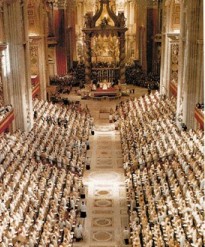 At the moment I’m reading through the documents of the Second Vatican Council in preparation for what we will be covering in the JP2 Group towards the end of the year. I thought it would make sense to do a few blog posts about what I’ve been reading.

 Today we read the final part of Chapter 1: