Quick Apology: Losing Authority

Today’s “Quick Apology” comes from a conversation a friend of mine recently had with a Reformed Protestant. It’s actually a bit of a long response for a “Quick” apology, but oh well…

Objection

“I’ll concede that the case for the historical church being the Catholic church is very strong. However, the chosen people (the Israelites) were consistently disobeying God throughout history and eventually ended up crucifying Christ. Throughout history the chosen people abandoned God. What makes you think that the Catholic Church hasn’t done this or won’t do this?”

Response

Here, the Protestant is admitting to many of the claims of the Catholic Church, but appears to be challenging the Church’s continued status as Christ’s Church, as well as calling into question her continued authority.

It must first obviously be admitted that sinners are found in the Catholic Church. After all, why else do you think I’m allowed membership?!. However, a few points should be made…

Old Testament

Israel certainly sinned over the course of Salvation History. However, would it mean that because of this, it would be better for a Jew or Gentile to abandon God’s people and “go it alone”? Of course not! If one left Judaism, thinking that this couldn’t possibly be the true religion due to the hypocrisy of some of their rulers and many its followers, then one would be making a huge mistake!

As Saint Paul said, “…to them belong the sonship, the glory, the covenants, the giving of the law, the worship, and the promises; to them belong the patriarchs (Romans 9:4-5). The Lord had given to Israel many wonderful gifts for the sake of salvation. It would be crazy to reject these gifts and walk away!

However, we actually have an example in the Old Testament of when some members of Israel did just that. After King Solomon’s death, his son ascended to the throne (1 Kings 12) who was a complete tyrant. The northern tribes refused to follow him and this resulted in the division of the Kingdom: the Kingdom of Israel in the north and the Kingdom of Judea in the south. This separatist movement received the condemnation of the prophets. Not only had they abandoned their rightful king, they had cut themselves off from the priesthood, the Temple and the sacrifices.

Screen Shot 2014-09-30 at 5.41.30 PM

Read more

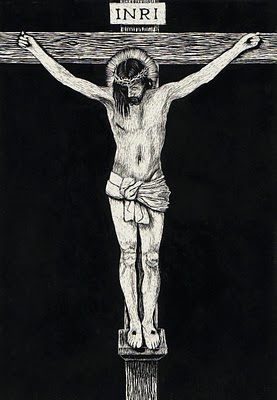
Symbolism: Why “INRI”?

Yesterday was the Feast of the Exultation of the Holy Cross. With that in mind, I’d like to share something that happened a few days ago. I was at Mass and, after communion, I was looking up at the large crucifix behind the altar. My eyes settled upon the sign above Jesus’ head and the thought crossed my mind:

“Huh…you know what?…I’m not really sure what ‘INRI’ stands for…”

How many thousands of crucifixes have I seen over the course of my life?!

Now, I wasn’t completely ignorant. I did remember the section of the Gospels where this sign is mentioned:

“Pilate had a notice prepared and fastened to the cross. It read: JESUS OF NAZARETH, THE KING OF THE JEWS…and the sign was written in Aramaic, Latin and Greek” – John 19:19-20

Hmm…so how exactly does “JESUS OF NAZARETH, THE KING OF THE JEWS” get reduced to “INRI”? It turns out that these are the initials of the Latin version of notice:

Iesus Nazarenus, Rex Iudaeorum
Jesus (of) Nazareth, King (of the) Jews

The meaning of this acronym is less obvious to us because, in the Latin translation, the words for “Jesus” and “Jews” don’t begin with the letter “J”, but instead start with an “I”.  Since Classical Latin doesn’t have a “J”,  an “I” is used instead.

So, next time you’re looking up at a crucifix and see the sign, you’ll know what it means. Behold your king!

“Here I stand, covered by grace
Under the blood that was shed for me
Here I kneel, before the King upon His throne
Here I bow, to worship the Lord
Enjoying his favour on my life today
Knowing that we’ll never be apart” – Here I stand, Phatfish

At the name of Jesus…

bowIf you have ever visited an Eastern Catholic parish or Eastern Orthodox parish, you will have noticed that whenever the Trinity or any of the divine names are mentioned, the priest and people will cross themselves and incline their heads in a bow, even if only slightly.


This is a practice I really like and I’ve often wished that this would be more present at western parishes. Well, I recently found out that, at least in theory, it should happen there too…

The place where you discover this is the General Instruction of the Roman Missal (GIRM), which is basically a commentary on the Missal, explaining how Mass should be celebrated:

A bow of the head is made when the three Divine Persons are named together and at the names of Jesus, of the Blessed Virgin Mary and of the saint in whose honor Mass is being celebrated.
– GIRM 275

How about that?! I did a little more digging and found out that this practice has considerable antiquity. For example, in the 13th Century, the Fathers of the Council of Lyons seem to have been inspired by the epistle to the Philippians where St. Paul talks about how “at the name of Jesus every knee should bow, in heaven and on the earth and under the earth” (Philippians 2:9-10). Here’s what the Council said:

Each should fulfill in himself that which is written… that at the name of Jesus every knee should bow; whenever that glorious name is recalled, especially during the sacred mysteries of the Mass, everyone should bow the knees of his heart, which he can do even by a bow of his head.
– Council of Lyons II, Constitution 25

So, even if it’s not common practice in your parish, I’d invite everyone to follow the guidance offered to us by the GIRM and to honour the Lord, His Mother and His Saints with this small gesture of reverence.

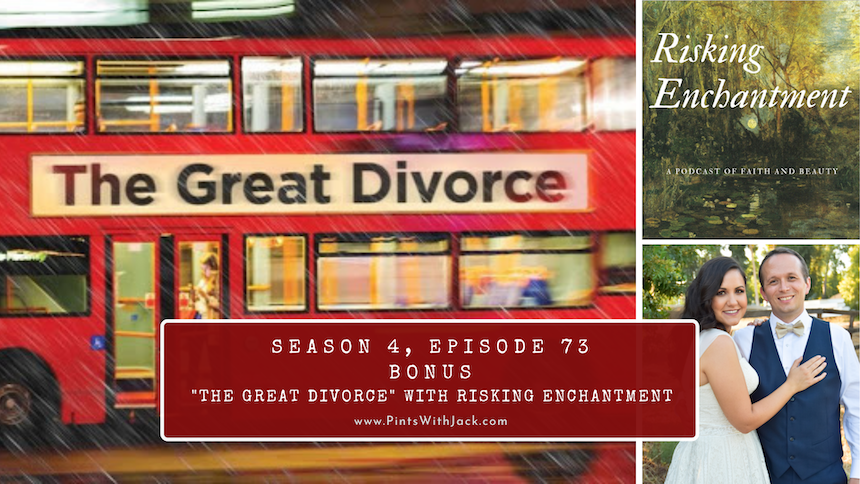
PWJ: S4E73 – Bonus – “The Great Divorce” with Risking Enchantment

David was invited onto the Risking Enchantment podcast with Phoebe and Rachel to discuss The Great Divorce.

S4E73: “The Great Divorce” with Risking Enchantment (Download)

If you enjoy this episode, you can subscribe manually, or any place where good podcasts can be found (iTunesGoogle Play, AmazonPodbeanStitcherTuneIn and Overcast), as well as on YouTube. The roadmap for Season 4 is available here.

More information about us can be found on our website, PintsWithJack.com. If you’d like to support us and get fantastic gifts, please join us on Patreon.

Read more

The Epistle of Joy – Episode #19 (Video)

Today we cover the last few verses of Philippians:

Greet every saint in Christ Jesus. The brethren who are with me greet you. All the saints greet you, especially those of Caesar’s household.

The grace of the Lord Jesus Christ be with your spirit. – Philippians 4:21-23

Here are my final thoughts:

For an audio-only version of this video, please click here.

PWJ: S3E34 – TWHF – “Retrospective”

Matt and I sat down and looked back on our reading of “Till We Have Faces” this season.

S3E34: “Till We Have Faces” Retrospective (Download)

If you enjoy this episode, you can subscribe manually, or any place where good podcasts can be found (iTunesGoogle PlayPodbeanStitcherTuneIn and Overcast), as well as on YouTube.

More information about us can be found on our website, PintsWithJack.com. If you’d like to support us and get fantastic gifts, please join us on Patreon.

The roadmap for Season 3 is available here.

Read more

Smelling the conciliar coffee

coffee Since this Year of Faith marks the 50th anniversary of the Second Vatican Council, I’d like to publish more posts concerning the Council this year.

Today I would like to share a little anecdote concerning the Council I came across in Archbishop Fulton Sheen’s autobiography, Treasure In Clay:

“Under the two great tiers which seated about 1,200 bishops on each side of the basilica, there were two coffee bars. It was not long before the Fathers found names for them. One was called Bar-Jona, which was part of the Hebrew name for St. Peter” – Fulton Sheen, Treasure In Clay, Page 302

How adorable is that?! Archbishop Sheen later writes that there was a lot of humour at the Council and that there were little poems written and passed around throughout the gathering. At the close of the Council, Bishop John P. O’Loughlin wrote the following:

As we bishops depart from old Roma
We can proudly display our disploma
     At the Council’s finale
     We say “buon natale”
And “goodbye” to Bar-Jona’s aroma

1 136 137 138 139 140 172