OCD: Curse and Blessing

Earlier this week I produced a summary of a paper written by Dr. Daniel G. Amen about combating Automatic Negative Thoughts. I decided that today I’d add something of an addendum to that post and talk a little bit about my experiences with Obsessive Compulsive Disorder (OCD).


OCD is an anxiety disorder in which the sufferers have repeated, unwanted thoughts which compel them to perform certain actions which provide relief from the unwanted thoughts. This relief, however, is only temporary and the feelings, unbidden, soon return.  The OCD mind then demands that the actions be performed once again.  The actions quickly become ritualistic, increasingly elaborate and need to be repeated over and over again with increasing frequency in order to relieve the sufferer’s mind.

Read more

“I’ll pray for you…”

The other day, after a rather difficult meeting with a friend I parted with the words “I’ll pray for you”.

It got me to thinking – how many times do I say that and I never actually do it? How many times do I use it as just a farewell, or as code for “Stop talking to me about your problems”?

That’s all I have to say. Please consider that as your thought for the day…

Romantic Movies

The other day on Facebook, a friend of mine who is a Christian speaker asked for recommendations for romantic movies, but only ones which didn’t have lots of inappropriate material. Now, I understand that the term “inappropriate material” means different things to different people, but I was quite amazed at some of the recommendations he received. Anyway, I decided to start compiling my own list of movies and I would love your help!

  1. Pride & Prejudice
  2. Sense & Sensibility
  3. Persuasion
  4. Emma
  5. Hitch
  6. Ever After
  7. Kate & Leopold
  8. You’ve got mail
  9. Sleepless in Seattle
  10. The Princess Bride
  11. Martha, mett Frank, Daniel and Laurence
  12. 50 First Dates
  13. Music & Lyrics
  14. IQ
  15. The Family Man
  16. Return to me

What did I miss? Do you have any other recommendations?

Speaking of suffering

Yesterday I shared a quotation on the subject of suffering from a book I recently finished, Jesus Among Other gods by Ravi Zacharias.

In that post, we saw that even to talk about good and evil we need an objective moral law, something which is rather difficult to explain while denying the existence of an eternal, transcendent God.

Today I’d like to offer a few more quotations from Zacharias’ book. For those of us who are involved in apologetics (which is, of course, every Christian!), he reminds us of a truth which we must keep forever at the front of our mind when speaking about the very difficult subject of pain and suffering.

How does a good God allow so much suffering? Immediately we enter into a very serious dilemma. How do you respond to the intellectual side of the question without losing the existential side of it? How do you answer…[those who are suffering] without drowning it all in philosophy?

– Ravi Zacharias, Jesus Among Other gods

Suffering is not simply a theoretical idea or only a subject for clever philosophical arguments, it is a very real reality with which people must live and it is a topic which is deeply emotionally charged.

Those who feel the pain… often shudder at how theoretical philosophical answers are. We do not like to work through the intellectual side of the question because we do not see where logic and philosophy fit into the problem of pain. If you have just buried a son or a daughter, or have witnessed brutality firsthand, this portion of the argument may bring more anger than comfort. Who wants logic when the heart is broken? Who wants a physiological treatise on the calcium component of the bone when the shoulder has come out of its socket? At such a time we are looking for comfort. We want a painkiller.

– Ravi Zacharias, Jesus Among Other gods

The solution to this problem is to balance delicately the intellectual and the emotional, speaking to both and neglecting neither:

We must not allow the anguish of the heart to bypass the reason of the mind. The explanation [of pain] must meet both the intellectual and the emotion demands of the question. Answering the questions of the mind while ignoring shredded emotions seems heartless. Binding the emotional wounds while ignoring the struggle of the intellect seems mindless. 

– Ravi Zacharias, Jesus Among Other gods

When my Dad died earlier this year, I didn’t want a dry philosophy lesson. I wanted people to grieve with me, but who were ready to talk when the time came to grapple intellectually and spiritually with what had happened.

“Lead Kindly Light” Poster

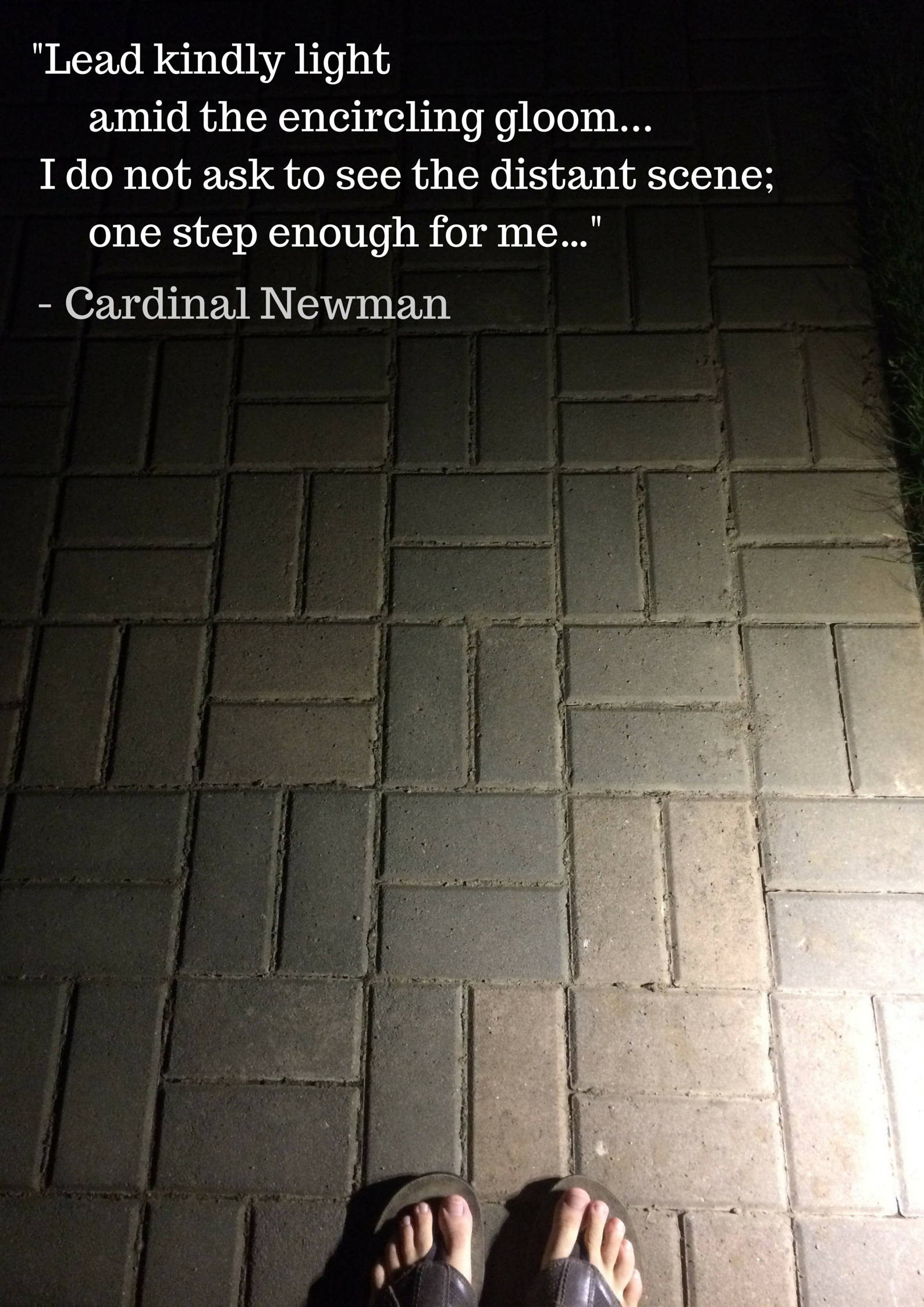
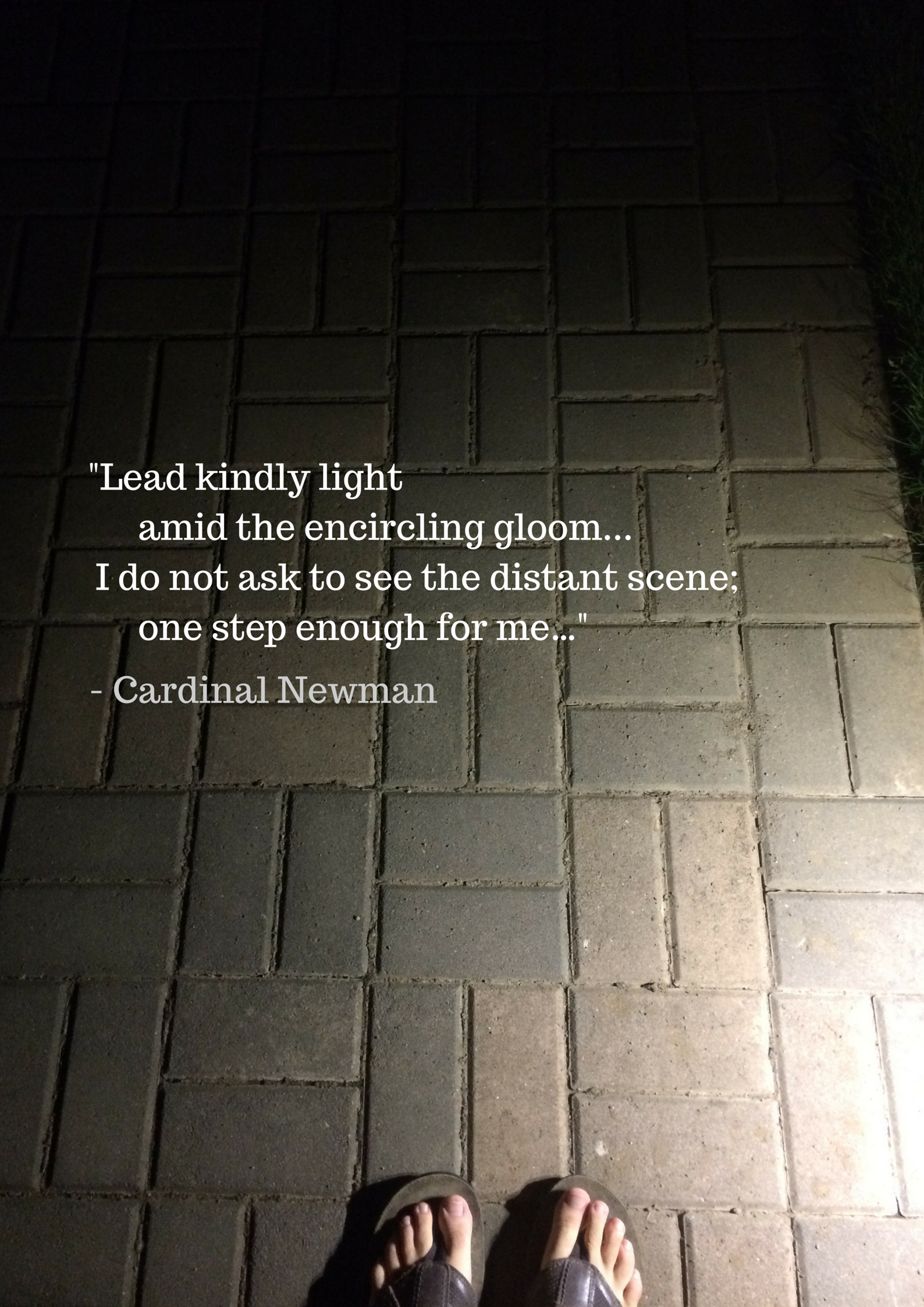
I’ve been playing around with the graphics program Canva recently and if you’ve looked at the Restless Pilgrim Facebook page recently, you’ll have seen the fruit of this.

One of the graphics I produced has been particularly popular so I thought I’d share a high resolution version of it here on the blog, together with a printable PDF version. I’ve also made a version for the iPhone “Locked” Screen.

Lead Kindly Light 

TEA: Mary and the Early Church (St. Ignatius)

Mary

Yesterday, I visited St. Ignatius Catholic Church in Los Angeles. The St. Ignatius Women’s Group invited me to give a presentation on the Blessed Virgin and the Early Church. This was a a longer version of a talk I had previously given at St. Brigid’s here in San Diego.

Over the course of forty-five minutes, I told the story of my initial struggles concerning Mary and the Catholic Marian doctrines, explaining how I eventually came to see the truth and beauty in the Catholic Church’s teaching concerning the Blessed Virgin. The audio and the handout are both available for download.

Mary and the Early Church (Download)

I was invited to speak to the group at St. Ignatius by a long-time reader of this blog. If you’re also interested in having me speak to a group at your parish or at a Diocesan Theology On Tap, please see my Speaking page for examples of other recorded talks. Just send me an email and we can work out the details! 🙂

Lectionary Resources

A few people have recently asked me where I get the material for my “Lectionary Notes” posts. Here’s the process I go through each week:

1. After we conclude our Bible Study in the JP2 Group, we all go to the church next door for adoration. In the presence of the Blessed Sacrament I read the Lectionary Scriptures for the following week and spend a little bit of time praying through them.

2. When I next have some time, I read through the texts again using my NIV Study Bible.

Regarding Bible translations, translators have to make a choice between translating from the original language word-for-word (“formal equivalence”) or providing a looser translation but which attempts to better convey the thought expressed by the original writer (“dynamic equivalence”). This essentially results in a trade-off between readability and fidelity to the original words of the text. I quite like the NIV in that it falls somewhere between formal and dynamic equivalence, but with a leaning more towards dynamic equivalence.

The NIV is not a Catholic Bible and unfortunately therefore is missing the books of Wisdom, Sirach etc. Some of the study notes also have a non-Catholic skew, but on the whole it has excellent cross-references and always at least offers an interesting point of view.

3. The next book I reach for is my Ignatius New Testament Study Bible. I can’t say how much I love this book. It’s the RSV translation, which follows the “formal equivalence” approach. I would not-so-humbly suggest that it is a far superior translation to the NAB which is used in the Lectionary. Ignatius Press have produced a superb resource here, with excellent notes, maps and word studies. Every Christian should own a copy – it’s a bargain at $16. I will wait here while you click on the link and go and order a copy from Amazon. Seriously, I’ll wait…Done? Okay, let’s continue!

Read more

1 … 46 47 48 49 50 … 137