Mere Christianity – Book III – Chapter 7 (“Forgiveness”)

Book-3

Picking back up my notes for C.S. Lewis’ “Mere Christianity”…

Notes & Quotes

1. Maybe it is forgiveness, rather than chastity, is the most unpopular thing in Christianity

(a) Because Christian forgiveness involves forgiving our enemies 

…we come up against this terrible duty of forgiving our enemies. Every one says forgiveness is a lovely idea, until they have something to forgive… And then, to mention the subject at all is to be greeted with howls of anger”

(b) People sometimes complain not that it’s not too hard, but just that it’s simply unfair!

“It is not that people think this too high and difficult a virtue: it is that they think it hateful and contemptible. ‘That sort of talk makes them sick,” they say. And half of you already want to ask me, ‘I wonder how you’d feel about forgiving the Gestapo if you were a Pole or a Jew?'”

2. But this is Christianity!

“I did not invent it. And there, right in the middle of it, I find “Forgive us our sins as we forgive those that sin against us.” There is no slightest suggestion that we are offered forgiveness on any other terms. It is made perfectly clear that if we do not forgive we shall not be forgiven. There are no two ways about it. What are we to do?”

3. In order to develop our ability to forgive, start small…

“When you start mathematics you do not begin with the calculus; you begin with simple addition. In the same way, if we really want (but all depends on really wanting) to learn how to forgive, perhaps we had better start with something easier than the Gestapo. One might start with forgiving one’s husband or wife, or parents or children, or the nearest NCO*, for something they have done or said in the last week. That will probably keep us busy for the moment”

* Non-Commissioned Officer in the army

3. There are misconceptions as to what it means to “love your neighbour as yourself”

“…how exactly do I love myself?”… I have not exactly got a feeling of fondness or affection for myself, and I do not even always enjoy my own society…. Do I think well of myself, think myself a nice chap? Well, I am afraid I sometimes do… but that is not why I love myself. In fact it, is the other way round: my self-love makes me think myself nice, but thinking myself nice is not why I love myself…. I can look at some of the things I have done with horror and loathing”

4. There is a distinction between the person and his/her actions

“I remember Christian teachers telling me long ago that I must hate a bad man’s actions, but not hate the bad man: or, as they would say, hate the sin but not the sinner.

…how could you hate what a man did and not hate the man? But years later it occurred to me that there was one man to whom I had been doing this all my life-namely myself… In fact the very reason why I hated the things was that I loved the man. Just because I loved myself, I was sorry to find that I was the sort of man who did those things. Consequently, Christianity does not want us to reduce by one atom the hatred we feel for cruelty and treachery. We ought to hate them… But it does want us to hate them in the same way in which we hate things in ourselves: being sorry that the man should have done such things, and hoping, if it is anyway possible, that somehow, sometime, somewhere, he can be cured and made human again”

5. Loving my neighbour does not mean refusing to punish him

“No, for loving myself does not mean that I ought not to subject myself to punishment-even to death. If one had committed a murder, the right Christian thing to do would be to give yourself up to the police and be hanged. It is, therefore, in my opinion, perfectly right for a Christian judge to sentence a man to death or a Christian soldier to kill an enemy”

(a) This does not contradict “Thy shalt not kill”?

“There are two Greek words: the ordinary word to kill and the word to murder. And when Christ quotes that commandment He uses the murder one… And I am told there is the same distinction in Hebrew. All killing is not murder any more than all sexual intercourse is adultery. When soldiers came to St. John the Baptist asking what to do, he never remotely suggested that they ought to leave the army: nor did Christ when He met a Roman sergeant-major-what they called a centurion”

4. If people What then, is the difference?

I imagine somebody will say, “Well, if one is allowed to condemn the enemy’s acts, and punish him, and kill him, what difference is left between Christian morality and the ordinary view?” All the difference in the world. Remember, we Christians think man lives for ever. Therefore, what really matters is those little marks or twists on the central, inside part of the soul which are going to turn it, in the long run, into a heavenly or a hellish creature. We may kill if necessary, but we must not hate and enjoy hating. We may punish if necessary, but we must not enjoy it. In other words, something inside us, the feeling of resentment, the feeling that wants to get one’s own back, must be simply killed. I do not mean that anyone can decide this moment that he will never feel it any more. That is not how things happen. I mean that every time it bobs its head up, day after day, year after year, all our lives long, we must hit it on the head. It is hard work, but the attempt is not impossible. Even while we kill and punish we must try to feel about the enemy as we feel about ourselves- to wish that he were not bad. to hope that he may, in this world or another, be cured: in fact, to wish his good. That is what is meant in the Bible by loving him: wishing his good, not feeling fond of him nor saying he is nice when he is not.

5. What’s the bottom line?

“I admit that this means loving people who have nothing lovable about them. But then, has oneself anything lovable about it? You love it simply because it is yourself, God intends us to love all selves in the same way and for the same reason: but He has given us the sum ready worked out on our own case to show us how it works. We have then to go on and apply the rule to all the other selves. Perhaps it makes it easier if we remember that that is how He loves us. Not for any nice, attractive qualities we think we have, but just because we are the things called selves. For really there is nothing else in us to love: creatures like us who actually find hatred such a pleasure that to give it up is like giving up beer or tobacco. …”

Discussion Questions

1. Why is the Christian doctrine of forgiveness so unpopular?

2. How does Jack suggest we start?

3. What does it mean to forgive your enemies and what does it not mean?

4. Does this mean we should be against capital punishment?

5. Why should we forgive others?

C.S. Lewis Doodle

No doodle!

The Epistle of Joy – Episode #8 (Video)

Today we continue through Chapter 2 of Philippians:

Therefore, my beloved, as you have always obeyed, so now, not only as in my presence but much more in my absence, work out your own salvation with fear and trembling; for God is at work in you, both to will and to work for his good pleasure.

Do all things without grumbling or questioning, that you may be blameless and innocent, children of God without blemish in the midst of a crooked and perverse generation, among whom you shine as lights in the world, holding fast the word of life, so that in the day of Christ I may be proud that I did not run in vain or labor in vain. Even if I am to be poured as a libation upon the sacrificial offering of your faith, I am glad and rejoice with you all. Likewise you also should be glad and rejoice with me. – Philippians 2:12-18

Here’s what I had to say:

For an audio-only version of this video, please click here.

 Previous Episode | Next Episode

Ignatius of Antioch and Friends

Today is the Feast Day of probably my favourite Early Church Father, St. Ignatius of Antioch:

Office Of Readings

Today in the Office of Readings we read a section of one of the letters he wrote on his way to martyrdom sometime around AD 107:

“I am writing to all the churches to let it be known that I will gladly die for God if only you do not stand in my way. I plead with you: show me no untimely kindness. Let me be food for the wild beasts, for they are my way to God. I am God’s wheat and shall be ground by their teeth so that I may become Christ’s pure bread. Pray to Christ for me that the animals will be the means of making me a sacrificial victim for God.

“No earthly pleasures, no kingdoms of this world can benefit me in any way. I prefer death in Christ Jesus to power over the farthest limits of the earth. He who died in place of us is the one object of my quest. He who rose for our sakes is my one desire. The time for my birth is close at hand. Forgive me, my brothers. Do not stand in the way of my birth to real life; do not wish me stillborn. My desire is to belong to God. Do not, then, hand me back to the world. Do not try to tempt me with material things. Let me attain pure light. Only on my arrival there can I be fully a human being. Give me the privilege of imitating the passion of my God. If you have him in your heart, you will understand what I wish. You will sympathize with me because you will know what urges me on.”

– Ignatius of Antioch, Letter to the Romans

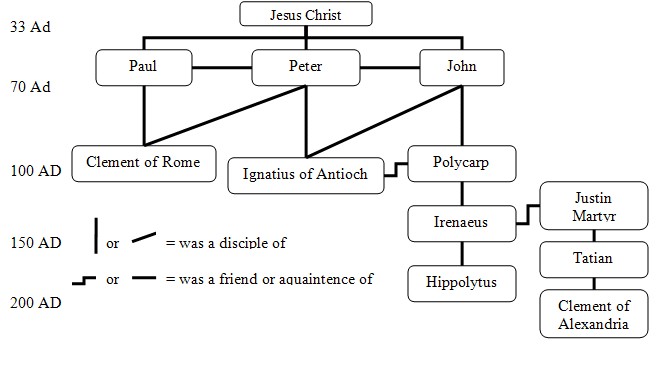
Early Church Relationships

Here is a diagram showing the relationships between Jesus, His Apostles, Ignatius of Antioch and some of the other Early Church Fathers:

Want to know more?

If you would like to read more of St. Ignatius’ writings, or listen to them free on MP3, be sure to check out the Church History section of this blog.

Mere Christianity – Book III – Chapter 12 (“Faith”)

Book-3

Picking back up my notes for C.S. Lewis’ “Mere Christianity”…

Notes & Quotes

1. Faith (in the second sense) arises after attempting the Christian life

“…Faith in this sense arises after a man has tried his level best to practise the Christian virtues, and found that he fails, and seen that even if he could he would only be giving back to God what was already God’s own. In other words, he discovers his bankruptcy”

2. What God cares about is the kind of creatures we are

“Now, once again, what God cares about is not exactly our actions. What he cares about is that we should be creatures of a certain kind or quality – the kind of creatures He intended us to be-creatures related to Himself in a certain way…if you are right with Him you will inevitably be right with all your fellow-creatures, just as if all the spokes of a wheel are fitted rightly into the hub and the rim they are bound to be in the right positions to one another”

3. This involves discovering our bankruptcy

“And as long as a man is thinking of God as an examiner who has set him a sort of paper to do, or as the opposite party in a sort of bargain – as long as he is thinking of claims and counterclaims between himself and God – he is not yet in the right relation to Him. He is misunderstanding what he is and what God is. And he cannot get into the right relation until he has discovered the fact of our bankruptcy”

(i) This must be truly recognized

“When I say ‘discovered,’ I mean really discovered: not simply said it parrot-fashion. Of course, any child, if given a certain kind of religious education, will soon learn to say that we have nothing to offer to God that is not already His own and that we find ourselves failing to offer even that without keeping something back. But I am talking of really discovering this: really finding out by experience that it is true.”

(ii) This requires us to try our hardest

Now we cannot, in that sense, discover our failure to keep God’s law except by trying our very hardest (and then failing). Unless we really try, whatever we say there will always be at the back of our minds the idea that if we try harder next time we shall succeed in being completely good. Thus, in one sense, the road back to God is a road of moral effort, of trying harder and harder. But in another sense it is not trying that is ever going to bring us home. All this trying leads up to the vital moment at which you turn to God and say, “You must do this. I can’t.”

(iii) This requires us to look back

“It is often only when he looks back that he realises what has happened and recognises it as what people call ‘growing up.’… A man who starts anxiously watching to see whether he is going to sleep is very likely to remain wide awake. As well, the thing I am talking of now may not happen to every one in a sudden flash – as it did to St Paul or Bunyan: it may be so gradual that no one could ever point to a particular hour or even a particular year”

4. It is then we put our trust in Christ

“The sense in which a Christian leaves it to God is that he puts all his trust in Christ: trusts that Christ will somehow share with him the perfect human obedience which He carried out from His birth to His crucifixion: that Christ will make the man more like Himself and, in a sense, make good his deficiencies”

(i) It’s a great deal

“…Christ offers something for nothing: He even offers everything for nothing. In a sense, the whole Christian life consists in accepting that very remarkable offer… What we should have liked would be for God to count our good points and ignore our bad ones”

(ii) This still requires obedience

…handing everything over to Christ does not, of course, mean that you stop trying. To trust Him means, of course, trying to do all that He says. There would be no sense in saying you trusted a person if you would not take his advice. Thus if you have really handed yourself over to Him, it must follow that you are trying to obey Him. But trying in a new way, a less worried way. Not doing these things in order to be saved, but because He has begun to save you already. Not hoping to get to Heaven as a reward for your actions, but inevitably wanting to act in a certain way because a first faint gleam of Heaven is already inside you.

5. Christians have often disputed about faith and works

“Christians have often disputed as to whether what leads the Christian home is good actions, or Faith in Christ. I have no right really to speak on such a difficult question, but it does seem to me like asking which blade in a pair of scissors is most necessary”

(i) Looking at the parodies of these positions can point us to the truth

(A) Works

“One set were accused of saying, ‘Good actions are all that matters. The best good action is charity. The best kind of charity is giving money. The best thing to give money to is the Church. So hand us over $10,000 and we will see you through.’ The answer to that nonsense, of course, would be that good actions done for that motive, done with the idea that Heaven can be bought, would not be good actions at all, but only commercial speculations”

(B) Faith

“The other set were accused of saying, ‘Faith is all that matters. Consequently, if you have faith, it doesn’t matter what you do. Sin away, my lad, and have a good time and Christ will see that it makes no difference in the end.’ The answer to that nonsense is that, if what you call your ‘faith’ in Christ does not involve taking the slightest notice of what He says, then it is not Faith at all-not faith or trust in Him, but only intellectual acceptance of some theory about Him”

(ii) Scripture puts the two together in one sentence

The first half is, “Work out your own salvation with fear and trembling” – which looks as if everything depended on us and our good actions: but the second half goes on, “For it is God who worketh in you”*- which looks as if God did everything and we nothing. I am afraid that is the sort of thing we come up against in Christianity. I am puzzled, but I am not surprised. You see, we are now trying to understand, and to separate into water-tight compartments, what exactly God does and what man does when God and man are working together… you will find that even those who insist most strongly on the importance of good actions tell you you need Faith; and even those who insist most strongly on Faith tell you to do good actions.

* St. Paul’s epistle to the Philippians

6. Christianity isn’t just about morality

“I think all Christians would agree with me if I said that though Christianity seems at first to be all about morality, all about duties and rules and guilt and virtue, yet it leads you on, out of all that, into something beyond. One has a glimpse of a country where they do not talk of those things, except perhaps as a joke. Every one there is filled full with what we should call goodness as a mirror is filled with light But they do not call it goodness. They do not call it anything. They are not thinking of it. They are too busy looking at the source from which it comes”

Discussion Questions

1. Why is it important to discover our bankruptcy? How do we reach that point?

2. What does it meant to trust God? Does it still require effort and obedience?

3. How does Jack respond to the Reformation argument concerning Sola Fide?

C.S. Lewis Doodle

No doodle!

TOT: Karen Reynolds

May 2, 2017: Karen Reynolds @ St. Luke, El Cajon

Karen Reynolds is a missionary with a lifetime of faithful service to the Church. She currently serves Dirty Vagabond Ministries as the Chief Operating Officer and Director of Development. She is passionate about sharing the love of Jesus Christ with the lost and training/equipping missionaries.

A veteran of over 20 years of youth, college and young adult ministry, Karen started her career with Young Life serving as the Development Director of the Ohio Valley. Prior to her leadership with Dirty Vagabond, she was a diocesan and parish ministry director in Ventura CA, Denver CO, and Bermuda – to name a few.

Karen is a nationally recognized speaker, having witnessed to thousands over the past 15 years. In addition to being an avid reader and traveler, she has recently begun her plans to play drums in a rock band.

“Dirty Vagabond Ministries & Evangelization” (Download)

Karen

PWJ: S1E25 – MC B3C12 – “Faith” (Part 2)

Faith

And so we come to the final chapter of Book III. Continuing on from last chapter, we continue to examine “faith”. This chapter focuses on faith in terms of salvation.

If you enjoy this episode, you can subscribe manually, or any place where good podcasts can be found (iTunesGoogle PlayPodbeanStitcher and TuneIn).

Please send any objections, comments or questions, either via email through my website or tweet us @pintswithjack. Be sure to follow our new Instagram account!

Episode 25: “Faith” (Part 2) (Download)

Read more

PWJ: S3E39 – VODT – “Voyage of Dawn Treader Movie” (Part 1)

Last week Matt and I discussed the book, The Voyage of the Dawn Treader. Today we team up with the guys from The Lamp-Post Listener podcast to discuss its movie adaptation.

S3E39: “The Voyage of the Dawn Treader Movie, Part 1” (Download)

If you enjoy this episode, you can subscribe manually, or any place where good podcasts can be found (iTunesGoogle PlayPodbeanStitcherTuneIn and Overcast), as well as on YouTube.

More information about us can be found on our website, PintsWithJack.com. If you’d like to support us and get fantastic gifts, please join us on Patreon.

The roadmap for Season 3 is available here.

Read more
1 156 157 158 159 160 172