Artwork of God’s Artwork
In a previous post I explained the meaning of the text “IC XC” which is found in Eastern icons. I thought today I would do a quick follow-up to explain the letters which commonly appear around the Theotokos…
The Theo-what?
“The Theotokos” (pronounced “th-ay-oh-to-kos”) is the name that Eastern Christians (both Orthodox and Catholic) typically give to Jesus’ mother, Mary. It was also the word used in the proclamation of the Council of Ephesus in 431 AD. In the Western Church, “Theotokos” is often loosely translated into English as “Mother Of God” (whereas it literally means “God-bearer”).
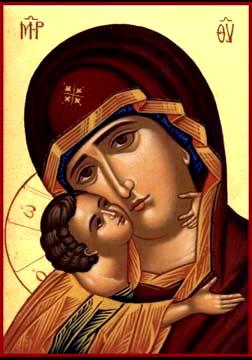
Giving Mary the title “Mother of God” has certainly caused some heated arguments in the history of Christianity. Some have mistakenly seen this title as an elevation of Mary to a height even greater than that of Jesus (if such a thing were possible!). Yet the title “Mother Of God” is really much more about Jesus than Mary, since to say that Mary is not the mother of God is to say that she gave birth only to His humanity, which would indicate some kind of rupture between Jesus’ human and divine natures. That’s kind of a weighty topic…I think I’ll come back to that another time….


 In this month’s “Theology on Tap” here in San Diego we had a talk by Bernadeane Carr entitled “Saints: Our friends in high places”. In it, she talked about the Saints who are associated with a particular cause, complaint or profession, the Saints whom we call “Patron Saints”. I therefore wanted to share with you some of the more…erm…”interesting” patron Saints I’ve come across. Believe it or not, there is a Patron Saint of unattractive people…
 Saint Drogo is the patron Saint of unattractive people because during one pilgrimage he contracted a disease which caused him to develop severe bodily deformities. The people of the village built a small cell attached to the local church to provide him with a place to live and to also protect them from seeing his deformities (nice, hey?!). St. Drogo stayed in his cell for the next forty years, having no contact with anyone, except to receive his simple sustenance: barley, water and the Eucharist.
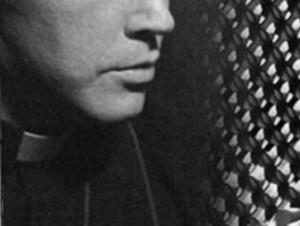 I have a confession.