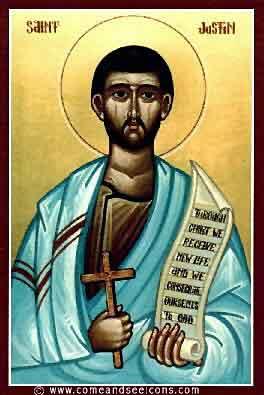
Justin Time!

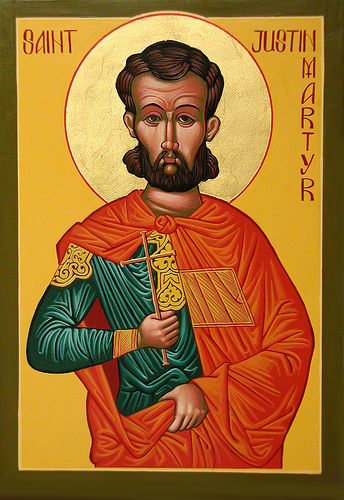
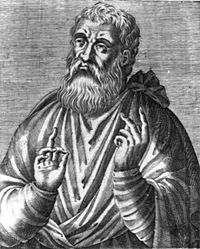
Justin MartyrYesterday I identified some of the common features recognizable by Catholics in St. Justin’s description of the Second Century liturgy. There were two other comments I wanted to make about the extract we studied last night in the JP2 Group from Justin’s First Apology.

Accept no imitations

It is popular these days to assert that Christianity just stole ideas from all the other religions around it. It is fortuitous, therefore, that we have the testimony of Justin asserting that it was the Mithras cult which imitated the Christian Eucharist and not the other way around:

“This the wicked devils have imitated, commanding the same thing to be done in the mysteries of Mithras. There, in the mystic rites of initiation, bread and a cup of water are placed amid certain incantations. This you already know or can discover”

Now, whether you choose to believe Justin’s assertion is another matter, but it is significant that we have a Christian writing to a Pagan Emperor trying to set the record straight.
Read more

This all sounds so familiar…

Justin MartyrYesterday I published a blog entry which contained the text which we are going to study tonight at the JP2 Group. We’re going to read this document as part of our three-week series looking at worship in the Early Church.

The text I posted yesterday was a substantial extract from a work by Justin Martyr. St. Justin was a Christian in the 2nd Century and he wrote an apologetic work addressed to the Emperor known as his First Apology. In this ancient document he provides a defense of the Christian faith, but he also describes in some detail the Christian worship of his era.

Justin wrote his First Apology in around AD 150 and, despite the nascent state of the Church at this time, the liturgy has a clear structure. Catholics and all those who attend “liturgical” churches should be able to recognize many things in Justin’s description which are present in their own worship:

1. Sunday Worship

Groups such as the Seventh Day Adventists say that Christians should worship on the Sabbath (Saturday), but it’s clear from St. Justin that in the Second Century Christian worship was on Sunday:

“And on the day called ‘Sunday’, all who live in cities or in the countryside gather… We hold our assembly on Sunday because it is the first day, on which God brought forth the world from darkness and matter. On the same day, Jesus Christ our Saviour rose from the dead”

Read more

Justin Martyr’s Worship

Justin MartyrFor the next three weeks in the JP2 Group we’re going to be looking at the worship in the Early Church.

The following text is an extract from the writing of Justin Martyr (c AD 100 – 165). The document is known as his First Apology, which was written to the Emperor Antionius Pius around AD 150-155. Various English translations were used in the rendering of this extract.

We will be studying this text as a group tomorrow.  At the weekend I’ll do another post about this text, together with a little bit of commentary…

Chapter 65: Baptism & Eucharist

After we have washed someone who has been convinced and has accepted our teaching, we bring him to the place where those who are called “brethren” are assembled. Together, then, we offer hearty prayers: for ourselves, for the illuminated person, and for all others in every place. We pray that we may be counted worthy, now that we have learned the truth, by our works be found good citizens and keepers of the commandments, so that we may be saved with an everlasting salvation.

Having ended the prayers, we greet one another with a kiss. Then bread and a cup of wine mixed with water are brought to the president of the brethren. Taking them, he gives praise and glory to the Father of the universe, through the name of the Son and of the Holy Spirit, and he offers thanks at considerable length for our being counted worthy to receive these things.

And when he has concluded the prayers and thanksgivings, all the people present express their assent by saying “Amen”, the Hebrew for “so be it”. And when the president has given thanks, and all the people have expressed their assent, those who are called “deacons” give to each person present a portion of the bread and the wine mixed with water, over which the thanksgiving was pronounced. To those who are absent, they carry away a portion.

Read more

“Getting” The Begetting

As part of one of my New Year’s Resolutions, I’ve begun reading through the New Testament. The other day I discovered something about the genealogy of Jesus which I thought was rather interesting. Matthew’s Gospel begins thus:

This is the genealogy of Jesus the Messiah the son of David, the son of Abraham:

Abraham was the father of Isaac, Isaac the father of Jacob, … and Jesse the father of King David.

David was the father of Solomon, whose mother had been Uriah’s wife, Solomon the father of Rehoboam,  …Josiah the father of Jeconiah and his brothers at the time of the exile to Babylon.

After the exile to Babylon: Jeconiah was the father of Shealtiel, … Matthan the father of Jacob, and Jacob the father of Joseph, the husband of Mary, and Mary was the mother of Jesus who is called the Messiah.

To our modern minds, this list seems rather dull, but to a First Century Jew it is tremendously exciting and important. If you want to know the man, you learn about his family. Anyway, Matthew’s list is about begetting! How can that not be exciting?! 😉

Read more

Meeting Scott Hahn

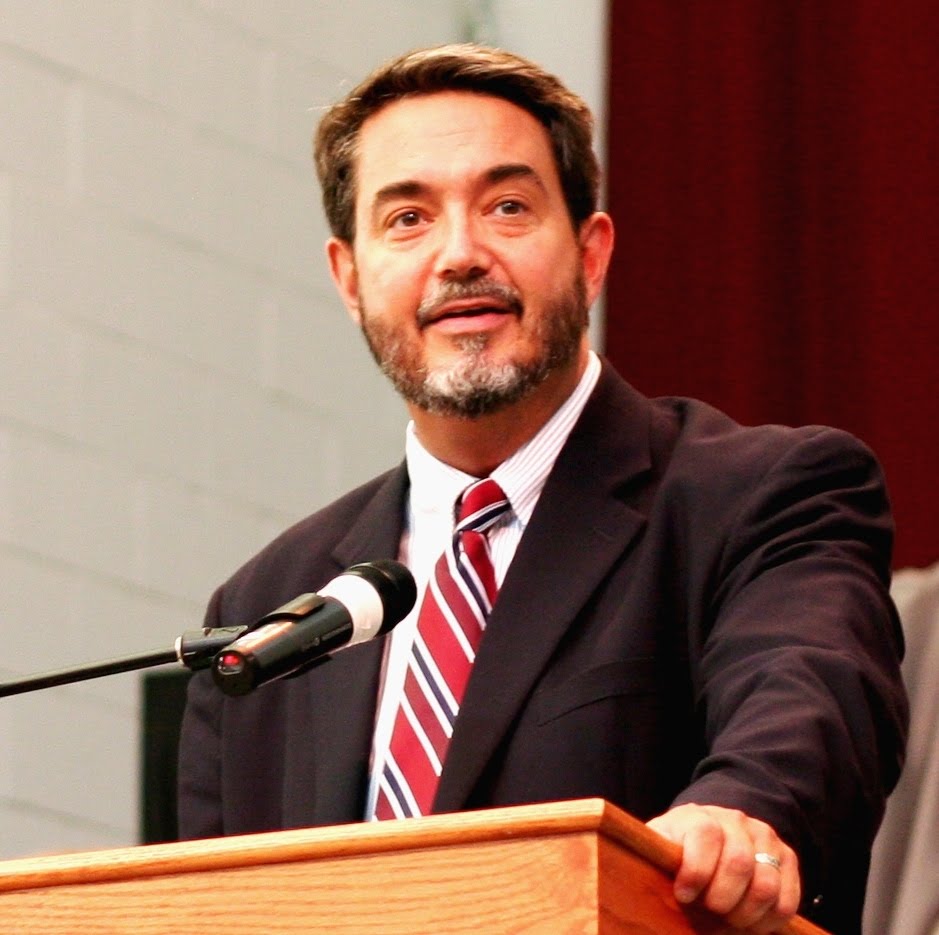
Last night I finally got to meet Dr. Scott Hahn. He was giving a talk at St. Therese’s Catholic Parish in San Diego. Unfortunately, I wasn’t able to come to the talk itself, but I managed to get to the church before he left.

I got him to sign one of his books.

I asked him a question concerning one of his previous talks on Matthew’s Gospel.

He was taller than I expected.

Good times 🙂

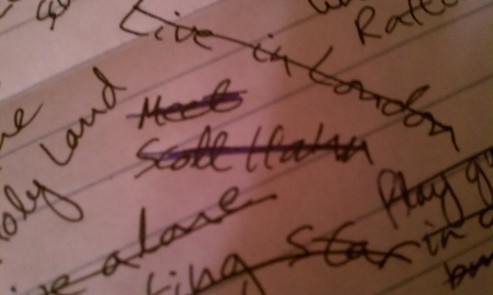
I have come close to meeting Dr. Hahn so many times, missing him by only a few days, hours or miles. Because of this, “Meet Scott Hahn” made it onto my Bucket List several years ago. It was with a great sense of satisfaction that, when I returned to my car last night, I finally crossed that item off my list:

Meet Scott Hahn Bucket List Item

Catholic Family Tree

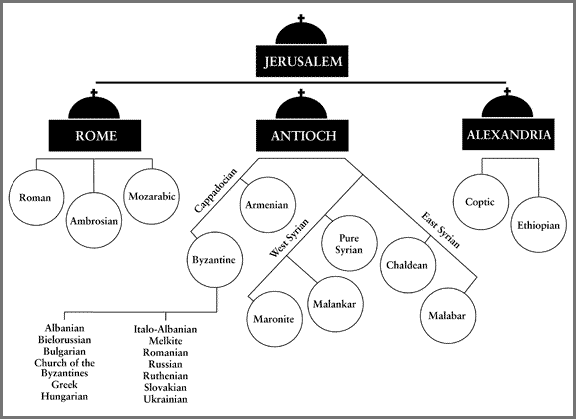
Last Thursday I celebrated the Feast of Theophany at Holy Angels Byzantine Catholic Parish with four of my Roman Rite friends. While we were there I attempted to explain how all the different rites of the Catholic Church relate to one another. I don’t think I did a very good job at explaining it, so I’m going to have another go now…

The Church began in Jerusalem (Acts 2) and, over time, major Christian centres developed in the cities of Rome, Antioch and Alexandria. It was from these cities that the major rites of the Church developed. This can be seen more clearly from the following diagram I found on a friend’s Facebook page:

Catholic Rites

The Second Vatican Council had this to say concerning the different rites of the Church:

“[In] faithful obedience to tradition, the sacred Council declares that Holy Mother Church holds all lawfully recognized rites to be of equal right and dignity, and that she wishes to preserve them in the future and to foster them in every way”

– Sacrosanctum Concilium

So, although the Catholic Church is one Church, it is also a communion of Churches.

1 530 531 532 533 534 586