One of the first things which struck me about the Qur’an the first time I read it was how it can suddenly and jarringly jump to a completely different scene,
I’ve often been told that the Torah and the Injil were only for the Jews. However, two problems: The Pickthall translation doesn’t hide it: He hath revealed unto thee (Muhammad)
John Fontain recently debated David Wood on the Islamic Dilemma, which points out that the Qu’ran both affirms the Torah and Gospel while contradicting them. John has a rather different
Those who attempt to say that the Qur’an teaches the corruption of the earlier scriptures, often appeal to Qur’an 5:48, but this argument turns on the translation of the word
I’m reading through the Qu’ran one last time this year and wanted to follow along with a Tafsir. I discovered Quran Garden which was just the sort of thing I
The Qur’an claims that if it were not from God, there would be many contradictions in it. However, there is one Qur’anic verse which presents an inherent contradiction! In chapter
The sun sets in muddy spring (18:86) Semen comes from between backbone & ribs (86:6-7) Stars are missiles to shoot devils (67:5) If a fly lands in your drink, one
The Qur’an speaks about Allah helping the followers of Jesus and keeping them “uppermost”, but this presents a dilemma since, historically, this has to refer to Trinitarian Christians… which is
A while ago there was this girl who was…well, she was pretty amazing…I was kinda nuts about her…
One evening I went to a Young Adult Diocesan event and was all all set to ask her out. Before I could speak to her that evening, the speaker got up and began his talk. During his presentation he gave a definition of “love” that I had never heard before:
“Love….is seeking the good of ‘the other’, in preference to your own, even at the expense of your own happiness”
One of the things I really liked about “The Da Vinci Code” (ridiculous ahistorial conspiracies aside) was that it got people looking at art and architecture with greater attentiveness to symbolism. Christianity has always used symbols very heavily to express the truths of the faith and its art developed rapidly as a vehicle for this.
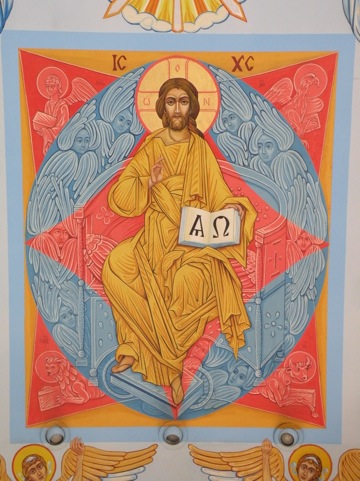
A few weeks ago I explained the meaning of the “IC XC” on icons, which is a short-hand for “Jesus Christ”, and earlier this week I explained the meaning of the letters which commonly appear above pictures of His mother. Today I’d like to provide a quick follow-up to another aspect of “IC XC” which you sometimes find in eastern art…
This is the painting on the front wall above the altar at Holy Angels:
Today is my sister’s wedding anniversary. I thought I’d mark it by sharing a very romantic, very nerdy video I found on YouTube…
While we’re on the subject of marriage, thanks to everyone who re-posted my entry “Husbands *love* your wives” – it’s now one of the most popular posts on this blog. Cheers! 🙂
Monday marked the end of this month’s “Theology On Tap”, a Diocesan Catholic young adult event, this time hosted by the JP2 Group. Our opening speaker at the start of the month was the incomparable Paul J Kim and the series of talks was brought to a close by Michaelene Fredenburg.
Michaelene’s talk was entitled “Invitation to healing: reaching those touched by abortion”. Abortion is certainly a very sensitive subject and Michaelene handled it beautifully and delicately. She didn’t present a theological treatise as to why abortion is wrong, but rather presented insight into the life of someone who has been affected by abortion and offered some guidance as to how to sensitively help that person.
It’s inevitable that most people reading this post will have been affected in some way by abortion, either directly or indirectly. For this reason, if you were unable to make it to this last “Theology On Tap” session I would encourage you check out her website at AbortionChangesYou.com.
I’ve previously written about one of my favourite Early Church Fathers, St. Polycarp and I’ve just finished preparing the account of his martyrdom that we’re going to be reading in the JP2 Group, starting next week.
Whenever we read documents from the Early Church I always work hard to try and produce the most readable translation for us to study. I do this by comparing many of the different translations and I do this in an attempt to eliminate all possible barriers to people reading, engaging with and actually enjoying these early Christian writers.
If you would like to view this document, links are provided below. The document is available in both Microsoft Word (.docx) and Adobe Reader formats (.pdf).
I’ve also recorded this document in an MP3 fjle because I personally learn best when I use audio. So…if you’re looking for something to listen to while you’re sunbathing at Pacific Beach over Memorial Day Weekend, look no further!
Do you remember the bit in the Acts of the Apostles where Paul is in Athens? We’re told that “A group of Epicurean and Stoic philosophers began to debate with him…When they heard about the resurrection of the dead, some of them sneered” (Acts 17:18, 32). Ever wondered who these guys were?
Well, wonder no more! I’ve recently come across a collection of “Three Minute Philosophy” videos on YouTube:
Warning! This guy’s videos can contain rather colourful language…
(Also, his video on St. Thomas Aquinus has a few errors in it…)