Meet Pope Francis

(Thanks to Da Mihi Animas for this one)
"We are travellers…not yet in our native land" – St. Augustine

(Thanks to Da Mihi Animas for this one)
It’s time for a quick reading list update. So far this year, I’ve finished the following books
The Screwtape Letters The Great Divorce , Mere Christianity, Problem of Pain – C.S. Lewis
The Desert Fathers: Sayings of the Early Christian Monks – Penguin Classics
Every Man’s Journey – James P. Campbell
Hold Me Tight – Dr. Sue Johnson
After Jesus – Reader’s Digest
St. Francis of Assisi – G.K. Chesterton
Jesus of Nazareth – Pope Benedict XVI
Weaving The Web – Tim Berners-Lee*
Roots of the Reformation – Karl Adam*
The Confessions of St. Augustine – St. Augustine
Imitation of Christ – Thomas à Kempis
This month I finished:
Philosophy For Dummies – Thomas Morris
Importance of Being Earnest – Oscar Wilde
I am currently reading:
Jesus Among Other Gods – Ravi Zacharias
…which leaves the following books still unread:
The Path of Life – Cyprian Smith OSB
Introduction to the Devout Life – St. Francis de Sales
Rediscover Catholicism – Matthew Kelly
Everlasting Man – G.K. Chesterton
The article Reading List Update first appeared on RestlessPilgrim.net
 While watching clips of “The Big Bang Theory” on YouTube, I came across a video of Mayim Bialik, the actress who plays Amy Farrah Fowler on the show. If you’re old like me, you may also remember her from the show Blossom, but I think it’s safe to say that her character in The Big Bang Theory is probably my favourite.
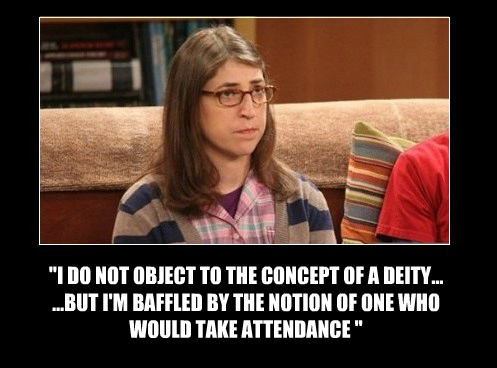
Amy Farrah Fowler: My kind of woman
The Art of Manliness offers “14 Red Flags to Look Out for in a Relationship”:

Agree? Disagree? And hmmm….might it be time to finally resurrect the Why doesn’t that nice Catholic Guy Ask Me Out posts?
I work for a software consultancy and, every now and then, clients say odd things. They are rarely as amazing as some of the things said at Clients From Hell though…

In the last two blog posts I critiqued the Scripture interpretations of Mack, a commentator on my Once Saved, Always Saved post. Mack had responded to my article, claiming that I had been misapplying Scripture passages to support my argument that it is possible to lose your salvation. If you would like to read my two previous replies, they are available here and here.
We have nearly finished looking at Mack’s commentary, so please pour yourself one last cup of tea and we’ll take a look at the final two passages…

In the last post I began to examine the responses of Mack, a recent commentator on my Once Saved, Always Saved post who offered some constructive criticism concerning the Scripture passages I presented.
I previously looked at Mack’s commentary of 1 John 5:16-17 and 2 Peter 2:20-22. I will now look at his analysis of several other passages which I offered in defense of the idea that it is possible to lose one’s salvation. Mack basically attempted to disqualify these texts since they were drawn from letters addressed to groups of people.
So, grab another cup of tea and we’ll look at what he had to say…