Quick Apology: “Saint intercession isn’t in the Bible”

In previous “Quick Apologies”, I’ve dealt with different aspects of the intercession of the saints. Today I’d like to address one of the final pieces of the puzzle…

Objection

After explaining the Catholic understanding of Saintly intercession, as well as having shown its merit, one is often presented with a common retort against many Catholic doctrines:

“But [Doctrine X] is not in the Bible!”

I’ve written before in another post about the problem with this objection and about the logical problems and presuppositions associated with it. However, is the claim actually true in this case? Is it correct to say that we don’t see saintly intercession within the pages of Scripture?

Response

We actually do see Saintly intercession within the pages of Scripture. We see departed Saints offering prayers and pleading for God to take action upon the earth.  In fact, we don’t just see departed Christians doing this…

Heavenly Helpers

In John’s Book of Revelation, we read the following:

And when he had taken the scroll, the four living creatures and the twenty-four elders fell down before the Lamb, each holding a harp, and with golden bowls full of incense, which are the prayers of the saints
– Revelation 5:8

These “twenty-four elders” are deceased humans, yet we are told that they offer bowls of incense before the throne of God which are representative of the prayers of other Christians. If they are offering these prayers to God, it would make sense that they have some knowledge of their content too.

In response to this, I’ve heard a variety of attempts to deny that this passage teaches Saintly intercession. However, the fact cannot be denied that the Book of Revelation presents us with a picture of the deceased interacting in some way with the prayers of those on earth. This stands in rather stark contrast to assertions which Catholics often hear (“Christians in Heaven can have nothing to do with Christians on earth”).

On earth as it is in Heaven

A little later in the Book of Revelation, we read about how the martyrs in Heaven petition God:

…I saw under the altar the souls of those who had been slain for the word of God and for the witness they had borne; they cried out with a loud voice, “O Sovereign Lord, holy and true, how long before thou wilt judge and avenge our blood on those who dwell upon the earth?” – Revelation 6:9-10

Here we have a concrete example of deceased Christian martyrs pleading for God to take action upon earth!

Not just Saints

A few chapters later, we see not only Saints, but angels as having something to do with prayers from earth:

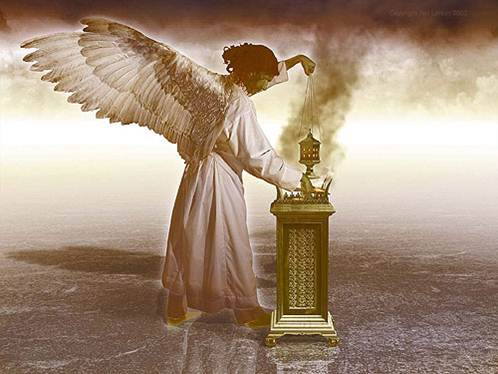
And another angel came and stood at the altar with a golden censer; and he was given much incense to mingle with the prayers of all the saints upon the golden altar before the throne; and the smoke of the incense rose with the prayers of the saints from the hand of the angel before God. – Revelation 8:3-4

One might ask how this is possible. How could an angel have anything to do with the prayers of men on earth? How could they know of the contents of a man’s prayer? If we recall that angels rejoice whenever a sinner repents (Luke 15:10) then surely anything is possible through the grace of God.

Angel

UPDATE 11/20/15 07:10 – I just got back from Mass where the First Reading included the first passage I quoted in this post. I had no idea prior to posting 🙂

Wise Words on Wednesday: Wanting a woman

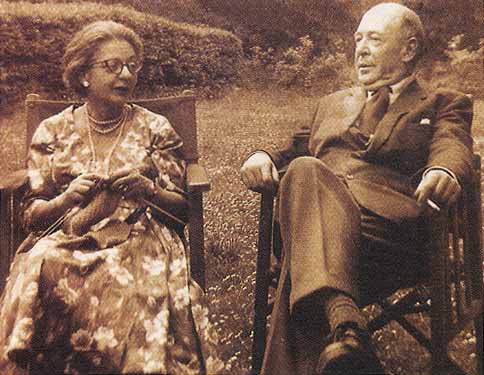
Joy and Lewis

“We use a most unfortunate idiom when we say, of a lustful man prowling the streets, that he ‘wants a woman.’ Strictly speaking, a woman is just what he does not want.

“He wants a pleasure for which a woman happens to be the necessary piece of apparatus. How much he cares about the woman as such may be gauged by his attitude to her five minutes after fruition (one does not keep the carton after one has smoked the cigarettes).

“Now Eros makes a man really want, not a woman, but one particular woman. In some mysterious but quite indisputable fashion the lover desires the Beloved herself, not the pleasure she can give.”

– C.S. Lewis, The Four Loves

Music Monday: Revelation Song

Today’s song is another from Kari Jobe, “Revelation Song”:
VERSE 1
Worthy is the Lamb who was slain

Holy, holy is He
Sing a new song to Him who sits on
Heaven’s mercy seat

CHORUS
Holy, holy, holy is the Lord God Almighty

Who was and is and is to come
With all creation I sing praise to the King of kings
You are my everything and I will adore You

VERSE 2
Clothed in rainbows of living color

Flashes of lighting rolls of thunder
Blessing and honor strength and glory and power be
To You the only wise King

VERSE 3
Filled with wonder awestruck wonder

At the mention of Your name
Jesus Your name is power, breath and living water
Such a marvelous mystery

What’s the big deal with Latin?

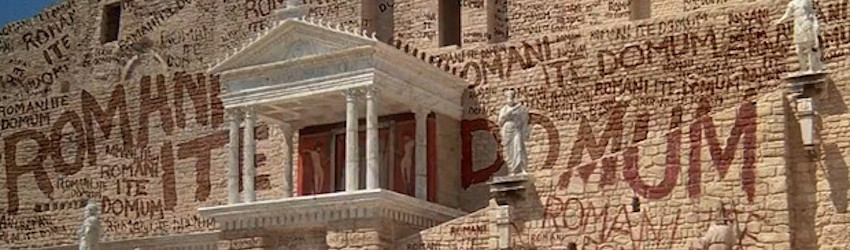
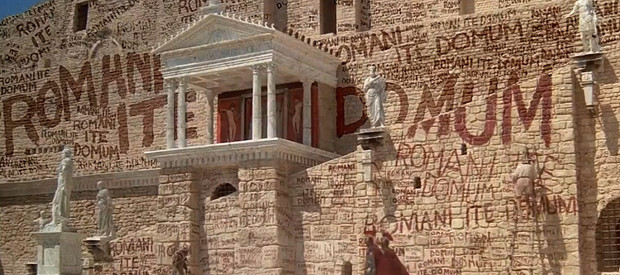
Latin

A couple of weeks ago, a friend sent me a question that I’d like to answer in this post:

So, what’s the deal with Latin? It seems to be considered holy or at least holier than the vernacular and I was wondering why. I know that shortly after Christ’s death the church was based in Rome and that Latin was the primary language of most of the Church fathers, I just didn’t know if that was all that was behind it or if there was more. Is it at all important to learn to pray certain prayers in Latin? Or even work to understand the Mass in Latin?

So, what’s the deal with Latin? In my opinion, it’s a horrible language that I was forced to study for three years in school which I absolutely hated. Next question? Okay, maybe that’s not the answer you were looking for.

Why Latin?

I suppose that you could say that Latin is important to Catholicism for a few reasons…

1. Lingua Sacra
The Catholic Church’s love of Latin finds an echo in Judaism. Although most Jews spoke Aramaic (or Greek outside of Palestine), it was Hebrew that was the language of the Temple and the Sacred Scriptures. Latin in Catholicism occupies a similar position as a “Lingua Sacra” (Sacred Language).

2. History
As you rightly point out, a few centuries after Christ Latin is starting to overtake Greek as the common language of the Roman Empire. Starting with Tertullian, the Early Church Fathers increasingly wrote in Latin. This meant that, at least in the West, Latin became the language of theology, liturgy and learning in general. All this resulted in the Latin language being tied to the faith in a very special way. Even once the general use of Latin started to decline, it was still used in the Church, as well as being the universal language of published scholarly works, law, science, …

3. Catholicity 
I never really saw the point in Latin Mass until I travelled abroad where my knowledge of the vernacular wasn’t too strong. I could typically follow along with the liturgy, knowing as I did the words of the Mass by heart. However, I remember my joy when we started singing the Sanctus, Benedictus, Amen*… I got a little taste of what a universal liturgical language could bring to the sense of oneness and catholicity of the Church.

* Please note, the “Kyrie” isn’t Latin, but Greek.

Should you learn it?

Now, is it important to learn to pray certain prayers in Latin or understand the Latin Mass? You could that is isn’t because typically most of the Masses you’ll attend will be in the vernacular (something which, by the way, the Eastern Churches have always done).

However, on the other hand, you could that it is very important because it is the patrimony of the Western Church and therefore deserves our attention, since it roots us to the historic Church. Personally, I go to Tridentine Mass a couple of times a year. I prefer my usual liturgy, but I attend periodically so as to gain an appreciation for the liturgy which was celebrated by many of our great Saints. Finally, please remember this great saying:

“Quidquid latine dictum sit altum videtur”
“Anything said in Latin sounds profound”

The cost of discipleship

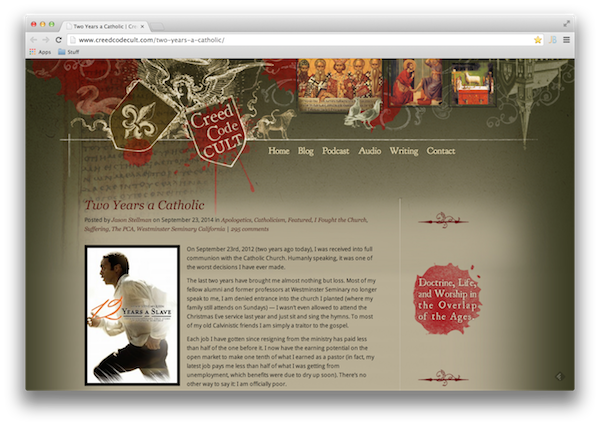
A couple of years ago, Jason Stellman, a Presbyterian pastor converted to Catholicism. I remember when he converted that there were lots of nasty comments in his Comment Box saying that he was converting for the “fame” and the “money” which apparently comes with being a Catholic convert. Well, two years later, on the anniversary of his entrance into the Church, Jason posted a reflection concerning his life now he’s Catholic. It’s a sobering read.

If any man would come after me, let him deny himself and take up his cross and follow me. – Mark 8:34

Screen Shot 2014-10-04 at 6.41.16 PM

By the way, if you’re ever looking to study Paul’s epistle to the Galatians, I can thoroughly recommend the six-part series freely available on Jason’s website. It’s really good.

1 167 168 169 170 171 322