Friday Frivolity: Baby Worship
"We are travellers…not yet in our native land" – St. Augustine
In my previous post, I recounted a little bit of my own story and how I came to reconsider the Catholic teaching concerning intercommunion. In today’s post I would like to present the two main issues around which this teaching revolves.

“Our Lord suggests that the Christian life is a battlefield. Only the squeamish and the cowardly return untouched and ‘whole’ from battle. If I find nothing in myself to discipline, it is because I suffer from an adolescent insecurity that wants nothing changed, and because I have installed myself in the illusion that everything about me is already perfect. Or I do not believe in anything worth defending, worth fighting for, more precious than my body and my ego in their splendid isolation. I clutch at the integrity and sovereignty of my body and ego as the ultimate treasure, little realizing that this body of ours has been given to us to engage it in adventure, in odysseys, in warfare, in heroic deeds for the common good.“
– Erasmo Leiva-Merikakis
A few of you have asked, so I thought I’d do a quick post to say that I haven’t had any more visits from the Jehovah Witnesses following my last meeting.

I went through the material they left concerning the Deuterocanon/Apocrypha. It wasn’t very good, just the usual objections. It was rather amusing though to find them trying to marshall St. Athanasius, particularly given that he vigorously opposed Arius who taught something similar to what Jehovah Witnesses believe about Jesus.

Reception of the Holy Eucharist has recently been the subject of scrutiny in the media, prompted by some of the discussions taking place in the “Synod on the Family”. In my own life, Holy Communion was also the subject of a recent incident concerning a friend of mine.
You see, a friend recently went to a Catholic conference together with a Protestant. Being a Catholic event, there was, of course, the celebration of the Eucharist. When time for Mass came, the non-Catholic was upset that she couldn’t go up to receive the Eucharist. She couldn’t do this because, under ordinary circumstances, the Catholic Church does not allow non-Catholics to receive Holy Communion.
“…members of those churches with whom we are not yet fully united are ordinarily not admitted to Communion”
– United States Conference of Catholic Bishops, “Guidelines For communion”
In this post I would like to provide a summary of what I say when I’m asked why it is that the Catholic Church doesn’t allow anyone to receive Holy Communion (the Eastern Orthodox Churches have similar rules for similar reasons). As usual, this won’t be an exhaustive theological explanation, simply a rough outline of the kind of thing I personally say when I’m asked to explain this particular Catholic teaching.
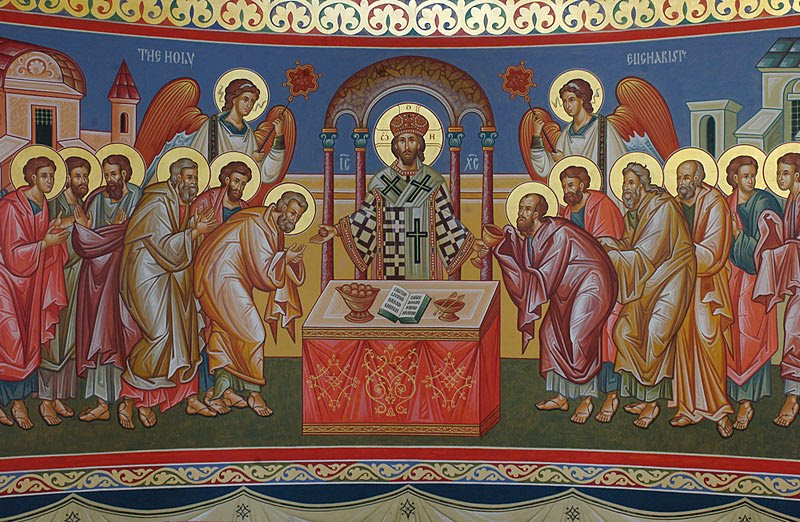
Recently, a clerical friend of mine was officially installed at a parish here in San Diego. It called to mind the invitation of Jesus to His Apostles:
“Follow me and I will make you become fishers of men” – Mark 1:17
I remember being in primary school and, upon hearing the phrase “fishers of men”, had fantastical pictures in my head of St. Peter and Andrew dragging ashore nets full of squirming bodies of fully-grown men. What can I say? I had a vivid imagination as a child.

There’s a lot of discussion online at the moment about the conditions under which people may or may not receive communion. I have another post in draft on this subject, but I wanted to do a quick post outlining some of the earliest Church testimony on this subject.
In the First Century, the Didache teaches the following:
“On the Lord’s day, gather yourselves together and break bread, give thanks, but first confess your sins so that your sacrifice may be pure. However, let no one who is at odds with his brother come together with you, until he has reconciled, so that your sacrifice may not be profaned.” – Didache (Chapter 14)
So here we see that unrepentant sin or in a state of disunity cannot receive communion. We find Justin Martyr in the Second Century saying something very similar:
“This food we call Eukaristia [the Eucharist], and no one is allowed to partake but he who believes that our doctrines are true, who has been washed with the washing for the remission of sins and rebirth, and who is living as Christ has enjoined” – St. Justin Martyr, First Apology (Chapter 66)
Here we find the three basic conditions to receiving communion: baptized, assent to Church doctrine and right living.
I’ve got a more substantial post in the works on the subject of interdenominational communion which I’ll publish next week…