The Four Loves – Chapter 3 (“Affection”)

Four Loves 3

I’m changing the format of my notes for these summaries of “The Four Loves”. This is so they reflect the format I use to prepare for our book group meetings. Perhaps when Matt and I look at this book in the podcast, I’ll construct new notes. Until then…

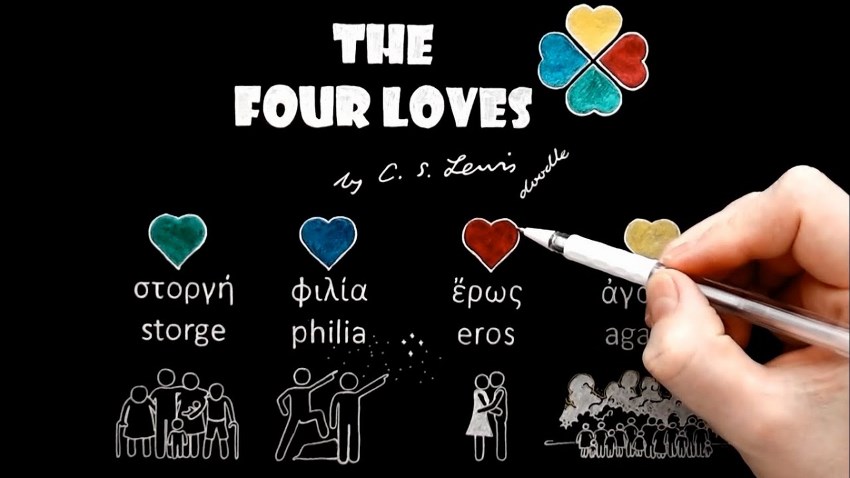
C.S. Lewis Doodle

Notes & Questions

Introduction

My Greek Lexicon defines storge as “affection, especially of parents to offspring”; but also of offspring to parents.. The image we must start with is that of a mother nursing a baby, a bitch or a cat with a basketful of puppies or kittens; all in a squeaking, nuzzling heap together; purrings… Affection is responsible for nine-tenths of whatever solid and durable happiness there is in our natural lives

The Need and Need-love of the young is obvious; so is the Gift-love of the mother. She gives birth, gives suck, gives protection. On the other hand, she must give birth or die. She must give suck or suffer. That way, her Affection too is a Need-love. There is the paradox. It is a Need-love but what it needs is to give. It is a Gift-love but it needs to be needed. We shall have to return to this point.

1. How does Jack define “storge”/”affection”?
2. Why is there a paradox within affection?
3. To what kind of objects do we attach affection?
4. Do Americans know “The Wind in the Willows”?!

The objects of affection

[Affection] is indeed the least discriminating of loves… almost anyone can become an object of Affection; the ugly, the stupid, even the exasperating. There need be no apparent fitness between those whom it unites… It ignores the barriers of age, sex, class and education… It ignores even the barriers of species.

But Affection has its own criteria. Its objects have to be familiar… I doubt if we ever catch Affection beginning. To become aware of it is to become aware that it has already been going on for some time. The use of “old”…as a term of Affection is significant…  It is no proof of our refinement or perceptiveness that we love them; nor that they love us. What I have called Appreciative Love is no basic element in Affection. It usually needs absence or bereavement to set us praising those to whom only Affection binds us. We take them for granted: and this taking for granted, which is an outrage in erotic love, is here right and proper up to a point. It fits the comfortable, quiet nature of the feeling… It lives with…soft slippers, old clothes, old jokes, the thump of a sleepy dog’s tail on the kitchen floor…

1. What kind of limits are there on affection?
2. Lewis says that affection has its own criteria. What is it?

The love cocktail

As gin is not only a drink in itself but also a base for many mixed drinks, so Affection…can enter into the other loves and colour them all through and become the very medium in which from day to day they operate. They would not perhaps wear very well without it… when your friend has become an old friend, all those things about him which had originally nothing to do with the friendship become familiar and dear with familiarity. As for erotic love, I can imagine nothing more disagreeable than to experience it for more than a very short time without this homespun clothing of affection…. No need to talk. No need to make love. No needs at all except perhaps to stir the fire.

…all three of [the loves] had in common, as their expression, the kiss. In modern England friendship no longer uses it, but Affection and Eros do… Again, both these loves tend – and it embarrasses many moderns – to use a “little language” or “baby-talk”… Different sorts of tenderness are both tenderness and the language of the earliest tenderness we have ever known is recalled to do duty for the new sort.

1. In what way is affection like gin?
2. Why does Jack think affection is so important in relation to friendship and eros?
3. Jack points to two things which remind us of the blending/overlappping of the loves. What are they?

Read more

Wise Words on Wednesday: To love is to be vulnerable

Heart

“To love at all is to be vulnerable. Love anything and your heart will be wrung and possibly broken. If you want to make sure of keeping it intact you must give it to no one, not even an animal. Wrap it carefully round with hobbies and little luxuries; avoid all entanglements. Lock it up safe in the casket or coffin of your selfishness. But in that casket, safe, dark, motionless, airless, it will change. It will not be broken; it will become unbreakable, impenetrable, irredeemable. To love is to be vulnerable.”

– C.S Lewis, The Four Loves

The Four Loves – Chapter 2 (Part 3: “Patriotism”)

Four Loves 2

Continuing my notes for The Four Loves, this is the second of two posts which continue my summary of Chapter 2 (“Likings and Loves for the subhuman”) of The Four Loves. In this post we will be looking at the final section of the chapter which Lewis devotes to the love of country, patriotism.

1. Everyone knows that patriotism can turn turn bad

…we all know now that this love [of country] becomes a demon when it becomes a god. Some begin to suspect that it is never anything but a demon.

2. But if we say it is always bad, we have to reject much

But then they have to reject half the high poetry and half the heroic action our race has achieved. We cannot keep even Christ’s lament over Jerusalem. He too exhibits love for His country.

3. In this chapter we will attempt to distinguish authentic patriotism from its demonic form

Let us limit our field…. We are only considering the sentiment itself in the shape of being able to distinguish its innocent from its demoniac condition.

4. We will be focussing on patriotism in subjects rather than rulers

Neither…[innocent nor demonic patriotism] is the efficient cause* of national behaviour. For strictly speaking it is rulers, not nations, who behave internationally. Demoniac patriotism in their subjects…will make it easier for them to act wickedly; healthy patriotism may make it harder: when they are wicked they may by propaganda encourage a demoniac condition of our sentiments in order to secure our acquiescence in their wickedness. If they are good, they could do the opposite. That is one reason why we private persons should keep a wary eye on the health or disease of our own love for our country.

* Jack is referring to one of the four causes described by Aristotle.

Read more

The Four Loves – Chapter 2 (Part 2: “Love of nature”)

Four Loves 2

Continuing my notes on The Four Loves, this is the first of two posts which continue my summary of Chapter 2 (“Likings and Loves for the subhuman”). In this post we will be looking at the section which Lewis devotes to the love of nature.

1. Some people have a special love of nature

For some people, perhaps especially for Englishmen and Russians, what we call “the love of nature” is a permanent and serious sentiment. I mean here that love of nature which cannot be adequately classified simply as an instance of our love for beauty.

(a) This is more than simply an appreciation of beauty

Of course many natural objects – trees, flowers and animals – are beautiful.

(i) Either of individual objects…

But the nature-lovers whom I have in mind are not very much concerned with individual beautiful objects of that sort. The man who is distracts them. An enthusiastic botanist is for them a dreadful companion on a ramble. He is always stopping to draw their attention to particulars. N

(ii) …or of vistas

or are they looking for “views” or landscapes. Wordsworth, their spokesman, strongly deprecates this. It leads to “a comparison of scene with scene”, makes you “pamper” yourself with “meagre novelties of colour and proportion”.

(b) For these lovers of nature, it is about the “Spirit” of the place

While you are busying yourself with this critical and discriminating activity you lose what really matters – the “moods of time and season”, the “spirit” of the place. And of course Wordsworth is right. That is why, if you love nature in his fashion, a landscape painter is (out of doors) an even worse companion than a botanist. It is the “moods” or the “spirit” that matter.

(c) Which is why beauty itself per se is the focus

Nature-lovers want to receive as fully as possible whatever nature, at each particular time and place, is, so to speak, saying. The obvious richness, grace and harmony of some scenes are no more precious to them than the grimness, bleakness, terror, monotony, or “visionary dreariness” of others. The featureless itself gets from them a willing response. It is one more word uttered by nature. They lay themselves bare to the sheer quality of every countryside every hour of the day. They want to absorb it into themselves, to be coloured through and through by it.

Read more

Reading “The Four Loves” at The Eagle And Child

The Four Loves

You may have noticed the posts on C.S. Lewis’ book, The Four Loves, appearing on this blog. Our San Diego C.S. Lewis book club has now finished Mere Christianity and we have now started on this other book from Lewis…just in time for Valentine’s Day:

Chapter 1: Introduction
Chapter 2: The likes and loves of the sub-human (1 | 2 | 3)
Chapter 3: Affection
Chapter 4: Friendship
Chapter 5: Eros
Chapter 6: Agape


The Four Loves – Chapter 2 (“Likings And Loves For The Sub-Human”)

Four Loves 2

Continuing my notes on The Four Loves, in this chapter Jack examines the likings/loves we have for things things which are not human (which he calls “subhuman”). In particular, he focuses in on love of nature and love of country. We will not deal with these in this post. Due to the length of the chapter, these will be dealt with in subsequent posts.

Notes and Quotes

1. Before we get to loves, we need to look at likes, which means we need to look at pleasures

…there is a continuity between our elementary likings for things and our loves for people. Since “the highest does not stand without the lowest”* we had better begin at the bottom, with mere likings; and, since to “like” anything means to take some sort of pleasure in it, we must begin with pleasure.

* This is a quotation from “The Imitation of Christ” by Thomas a Kempis

2. We may divide pleasures into two kinds

Now it is a very old discovery that pleasures can be divided into two classes…

(a) Need Pleasures

…those [pleasures] which would not be pleasures at all unless they were preceded by desire… An example… would be a drink of water. This is a pleasure if you are thirsty and a great one if you are very thirsty. But probably no one in the world… ever poured himself out a glass of water and drank it just for the fun of the thing.

(b) Appreciative Pleasures

…[the other kind are] those which are pleasures in their own right and need no such preparation [of desire]. An example… would be the unsought and unexpected pleasures of smell – the breath from a bean-field or a row of sweet-peas meeting you on your morning walk. You were in want of nothing, completely contented, before it; the pleasure, which may be very great, is an unsolicited, super-added gift.

3. There can be complications with dividing up pleasures in this way

(a) You can have both pleasures at the same time

If you are given a coffee or beer where you expect (and would have been satisfied with) water, then of course you get a pleasure of the first kind (allaying of thirst) and one of the second (a nice taste) at the same time.

(b) Addiction can turn pleasure from appreciative-pleasure to need-pleasure

For the temperate man an occasional glass of wine is a treat like the smell of the bean-field. But to the alcoholic…no liquor gives any pleasure except that of relief from an unbearable craving. 

Read more

1 2 3