Tag: The Four Loves
C S Lewis, Gender, and The Four Loves
Professor Brenton Dickieson recently gave an online presentation on “C.S. Lewis, Gender, and The Four Loves”:
A certain English podcast jumped in to share some of his thoughts…
Notes for The Four Loves
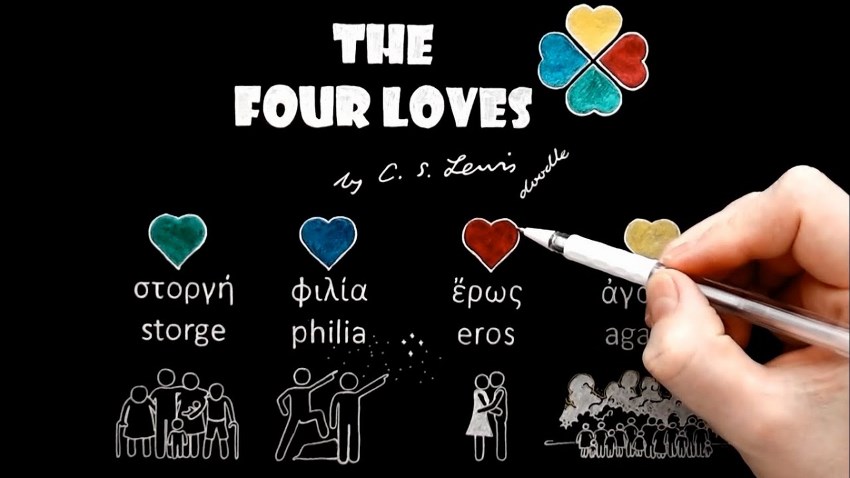
In a couple of weeks I’ll be giving a talk here in San Diego based on The Four Loves by C.S. Lewis. I remembered that I had written some notes for our discussion group and posted them here. However, when I went to find them I discovered that I didn’t have a single index page with all the links….so here it is.
Chapter 1
“Introduction”
Chapter 2
Likings and Loves of the Sub-Human, Love of Nature, Patriotism
Chapter 3
Affection
Chapter 4
Friendship
Chapter 5
Eros
Chapter 6
Agape
Here are some other resources relating to The Four Loves which I think are helpful:
“The Four Loves” Notes & Quotes

Since I’ve now finished posting my outlines for each of the chapters of “The Four Loves”, I thought I should have a post which links to all of them in one place:
Chapter 1: Introduction
Chapter 2: Likings and loves of the sub-human: Love of Nature and Patriotism
Chapter 3: Affection
Chapter 4: Friendship
Chapter 5: Eros
Chapter 6: Charity
The Four Loves – Chapter 6 (“Charity”)

C.S. Lewis Doodle
Themes
The natural loves are not self-sufficient
The natural loves are not self-sufficient. Something else…must come to the help of the mere feeling if the feeling is to be kept sweet… It is no disparagement to a garden to say that it will not fence and weed itself, nor prune its own fruit trees, nor roll and cut its own lawns.
Natural loves as rivals to God
There were two reasons for my delay… [The] older theologians were always saying very loudly that (natural) love is likely to be a great deal too much. The danger of loving our fellow creatures too little was less present to their minds than that of loving them idolatrously. In every wife, mother, child and friend they saw a possible rival to God. So of course does Our Lord
…For most of us the true rivalry lies between the self and the human Other, not yet between the human Other and God. It is dangerous to press upon a man the duty of getting beyond earthly love when his real difficulty lies in getting so far.
But to have stressed the rivalry earlier in this book would have been premature in another way also… The loves prove that they are unworthy to take the place of God by the fact that they cannot even remain themselves and do what they promise to do without God’s help… Even for their own sakes the loves must submit to be second things if they are to remain the things they want to be.
Disagreeing with St. Augustine
…[For the] older theologians… the danger of loving our fellow creatures too little was less present to their minds than that of loving them idolatrously. In every wife, mother, child and friend they saw a possible rival to God. So of course does Our Lord.
In words which can still bring tears to the eyes, St. Augustine describes the desolation in which the death of his friend Nebridius plunged him. Then he draws a moral. This is what comes, he says, of giving one’s heart to anything but God. All human beings pass away. Do not let your happiness depend on something you may lose…. Of course this is excellent sense… [However,] if I am sure of anything I am sure that [Jesus’] teaching was never meant to confirm my congenital preference for safe investments and limited liabilities… Would you choose a wife or a Friend – if it comes to that, would you choose a dog in this spirit? One must be outside the world of love, of all loves, before one thus calculates
We follow One who wept over Jerusalem and at the grave of Lazarus, and, loving all, yet had one disciple whom, in a special sense, he “loved”… Even if it were granted that insurances against heartbreak were our highest wisdom, does God Himself offer them? Apparently not. Christ comes at last to say “Why hast thou forsaken me?”
Read more
The Four Loves – Chapter 5 (“Eros”)

C.S. Lewis Doodle
Quotations
What is Eros?
…that state which we call “being in love”… Sexuality makes part of our subject only when it becomes an ingredient in the complex state of “being in love”. That sexual experience can occur without Eros… and that Eros includes other things besides sexual activity, I take for granted… The carnal or animally sexual element within Eros, I intend… to call Venus.
Eros, Venus and Morality
I am not at all subscribing to the popular idea that it is the absence or presence of Eros which makes the sexual act “impure” or “pure”… Most of our ancestors were married off in early youth to partners chosen by their parents on grounds that had nothing to do with Eros… Conversely, this act, done under the influence of a soaring and iridescent Eros which reduces the role of the senses to a minor consideration, may yet be plain adultery, may involve breaking a wife’s heart, deceiving a husband, betraying a friend, polluting hospitality; and deserting your children. It has not pleased God that the distinction between a sin and a duty should turn on fine feelings.
Love’s Contemplative
Very often what comes first is simply a delighted pre-occupation with the Beloved – a general, unspecified pre-occupation with her in her totality. A man in this state really hasn’t leisure to think of sex. He is too busy thinking of a person. The fact that she is a woman is far less important than the fact that she is herself. He is full of desire, but the desire may not be sexually toned. If you asked him what he wanted, the true reply would often be, “To go on thinking of her.” He is love’s contemplative.
… Sexual desire, without Eros, wants it, the thing in itself; Eros wants the Beloved…
The thing is a sensory pleasure; that is, an event occurring within one’s own body. We use a most unfortunate idiom when we say, of a lustful man prowling the streets, that he “wants a woman”. Strictly speaking, a woman is just what he does not want. He wants a pleasure for which a woman happens to be the necessary piece of apparatus. How much he cares about the woman as such may be gauged by his attitude to her five minutes after fruition (one does not keep the carton after one has smoked the cigarettes). Now Eros makes a man really want, not a woman, but one particular woman. In some mysterious but quite indisputable fashion the lover desires the Beloved herself, not the pleasure she can give.
The Four Loves – Chapter 4 (“Friendship”)

C.S. Lewis Doodle
Notes
Friendship and Modernity
…very few modern people think Friendship a love of comparable value [to Affection and Eros] or even a love at all. To the Ancients, Friendship seemed the happiest and most fully human of all loves; the crown of life and the school of virtue. The modern world, in comparison, ignores it.
The first and most obvious answer is that few value it because few experience it. And the possibility of going through life without the experience is rooted in that fact which separates Friendship so sharply from both the other loves. Friendship is…the least natural of loves; the least instinctive, organic, biological, gregarious and necessary…The pack or herd…may even dislike and distrust it.
…all that had once commended this love [to the Ancients] now began to work against it. [For modernity,] …it had not tearful smiles and keepsakes and baby-talk enough to please the sentimentalists. There was not blood and guts enough about it to attract the primitivists.
Secret Homosexuality?
It has actually become necessary in our time to rebut the theory that every firm and serious friendship is really homosexual… The very lack of evidence is thus treated as evidence; the absence of smoke proves that the fire is very carefully hidden… Those who cannot conceive Friendship as a substantive love but only as a disguise or elaboration of Eros betray the fact that they have never had a Friend…
Kisses, tears and embraces are not in themselves evidence of homosexuality… On a broad historical view it is…not the demonstrative gestures of Friendship among our ancestors but the absence of such gestures in our own society that calls for some special explanation. We, not they, are out of step.
Contrasting the friendship and the love affair
Lovers are always talking to one another about their love; Friends hardly ever about their Friendship. Lovers are normally face to face, absorbed in each other; Friends, side by side, absorbed in some common interest. Above all, Eros (while it lasts) is necessarily between two only. But [in friendship]… we possess each friend not less, but more as the number of those with whom we share… increases.