What does it mean “to pray to a Saint”?
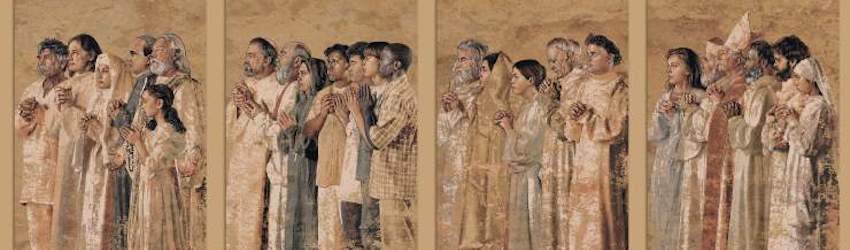
This blog post is meant as a supplement to my earlier earlier posts on the subject of Saintly intercession (read here and here)…
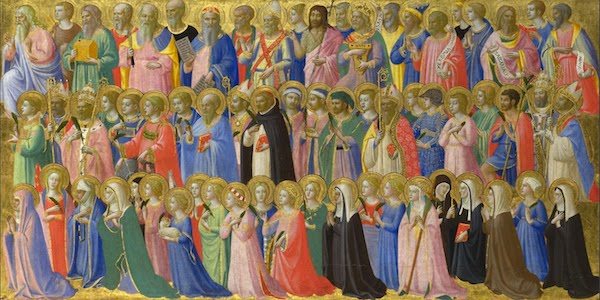
all_saints

One issue we have in Catholic-Protestant dialogue concerning the Saints is the language we use. You will often hear Catholics talking about “praying to Saints”. However, it is important to point out that what we really mean is that we’re asking the Saints to pray for us.

What’s in a name?

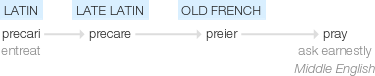
Part of the problem is the use of the verb “to pray”. It can mean two different things, depending on context. The word itself comes into English from the Latin word “precari”, which means “obtained by entreaty”. To pray, therefore, means to ask for something.
This is aptly demonstrated in my favorite Shakespeare play, A Much Ado About Nothing (Act 2, Scene 3):

BENEDICKAn he had been a dog that should have howled thus, they would have hanged him: and I pray God his bad voice bode no mischief…

DON PEDRO: Yea, marry, dost thou hear, Balthasar? I pray thee, get us some excellent music…

Here you see both uses of the word “pray”. In the first, Benedick petitions God, and in the second, Don Pedro asks Balthasar for music. In the former, a request is made to God, in the latter, to man.

A better dialogue

While I think that pointing out this distinction goes a long way to further Catholic-Protestant dialogue, I think that Catholics should go the extra mile and be careful with the way they speak around Protestants, so as to communicate the Catholic Faith as clearly as possible.

When talking with Protestants about praying to Saints, it might be worth spelling out exactly what you mean, saying explicitly that you’re asking the Saints for their intercession before the throne of God. Rather than talking about “Praying to the Saints”, you might speak about “Praying with the Saints”. Most Protestants are used to talking about praying with friends, so when expressed in these terms, the Catholic devotion will seem less alien and more accessible.

All you angels and saints, pray for us.
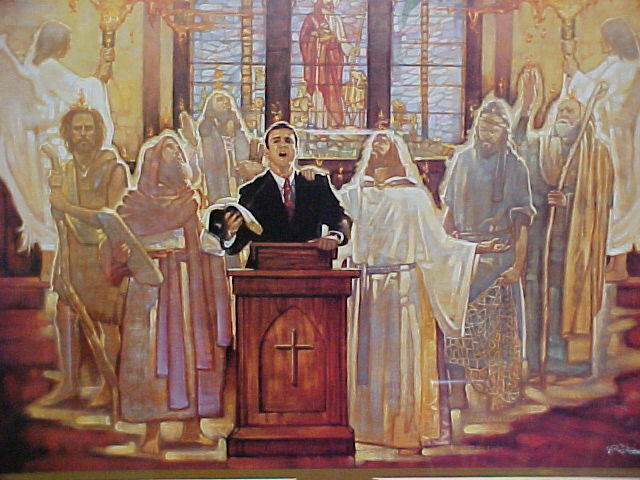
Quick Apology: Why not go to the source?

Today’s “Quick Apology” is a sequel to an earlier post, Quick Apology: You can’t pray to dead people. In that post I explained how those who have died in friendship with Christ are not “dead”, but are in fact more alive than we are. On Facebook, one of my friends responded with this question…

Objection

“But why would you want to pray to a Saint? Why not just go to the source, Christ?”

Response

This question is a reasonable one and makes sense until we consider everyday Christian practice…

When I meet up with my closest Christian friends, I will almost always ask them for their prayers concerning particular things going on in my life. However, if the above objection were valid, shouldn’t I being going directly to Christ? Why would I ask others to intercede for me when I could just instead make my requests to the Source directly?

To be certain, Christ has a special kind of mediation (1 Timothy 2:5), but that doesn’t preclude other kinds of mediation. In fact, we’re told in Scripture that we should intercede for each other (1 Timothy 2:1). So, the reasons why one would ask the Saints for their intercession are the same reasons why one would ask for the prayers of close friends. As my friend Steve said:

I’ve never seen a man in a true emergency when, for example, a car wreck requires emergency surgery for his young child, opt out of having others pray with him because he’d rather go straight to the Source.

It’s not an either/or proposition. Praying to the Lord directly is a good thing. Asking for the intercession of others is also a good thing. These two things don’t have to be in competition.

“We are taught by the Catholic faith that we may pray not only to God himself, but also to the Blessed in heaven, though in different manner; because we ask from God as from the Source of all good, but from the Saints as from intercessors – Pope Leo XIII (Augustissimae Virginis Mariae 9)

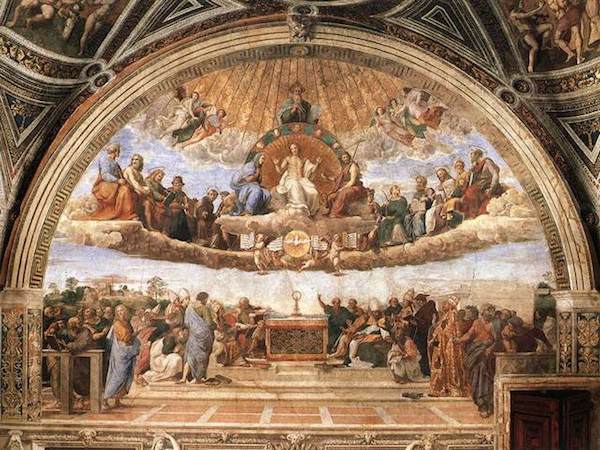
So, back to the question: why would you want to pray to Saint? Well, when we are baptised, we become part of a very large family, a “great cloud of witnesses”, all united together in Christ. What do good families do? They pray for each other.

When we ask friends to pray for us, I think it’s safe to say that we particularly request intercession from those whom we esteem as being strong in faith since “the prayer of a righteous man has great power in its effects” (James 5:16). Who is more righteous than those standing before the throne of God, those inthe city of the living God, the heavenly Jerusalem…just men made perfect”?

Cloud of Witnesses

PS – I’ll endeavour to do a more thorough post in the future as to what mean when we speak of “prayer” to the Saints. Don’t let me forget…

PPS – Joe over at Shameless Popery also blogged about this topic yesterday. Go check it out 🙂

Quick Apology: You can’t pray to dead people

Continuing in my series of brief apologetic responses, today I would like to look at the subject of Saintly intercession. As I mentioned last time, these will not be thorough, nuanced rebuttals, but simply how I typically would reply when I only have a brief window of opportunity to respond to objections to my Faith.

Objection

I often see on internet forums the following common objection to Saintly intercession:

“You can’t pray to dead people”

Response

In response to this objection I point out that the Saints are not dead:

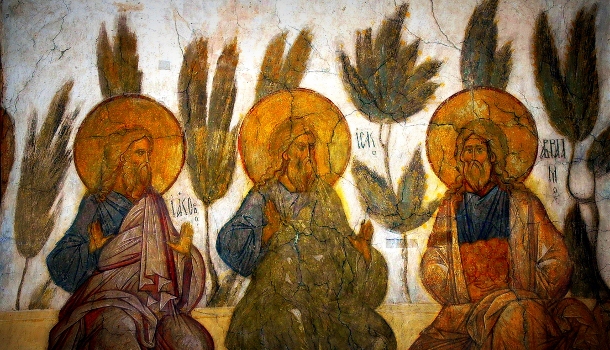
“…have you not read what was said to you by God, ‘I am the God of Abraham, and the God of Isaac, and the God of Jacob’? He is not God of the dead, but of the living.” – Matthew 22:32

If Jesus says that the Saints (“Abraham…Isaac….Jacob”) are alive and well, then I think it’s pretty safe to assume that they are indeed alive. Last week we had the Feast of the Transfiguration when Jesus speaks with Moses…a “dead” man (Matthew 17:1-4). Therefore, it is incorrect to call those Christians who have passed away “dead”. They are more alive in God than they have ever been!

Abraham-Isaac-and-Jacob-610x350

Does God share His glory?

There are some posts to which I regularly refer/hyperlink during apologetic discussions. Many of these kinds of posts are now found in this blog’s sidebar. 

I link to such posts because it saves me from repeatedly writing the same explanation, and it also helps limit the highjacking of the discussion thread with side issues. If someone wants to dispute the particular assertion then they have an entire blog post in which to do it where I make my case.

Today’s post is one of those posts which I think I’ll be linking to regularly…

Last week I was dialoguing with a commenter by the name “Sola Fide” and he made the assertion which I’ve heard many times before:

Sharing the glory of Christ with a human is idolatry… You are sharing the glory of Christ with Mary…
– User “Sola Fide”

Although it comes from admirable intentions, statements like this are rather mind-boggling when one considers the Biblical data available. Does the Bible ever speak about God sharing His glory with mere creatures? The short answer is, yes…

Glory

Read more

Before 300: Pre-Constantinian Christianity

It is often asserted that the Catholic Church was founded by the Constantine, who was Emperor of the Roman Empire from AD 306-337. A couple of weeks ago, a lady named Monica made such an assertion and in earlier post I pointed out some of the problems with such a theory.

However, today I would like to do something a little different… In this post I would like to set forth the positive historical case for the existence of the Catholic Faith in the generations prior to Constantine. I will show how twenty-two different Catholic doctrines were taught long before Constantine rose to power:

  1. The Church is Catholic
  2. The Church has a three-fold structure of leadership
  3. There is unity through episcopal authority and schism is evil
  4. Sacred Tradition is authoritative
  5. Worship is liturgical
  6. There is Apostolic Succession
  7. Peter has Primacy
  8. The Eucharist is a Sacrifice
  9. Jesus is truly present in the Eucharist
  10. The Eucharist is taken to the sick
  11. Infants are to be baptized
  12. Baptism actually washes away sin
  13. Priests forgive sins
  14. Works are involved in salvation
  15. Prayers are said for the dead
  16. There is purgation after death
  17. Relics are venerated and Saints are celebrated
  18. Mary is the New Eve
  19. Mary was a perpetual virgin
  20. Mary is the Mother of God
  21. Prayers are made to Saints
  22. Songs are sung to Mary

I will demonstrate these early Christian belief by looking at primary sources alone and restricting myself to writings produced prior to AD 300.

Read more
1 2 3 4 5