Mere Christianity – Book II – Chapter 1 (“Rival Conceptions of God”)
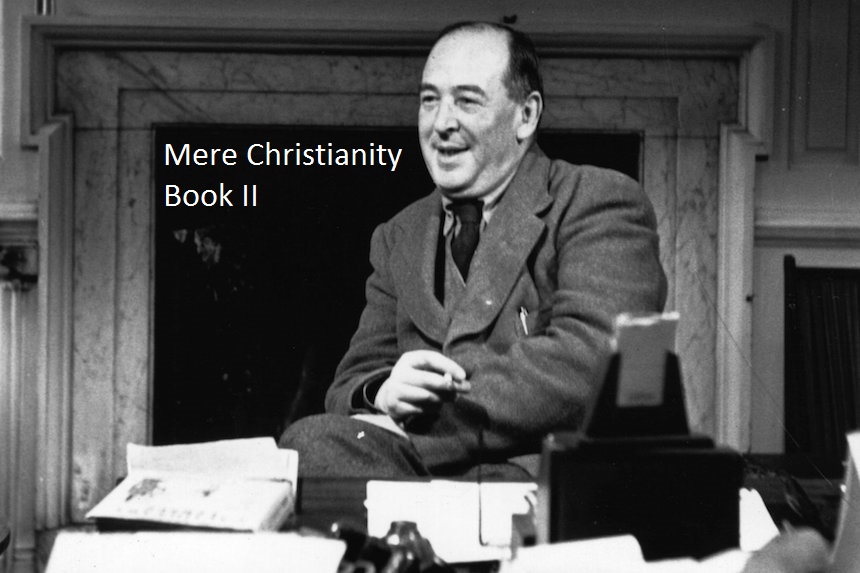
Book 2

We now begin the second Book of “Mere Christianity” which is entitled “What Christian’s Believe”. Previously I had been posting my notes as I read. Here are my notes for the first chapter of Book II:

Notes & Quotes

1. Christians can recognize the elements of truth in other religions

“If you are Christian you do not have to believe that all the other religions are simply wrong all through. If you are an atheist you do have to believe that the main point in all the religions of the whole world is simply one huge mistake. If you are a Christian, you are free to think that all those religions, even the queerest ones, contain at least some hint of the truth”

2. Christians can still make absolute claims

“As in arithmetic – there is only one right answer to a sum…but some of the wrong answers are much nearer being right than others”

3. Humanity may be divided first into two groups, the majority who believe in some kind of deity and a minority who do not. This group may be further subdivided into the kind of deity in which they believe:

(a) Pantheists

These believe that:

(i) God who is beyond good and evil

“…these people think that long before you got anywhere near the divine point of view the distinction [between good and evil] would have disappeared altogether…[This is] Pantheism. It was held by the great Prussian philosopher Hegel and, as far as I can understand them, by the Hindus.”

(ii) God and the universe almost the same thing

“Pantheists usually believe that God, so to speak, animates the universe as you animate your body: that the universe almost is God, so that if it did not exist He would not exist either, and anything you find in the universe is a part of God”

These two beliefs are connected:

“If you do not take the distinction between good an bad very seriously, then it is easy to say that anything you find in this world is a part of God”

(b) Non-Panthesists

These believe that:

(i) God who is ‘good’

“…a God who takes sides, who loves love and hates hatred, who wants us to behave in one way and not in another…[a view] held by Jews, Mohammadans and Christians”

The word “Mohammadans” is an old word used to describe Muslims (since they were followers of Mohammad).

(ii) God is distinct from His creation

“…God invented and made the universe – like a man making a picture or composing a tune. A painter is not a picture, and he does not die if his picture is destroyed”

These beliefs are connected:

“…if you think some things really bad, and God really good, then you cannot talk like that. You must believe that God is separate from the world and that some of the things we see in it are contrary to His will…a great many things have gone wrong with the world that God made and that God insists, and insists very loudly, on putting them right again”

4. The very question as to why there is evil in the world presupposes God

“My argument against God was that the universe seemed so cruel and unjust. But how had I got this idea of just and unjust? A man does not call a line crooked unless he has some idea of a straight line…I could have given up my idea of justice by saying it was nothing but a private idea of my own. But if I did that then my argument against God collapsed too – for the argument depended on saying that the world was really unjust, not simply that it did not happen to please my fancies”

Discussion Questions

1. Why does Jack say that when he became a Christian he adopted the more “liberal” view?

2. Is it possible to affirm the truth of other religions while still holding to the absolute truth claims of Christianity?

3. Can you think of any religion completely devoid of ALL truth?

4. Into what two central conceptions of God does Jack say people hold? Do you think we could divide it up in a different way?

5. In what way do these conceptions of God and our attitudes towards the Moral Law and the Universe relate to each other?

6. Why does the very question of asking about evil in the world presuppose the existence of God?

C.S. Lewis Doodle

(The video does work, honest!)

The name “Jehovah”

Since I haven’t written about Jehovah Witnesses in a while, I thought that today I would address the origin of one of this group’s distinctive practices – exclusive use of the name “Jehovah”.

watchtower

If you ever come across Jehovah’s Witnesses, either on the street or if they come to your door, it’s not unusual for them to emphasize that God’s name is “Jehovah” and the only appropriate name to be used in reference to Him. They might even go further and claim that other Christian groups have “hidden” the name of God despite, as we will see, that this word was first invented inside the Catholic Church.

Read more

Sunday School: The Four Levels of Happiness

“Being human is a cultural event. No one is human by themselves and no one becomes human without the help of those around them… To learn to be a human is to live in a tradition… We must learn and be formed by the Tradition of the Spirit in the ethos of Christ’s self-sacrificing way of life.“ – Source

We are born into the family of humans inhabiting a great story of love and redemption. God himself came and lived amongst us and by uniting with our nature conquered death through his Holy Resurrection. The Christian life is one of transformation. When you were baptized and Chrismated, you were united to Christ and transformed into a new person. God is present to us in the Sacred Mysteries where we celebrate this new life with those past, present and future. It is a beautiful gift to live within a tradition as rich as the one we have all been blessed to receive. We will attempt to explore in some small ways how you too can better understand and live this tradition. Within it is a great storehouse of wisdom to draw upon so that we may live a rich life regardless of the assaults and challenges we face.

“Everything you do, all your work, can contribute towards your salvation. It depends on you, on the way you do it. History is replete with monks who became great saints while working in the kitchen or washing sheets. The way of salvation consists in working without passion, in prayer.” – Elder Sophrony of Essex

Levels of Happiness

We desire perfect love, perfect truth, perfect justice, perfect unity, perfect beauty. Fr. Robert Spitzer, SJ created a system enumerating 4 levels of happiness to help guide us in discerning our actions and thoughts in light of these truths.

Level 1 – Happiness derived from material objects and the pleasures they can provide. This is the most basic level of happiness, and it can come from eating fine chocolate, driving a sports car, a cool swim on a hot day, or other forms of physical gratification. Level 1 happiness is good but limited. The pleasure it provides is immediate but short-lived and intermittent. It is also shallow; it requires no reflection, and it doesn’t extend beyond the self in any meaningful way.

Level 2 – Happiness derived from personal achievement and ego gratification. You feel Level 2 happiness when people praise you; when they acknowledge your popularity and authority; when you win in sports or advance in your career. Level 2 happiness is usually comparative because the ego measures success in terms of advantage over others. You’re happy when you’re seen as smarter, more attractive, or more important than others, and you’re unhappy when you lose the comparison game. Level 2 happiness is short-term and tenuous. You can be happy that you won today, and then anxious you might lose tomorrow. Level 2 is not inherently bad because we all need success, self-esteem, and respect to accomplish good things in life. But when Level 2 happiness – self-promotion – becomes your only goal, it leads to selfabsorption, jealousy, fear of failure, contempt, isolation, and cynicism.

Level 3 – Happiness derived from doing good for others and making the world a better place. Level 3 happiness is more enduring because it is directed toward the human desire for love, truth, goodness, beauty, and unity. It is capable of inspiring great achievements because it unites people in pursuit of the common good, whereas Level 2 happiness divides people. Level 3 is empathetic, not self-absorbed, and it looks for the good in others, not their flaws. It sees life as an opportunity and an adventure, not an endless series of problems to overcome. Because people have limits, Level 3 happiness also has its limits. None of us are perfect, so we can’t find perfect fulfillment in other people.

Level 4 – Ultimate, perfect happiness. When others fall short of our ideals, or we fall short ourselves, we’re disappointed. This disappointment points to a universal human longing for transcendence and perfection. We don’t merely desire love, truth, goodness, beauty, and unity; we want all of these things in their ultimate, perfect, never-ending form. All people have this desire for ultimacy, which psychologists call a desire for transcendence – a sense of connection to the larger universe. Some express this desire through spirituality and religious faith. Others express the same longing through philosophy, through art, or through scientific efforts to solve the mysteries of life and the universe.

What path will you choose? What can we know? What should we know? When challenged, how will you respond? Why do you believe? Why are you a Christian? What does Christ mean to you today? What should you know, think or believe? We will attempt to answer some of these in ways which are comprehensible and actionable.

1 2 3 4