The Prayer of St. Ephrem
I’ve added a new prayer to my Catholic Prayers podcast feed, since Hallow doesn’t seem to have the Prayer of St Ephrem…
Prayer of St. Ephrem (Download)
"We are travellers…not yet in our native land" – St. Augustine
I’ve added a new prayer to my Catholic Prayers podcast feed, since Hallow doesn’t seem to have the Prayer of St Ephrem…
Prayer of St. Ephrem (Download)

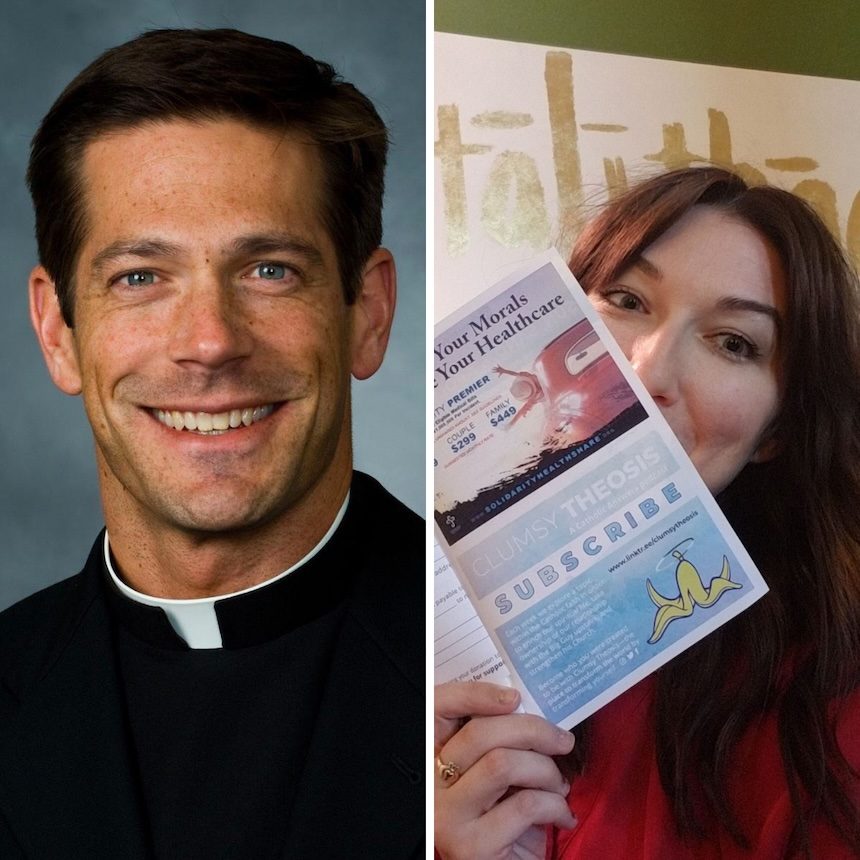
I’m sure many of you out there are following along with Fr. Mike Schmitz’s Bible-in-a-year podcast.
One of the things which I’ve learnt from reading The Silmarillion this year (the Old Testament of Middle Earth!) is that it’s really helpful to periodically review the story so far and to remind yourself how you got here.
With this in mind, I’d like to direct you to some recent episodes from my friend Richaél from the Clumsy Theosis podcast who is currently working through the story of Salvation History at a high level, covering in five episodes the material covered in the last fifty episodes of Fr. Mike’s podcast…
Read more

This past week I was responding to someone in the comments section of my blog and I came across an issue I hadn’t encountered before…
It turns out that some groups will argue that Jesus didn’t die on Good Friday, but on the Wednesday before. I’ve noticed this chiefly among Fundamentalists and Messianic Jews. The case is made from Jesus’ own words in Matthew’s Gospel:
“For as Jonah was three days and three nights in the belly of the whale, so will the Son of man be three days and three nights in the heart of the earth.”
Matthew 12:40
It is argued that in order for Jesus’ words to be true, we must work backwards three full days and three full nights from Resurrection Sunday. If we do this, we would conclude that Christ’s Crucifixion took place, not on Friday, but Wednesday:
Some of these folks will say that Christians of past generations simply made a mistake in placing the Crucifixion on Good Friday, but others go further, arguing that this was an attempt to Paganize Christianity (although, as is typical with such assertions, I’m rather at a loss as to what this achieves).
So, how might we respond to this claim?
Read more

I just had a loooooong comment added to my article explaining the meaning of “IHS”:
What is the difference between a Christian and a Protestant. If we are to FULLY lean on God’s Word, we are to be called “Christian” 3 times in the NT. Obviously, we are no Jewish/Hebrew, and we are the bride, NOT the chosen people of God. I have been called a Protestant and never understood why, as it is a title, NOT a belief. I believe in God’s Word, that Jesus (who is God in the flesh) became man to die for our sins and ONLY through his sacrifice, I am saved, by grace NOT by works “lest any man should boast”. So, biblically speaking, there are only 2 kinds of people; believers and non-believers, aka “sheep and the goat’s. Not sure if I may have missed it in the Hebrew, Greek and Aramaic of being called a Protestant, but there is that.
Blog Comment
Scripture is the authority, as it IS Jesus (John 1:1) and if you do not accept that verse, then you have issues you need to figure out before discussing any scripture or claim (generalization, NOT a finger point). So, if Jesus IS the Word of God, and is God, within his Word (himself) he promises to preserve His Word and never changes. Would we agree on that? Now, if we agree with that, then we can logically conclude, only 1 version of the Word of God that is among men is correct. That meaning; certain versions have pieces added to and others have some taken away. So, then, which ones?!
Now, my next question(s) are as follows, how would a Catholic respond (with scripture and other sources) for the following information:
For the first 280 years of Christian history, Christianity was banned by the Roman Empire, and Christians were terribly persecuted. This changed after the “conversion” of the Roman Emperor Constantine. Constantine provided religious toleration with the Edict of Milan in AD 313, effectively lifting the ban on Christianity. Later, in AD 325, Constantine called the Council of Nicea in an attempt to unify Christianity. Constantine envisioned Christianity as a religion that could unite the Roman Empire, which at that time was beginning to fragment and divide. While this may have seemed to be a positive development for the Christian church, the results were anything but positive. Just as Constantine refused to fully embrace the Christian faith but continued many of his pagan beliefs and practices, so the Christian church that Constantine and his successors promoted progressively became a mixture of true Christianity and Roman paganism.
Most Roman Catholic beliefs and practices regarding Mary are completely absent from the Bible. Where did those beliefs come from? The Roman Catholic view of Mary has far more in common with the Isis mother-goddess religion of Egypt than it does with anything taught in the New Testament. Interestingly, the first hints of Catholic Mariology occur in the writings of Origen, who lived in Alexandria, Egypt, which happened to be the focal point of Isis worship.
The Lord’s Supper being a consumption of the literal body and blood of Jesus is not taught in the Bible. The idea that bread and wine are miraculously transformed into the literal body and blood of Jesus (transubstantiation) is not biblical. However, several ancient pagan religions, including Mithraism, which was very popular in the Roman Empire, had some form of “theophagy” (the eating of one’s god) as a ritualistic practice.
Roman Catholicism has “saints” one can pray to in order to gain a particular blessing. For example, Saint Gianna Beretta Molla is the patron saint of fertility. Francis of Assisi is the patron saint of animals. There are multiple patron saints of healing and comfort. Nowhere is even a hint of this taught in Scripture. Just as the Roman pantheon of gods had a god of love, a god of peace, a god of war, a god of strength, a god of wisdom, etc., so the Catholic Church has a saint who is “in charge” over each of these and many other categories. Many Roman cities had a god specific to the city, and the Catholic Church provided “patron saints” for cities as well.
The idea that the Roman bishop is the vicar of Christ, the supreme leader of the Christian Church, is utterly foreign to the Word of God. The supremacy of the Roman bishop (the papacy) was created with the support of the Roman emperors. While most other bishops (and Christians) resisted the idea of the Roman bishop being supreme, the Roman bishop eventually rose to supremacy, again, due to the power and influence of the Roman emperors. After the western half of the Roman Empire collapsed, the popes took on the title that had previously belonged to the Roman emperors—Pontifex Maximus.
Many more examples could be given. These four should suffice in demonstrating the origin of the Catholic Church. Of course, the Roman Catholic Church denies the pagan origin of its beliefs and practices. The Catholic Church disguises its pagan beliefs under layers of complicated theology and church tradition. Recognizing that many of its beliefs and practices are utterly foreign to Scripture, the Catholic Church is forced to deny the authority and sufficiency of Scripture.
The origin of the Catholic Church is the tragic compromise of Christianity with the pagan religions that surrounded it. Instead of proclaiming the gospel and converting the pagans, the Catholic Church “Christianized” the pagan religions and “paganized” Christianity. By blurring the differences and erasing the distinctions, the Catholic Church made itself attractive to the idolatrous people of the Roman Empire. One result was the Catholic Church becoming the supreme religion in the Roman world for centuries. However, another result was the most dominant form of Christianity apostatizing from the true gospel of Jesus Christ and the true proclamation of God’s Word.
Second Timothy 4:3–4 declares, “For the time will come when men will not put up with sound doctrine. Instead, to suit their own desires, they will gather around them a great number of teachers to say what their itching ears want to hear. They will turn their ears away from the truth and turn aside to myths.”
The comment is what I call “Spam Evangelism”. This is where someone goes around pasting the same text on any website they can find. It usually begins as a simple question but quickly degenerates into a confusing long list of challenges to Catholic doctrine which jump from topic to topic. In this case, it wasn’t even posted on an article which related to Catholic doctrine! When I respond, 99% of the time I never receive a reply…
Fortunately for the person who posted this, Heath, I have a policy of always answering questions! Additionally, I want to provide a resource to anyone else who has this posted on their blogs or social media pages…
Read more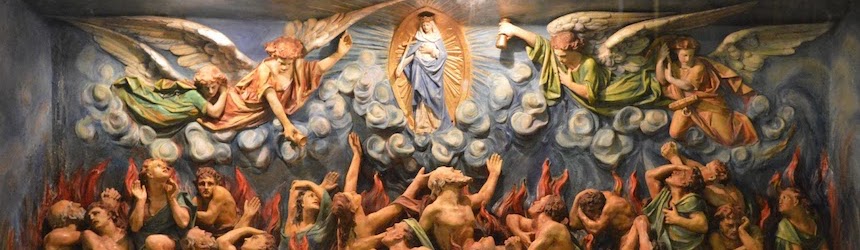
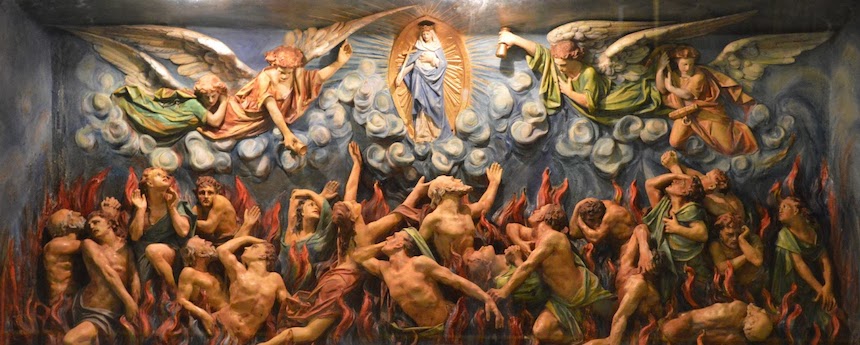
Recently, a listener to our C.S. Lewis podcast reached out to us. She had just begun RCIA with her family and they were quite taken aback when the priest described Purgatory in the following way:
“Purgatory is a place of fire and burning. However, there will be hope there because you will know you’re getting out someday.”
RCIA Class
It seemed to her that this would make the work of Christ incomplete. After the class, her daughter exclaimed:
“How do they expect anyone to convert if you’re still going to Hell? Because that’s exactly what Purgatory sounds like!”
When they got home, they did some googling and found several other sources that said Purgatory would be the same fire of hell, but with the hope of one day escaping.
Since my co-host and I had spoken about Purgatory on the podcast, she sent us a message expressing her consternation. I too once balked at the fire imagery I saw in some artistic depictions of Purgatory (such as in the altarpiece above), so I thought it would be a good idea to turn my answer into a blog post…


So several years ago, after my return from Seattle to San Diego, I sat down and thought about what I was looking for in a wife.
Today I get married.
Here’s the list…
Mission Accomplished.

Some of those attending our wedding (or watching it on Facebook) may not be familiar with the Byzantine Catholic Church. The video below (and transcript which follows) provides a short explanation of what will happen during our wedding so that our guests may better understand the ceremony. We pray that we will all grow closer to each other and to the Lord through this celebration of our marriage.…