One of the first things which struck me about the Qur’an the first time I read it was how it can suddenly and jarringly jump to a completely different scene,
I’ve often been told that the Torah and the Injil were only for the Jews. However, two problems: The Pickthall translation doesn’t hide it: He hath revealed unto thee (Muhammad)
John Fontain recently debated David Wood on the Islamic Dilemma, which points out that the Qu’ran both affirms the Torah and Gospel while contradicting them. John has a rather different
Those who attempt to say that the Qur’an teaches the corruption of the earlier scriptures, often appeal to Qur’an 5:48, but this argument turns on the translation of the word
I’m reading through the Qu’ran one last time this year and wanted to follow along with a Tafsir. I discovered Quran Garden which was just the sort of thing I
The Qur’an claims that if it were not from God, there would be many contradictions in it. However, there is one Qur’anic verse which presents an inherent contradiction! In chapter
The sun sets in muddy spring (18:86) Semen comes from between backbone & ribs (86:6-7) Stars are missiles to shoot devils (67:5) If a fly lands in your drink, one
The Qur’an speaks about Allah helping the followers of Jesus and keeping them “uppermost”, but this presents a dilemma since, historically, this has to refer to Trinitarian Christians… which is
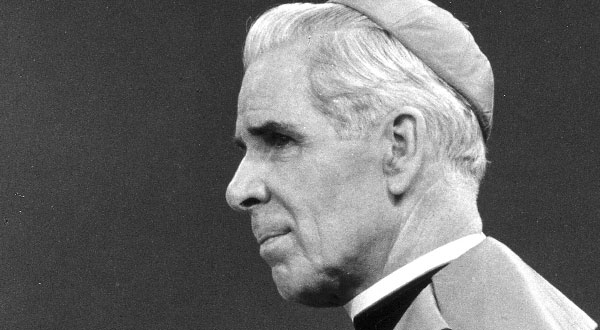
”I am worried about America! I am not so much worried about its politics and economics, important though they be: I am worried about its soul. After all, politics and economics are determined by the sense of values which underlies them.” – Archbishop Fulton Sheen
A while ago I promised a friend that I would do an in-depth treatment of the Catholic Church’s teaching on the Communion of Saints. I’m still planning on doing that more detailed examination at some point in the future, but today I’d like to do another brief post following on from yesterday’s posts about All Saints Day.
I’ve mentioned Jay before, a Protestant with whom I dialogued for several months. During our discussions he brought up the subject of the Saints. It wasn’t really pertinent to the subject at hand so I didn’t dwell on it for long, but here was what I wrote to him:
“The Saints” was another issue you raised, but again, in an effort to stay on-topic, I’ll try to be brief.
We don’t worship Saints – we honour them. Worship is for God alone. If you catch any Catholic worshiping a Saint, let me know and I’ll make sure that both their Priest and Bishop find out. I will ensure that they are kept behind after Mass for extra catechism classes while the other parishioners enjoy coffee and donuts 😉
I can pretty much guarantee that all of your disagreements stem from how you view the Church. The Catholic view is that the Body Of Christ is simply one, composed of:
1. …those here on earth (“Church Militant”)
2. …those in purgatory (“Church Expectant”)
3. …and those in heaven (“Church Triumphant”).
Although we may be physically separated by the barrier of death, we nonetheless remain united to each other.
I’m sure you’ve asked people to pray for you before – it’s a very natural thing to do and I’m guessing you would find no conflict here with 1 Timothy 2:5 (to which you allude). Moses, Abraham and Job were all mediators and intercessors. In fact, as you rightly point out, interceding for others is a living out of our universal priestly calling.
I would also suggest that the people you ask to pray for you are often those whose faith is the strongest, as you hope in the power of their intercession (James 5:17). The Catholic response to this is a hearty “Amen!” But how much more powerful will the prayer be of one who has been completely sanctified and is standing before the throne of God?
There’s loads more I could say about this, but I’ll simply say that this is why we ask Saints for their intercession and why the Vatican teaches “filial reverence” – it’s simply because these are people who are part of the Church – it’s just that this part that is in heaven.

 A while ago I promised a friend that I would do an in-depth treatment of the Catholic Church’s teaching on the Communion of Saints. I’m still planning on doing that more detailed examination at some point in the future, but today I’d like to do another brief post following on from
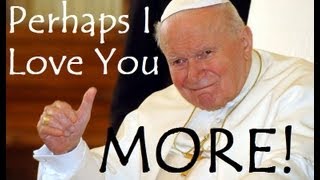 This put a smile on my face this morning, Pope John Paul II singing