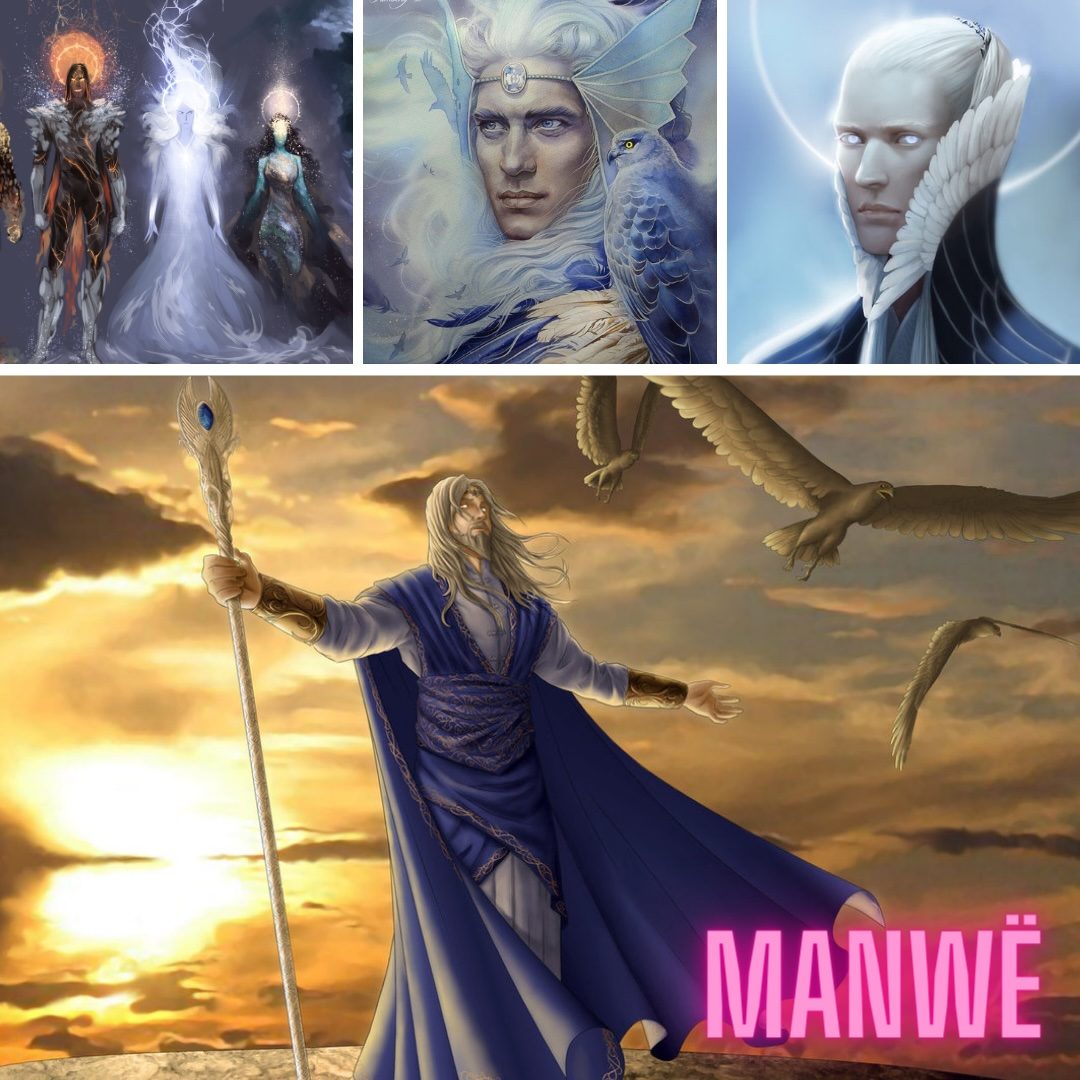
In an effort to establish more clearly in my mind the different Valar, I thought I would put together some memorable graphics and a short description for each of the main ones. Today’s post is about Manwë and Varda…
Manwë
Type: Vala
Name meaning: “The good”
Other titles: “King of Arda”, “Lord of the Air”
Appearance: His eyes and clothing are blue and his sceptre is made of sapphire.
Location: Lives in the mansions of Ilmarin atop the mountain of Taniquetil
Loves: All birds, particularly eagles, are sacred to him. He has a soft spot for the Vanyar Elves because of their skill in poetry.
Varda
Type: Vala
Name meaning: “Sublime”/”Lofty”
Other titles: “Queen of the Heavens”, “Queen of Light”, “Gilthoniel”, “Elbereth”, “Lady of the stars”
Appearance: Extremely beautiful
Location: Lives in the mansions of Ilmarin atop the mountain of Taniquetil
Loves: Light. She rekindled the stars, lit the Lamps of the Valar, and placed the Sun and Moon in the heavens.
I’m going to be doing a series of posts here as I read The Silmarillion to help me keep all the Valar straight in my head. This is an introductory post, giving an overview of the Valar…
The Main Valar
Not all of the Valar come up that often in The Silmarillion. Here are the main ones to remember:
I’ve been reading the Silmarillion this year. I’ve found it really helpful to recap on the stories as I’ve progressed through the book, making sure that they’re firmly established in my head, as well as the geography, genealogies and all the different pronunciations! I’ve done this chiefly through podcasts and YouTube videos.
This post contains all the different videos which I’ve watched…
Tolkien Road Summaries
Detailed Level Overview
These videos are great because they include lots of maps…
High Level Overview
I’ll also soon post an article where I share the images I used to help keep the different Valor straight in my head.
This past week I was responding to someone in the comments section of my blog and I came across an issue I hadn’t encountered before…
It turns out that some groups will argue that Jesus didn’t die on Good Friday, but on the Wednesday before. I’ve noticed this chiefly among Fundamentalists and Messianic Jews. The case is made from Jesus’ own words in Matthew’s Gospel:
“For as Jonah was three days and three nights in the belly of the whale, so will the Son of man be three days and three nights in the heart of the earth.”
Matthew 12:40
It is argued that in order for Jesus’ words to be true, we must work backwards three full days and three full nights from Resurrection Sunday. If we do this, we would conclude that Christ’s Crucifixion took place, not on Friday, but Wednesday:
Some of these folks will say that Christians of past generations simply made a mistake in placing the Crucifixion on Good Friday, but others go further, arguing that this was an attempt to Paganize Christianity (although, as is typical with such assertions, I’m rather at a loss as to what this achieves).